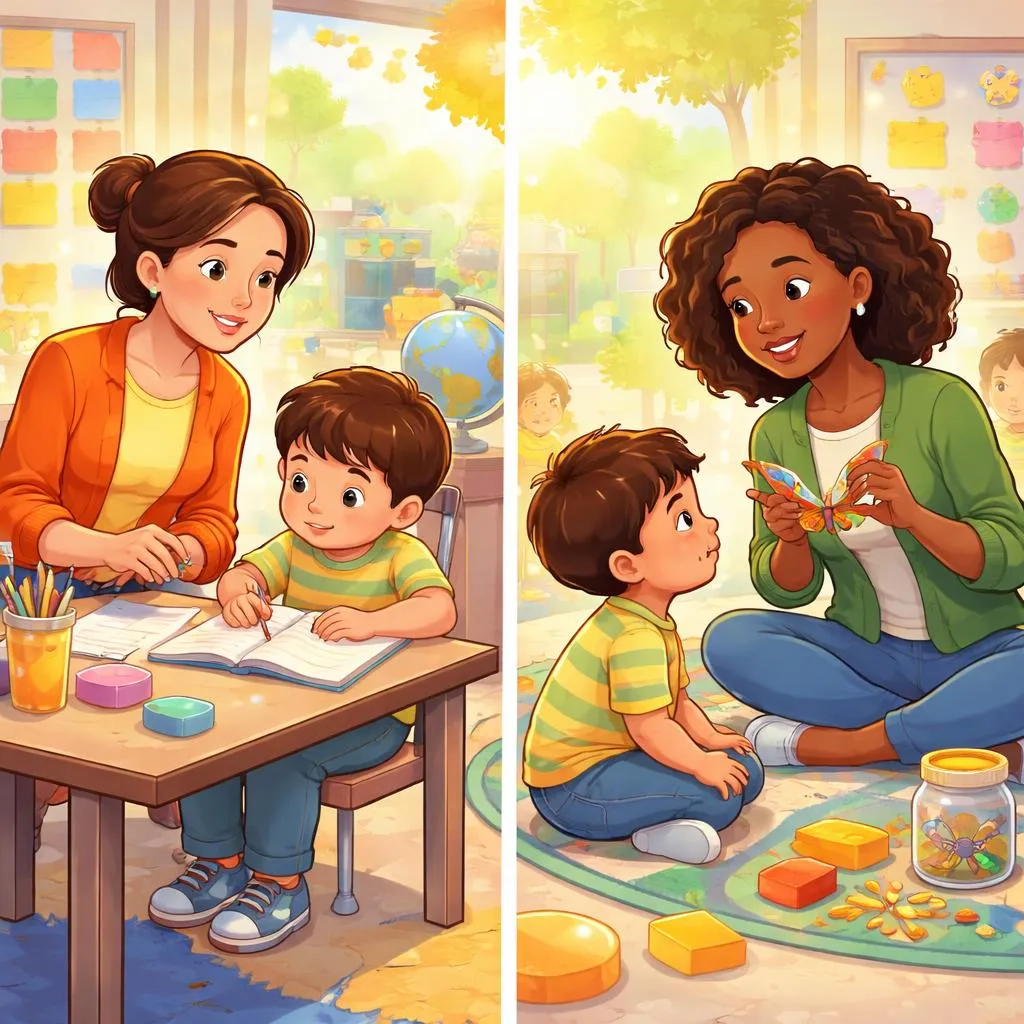

What Do These Expressions Mean? “A teacher” and “an educator” both mean a person who helps others learn new things. They tell a child that this person’s job is to share knowledge and skills. Children hear these words at school, in books, or when talking about jobs. Both describe a learning helper.
“A teacher” is the common, everyday word for a person who teaches. A child says it when asking “Is the teacher going to read us a story?” It is warm and familiar.
“An educator” means the same thing, but it is more formal. It is less common in child talk. It might be used in books or official documents. It sounds grown-up.
These expressions seem similar. Both mean “a person who teaches.” Both describe the same job. But one is for everyday talk while one is for formal use.
What's the Difference? One is the standard, everyday word. One is a formal or professional word. “Teacher” is what you say to your family and friends. It is simple and direct. Children learn it first.
“Educator” is used in formal writing, on school websites, or in professional contexts. You might see it in a mission statement: “Our educators are dedicated.” A child saying “educator” sounds very grown-up. It is correct but unusual.
Think of a child talking about their classroom. “My teacher helps me read” is right. “My educator helps me read” would sound odd. One is natural. One is formal.
One is for all conversations. The other is for formal or written English. “Teacher” for talking. “Educator” for writing. Use the first for speaking. Use the second for understanding.
Also, “educator” can include principals, librarians, and even parents. “Teacher” usually means the person in front of the classroom. “Educator” is a broader term.
When Do We Use Each One? Use “teacher” for everyday conversation. Use it for classroom teachers, substitutes, and tutors. Use it as the standard word for someone who teaches. It fits daily life.
Examples at home: “My teacher gave me a sticker.” “I want to be a teacher when I grow up.” “The teacher reads us stories.”
Use “educator” rarely. Use it in formal writing, on forms, or in professional contexts. Use it to teach the word. Children almost never need to say this word.
Examples for formality: “Our school’s educators are very kind.” (brochure) “The educator’s conference is next week.” (professional) “She is an educator who focuses on early childhood.” (formal)
Most children should just say “teacher.” It is clear, natural, and friendly. “Educator” is good to understand for reading. But for speaking, “teacher” is best.
Example Sentences for Kids A teacher: “A teacher helps you learn math.” “My teacher reads my journal.” “I like my teacher.”
An educator: “An educator is someone who teaches.” (learning definition) “The museum’s educator showed us fossils.” (formal) “My mom is an educator at a college.” (professional)
Notice “teacher” is normal speech. “Educator” is formal and broader. Children learn both. One for life. One for reading.
Parents can use “teacher” every day. Save “educator” for vocabulary lessons. “The word ‘educator’ means teacher, but it sounds more official.” Learning happens in small moments.
Common Mistakes to Avoid Some children say “educator” for everyday talk. That sounds strange. Friends may not understand. Stick with “teacher.” Simple is better.
Wrong: “My educator gave me homework.” Right: “My teacher gave me homework.”
Another mistake: thinking a teacher is not an educator. All teachers are educators. But not all educators are classroom teachers (some are museum staff, etc.). Teach the difference.
Wrong: “A teacher is different from an educator.” Right: “All teachers are educators, but not all educators are teachers.”
Some learners think “educator” is a fancier word. It is more formal, but not “better.” For a child, “teacher” is the right word.
Also avoid saying “educator” to a young child. They will not understand. Say “teacher” for clarity.
Easy Memory Tips Think of “teacher” as an apple on a desk. Classroom. Familiar. Friendly. For everyday.
Think of “educator” as a diploma on a wall. Professional. Formal. For official contexts.
Another trick: remember the place. “Teacher” = classroom. “Educator” = school system, museum, college. Classroom gets “teacher.” Broader places get “educator.”
Parents can say: “Teacher for a lesson. Educator for a profession.”
Practice at home. Talking about school: “teacher.” Reading a school brochure: “educator.”
Quick Practice Time Let us try a small exercise. Choose the better phrase for each situation.
A child tells a friend about their day at school. a) “My educator read a story.” b) “My teacher read a story.”
A school website describes the staff who help students learn. a) “Our teachers are dedicated.” b) “Our educators are dedicated.”
Answers: 1 – b. A child talking about their day fits the everyday “teacher.” 2 – a or b. “Educators” is more formal and fits a school website.
Fill in the blank: “When I talk about the person in my classroom, I say ______.” (“Teacher” is the natural, everyday, standard choice.)
One more: “When a museum describes the person who leads school groups, it says ______.” (“Educator” fits the formal, professional, broader description.)
Teachers change lives. “Teacher” is for talking. “Educator” is for formal writing. Teach your child both. A child who learns both can speak of school and understand the profession.