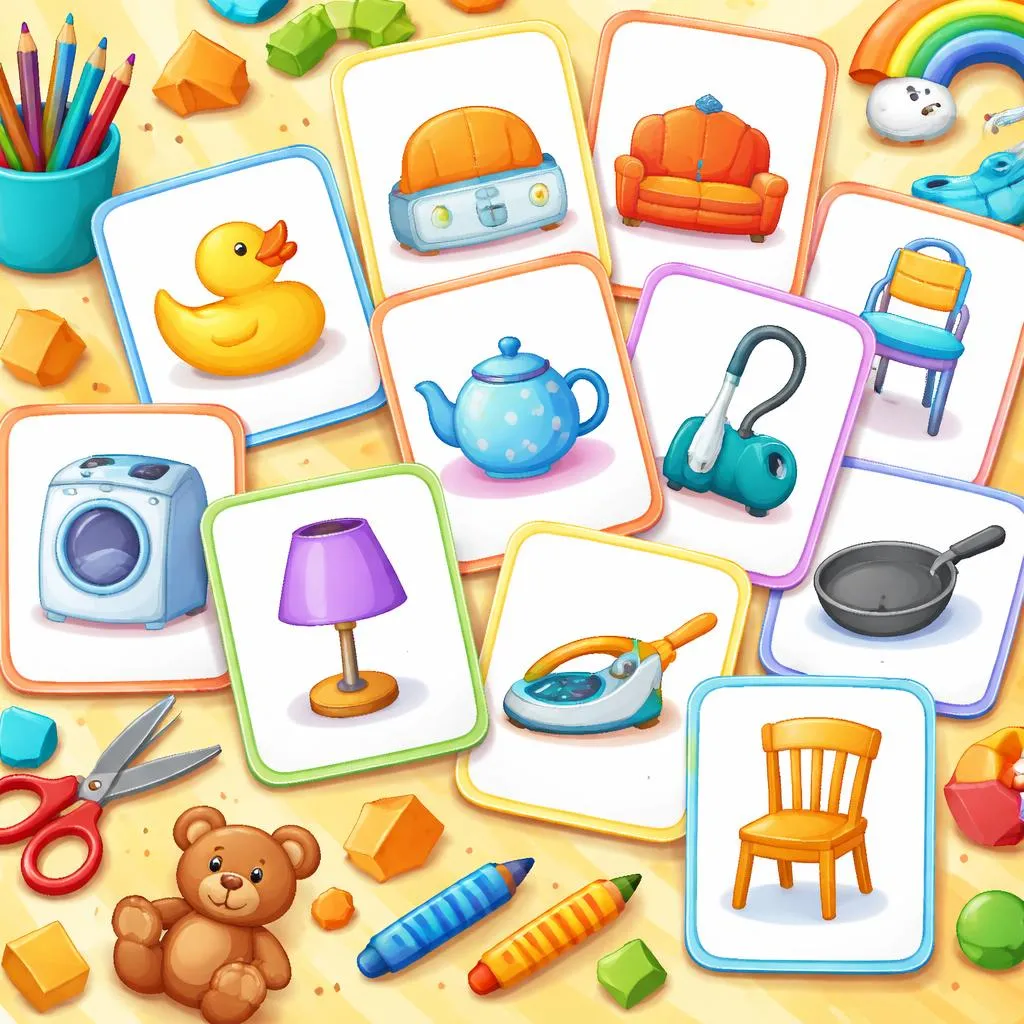

Here is a big set of very simple pictures for teaching common household items and furniture vocabulary! There are 9 items for each of these rooms: bathroom bedroom kitchen living room Within the file, the images are grouped by room first, then alphabetically. This makes it easy to print one room at a time, say, if you’re not planning to teach all 36 words in one go. The Household Objects flashcards are available in colour or black and white. The small size flashcard sets could also be used as student worksheets, for example for colouring dictation (if printed in black and white) or a labelling activity (with or without colour printing). With 36 picture cards of mostly singular nouns, this set is sort of asking to play a game of Go Fish, isn’t it? Have fun! NOTE: There are two lamp cards, a floor lamp and a table lamp, but both are just labelled “lamp”.
Word list: armchair, bath mat, bathtub, bed, bookcase, chest of drawers, coffee table, cupboards, curtains, cutlery, desk, dining set, dresser, houseplant, lamp (floor), lamp (table), medicine cabinet, microwave oven, mirror, nightstand, picture, pot and pan, refrigerator, rug, shelves, shower, sink, sofa, stool, stove, toilet, toilet paper holder, towel rack, trash can, TV stand, wardrobe
Click here to download the full Household Objects PDF — free
By practicing with Household Objects flashcards, children can:
- Build vocabulary related to everyday items found in different rooms of a house, such as the bathroom, bedroom, kitchen, and living room.
- Improve word recognition and pronunciation through visual association with pictures.
- Enhance memory and cognitive skills by matching words to images.
- Develop language skills by using the flashcards in sentences and conversations.
- Foster curiosity about their environment by learning the names of common household objects.
How to Teach Household Objects Flashcards with Flashcards
Parents and educators can use these flashcards in various ways to support children’s learning. Start by introducing a few flashcards at a time, focusing on one room’s vocabulary to avoid overwhelming the child. Show the picture, say the word clearly, and encourage the child to repeat it. Use the flashcards to create simple matching games or ask children to find the real objects around the house. Incorporating flashcards into daily routines, such as mealtime or bedtime, can make learning natural and engaging. For younger children, coloring the black and white versions can also reinforce word recognition.
(1) Fun Household Objects Flashcard Games
(2) Example Sentences with Household Objects Vocabulary
Playing games like “Go Fish” or memory matching with the flashcards helps children remember the words in a playful way. For example, ask children to find pairs of cards or to “fish” for a card you name. You can also play “I Spy” using the flashcards to encourage observation skills. Example sentences to practice could include: “The sofa is soft and comfy,” or “Please put the cutlery on the table.” Adding emotions to sentences, such as “I feel happy when I sit on the armchair,” helps children connect language with feelings and context.
Free Household Objects Flashcards PDF Download
You can download and print the full set of 36 colorful or black-and-white flashcards for free from the provided link. The cards are organized by room and alphabetically, making it easy to select specific groups for focused learning. Printing the black and white version allows children to color the cards, turning the activity into both a language and art exercise. This flexibility supports different teaching styles and learning preferences.
FAQ about Household Objects Flashcards
Q: How many words are included in the set?
A: There are 36 words, covering common household items across four rooms.
Q: Can these flashcards be used for older children?
A: Yes, they are simple but effective for beginners and can be adapted with more complex sentence practice for older learners.
Q: What if my child doesn’t recognize some objects?
A: Use the flashcards alongside real objects or pictures from around your home to build familiarity.
Q: Are there suggestions for further activities?
A: Yes, labeling household items, storytelling using the flashcards, and role-playing games can deepen understanding.
These flashcards provide a fun, interactive way for children to learn everyday vocabulary and develop language skills that are useful both at home and in school.