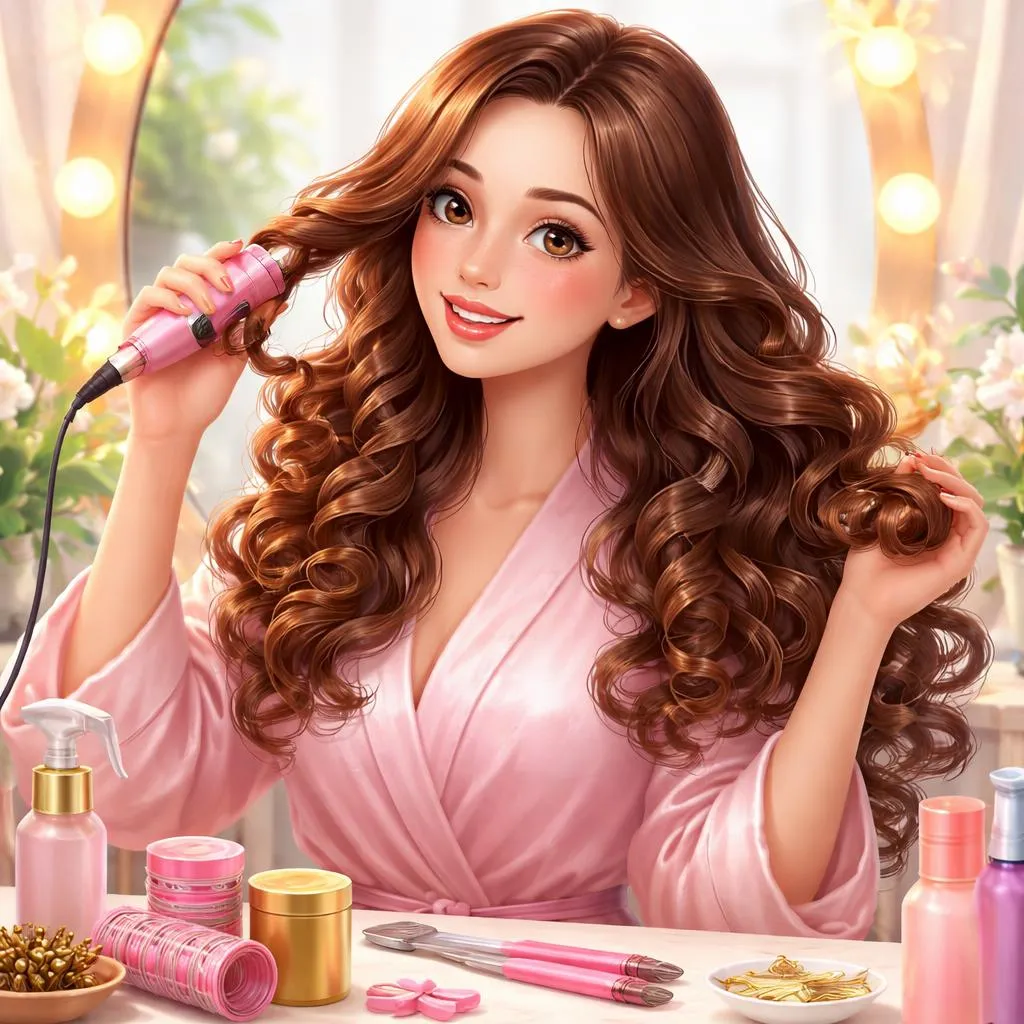

You wrap a strand of hair around your finger. It makes a ringlet. That is a curl.
Today we learn four words. “Curl,” “curly,” “curling,” and “curler.”
Each word shares the idea of a round, spiral shape. Each does a different job.
Parents and children can learn these words together. They help with hair and sports.
What Does “Same Word, Different Forms” Mean?
One idea takes different shapes. The idea here is a twisted or looped shape.
“Curl” is a verb. “Please curl the ribbon with scissors.” Action.
“Curl” is also a noun. “A curl of smoke rose from the chimney.” Shape.
“Curly” is an adjective. “My dog has curly fur.” Describes.
“Curling” is a noun (sport) or adjective. “Curling is played on ice.” Sport. “Curling hair needs heat.” Describes.
“Curler” is a noun. “She slept in curlers to get waves.” Tool.
Same root. Different endings. Different jobs. The spiral stays.
Personal Pronouns Change Their Form
Pronouns change for grammar. “I” becomes “me.” “We” becomes “us.”
Our words change for role and description. “I curl my lashes.” Present.
“Her hair is curly.” Describes. “Curling is fun.” Sport.
“She uses a curler.” Tool.
Pronouns help us speak faster. Word families help us talk about hair and winter sports.
When children know these four words, they describe textures and games.
From Verb to Noun to Adjective to Adverb – One Family, Many Words
“Curl” works as a verb. “Curl the paper around a pencil.” Action.
“Curl” also works as a noun. “She has a natural curl in her hair.” Shape.
“Curly” is an adjective. “Curly fries are twisted potatoes.” Describes.
“Curling” is a noun. “Curling is a winter Olympic sport.” Sport.
“Curling” is also an adjective. “The curling smoke drifted upward.” Describes.
“Curler” is a noun. “A hot curler makes tight curls.” Tool.
We have adverbs “curly” (no), “curlingly” (rare). Skip them.
Six meanings. Very rich family.
One Root, Many Roles – How Words Grow from Actions to Qualities
The root “curl” comes from Old English “crull,” meaning curly or curly-haired.
From that root, we add “-y” to make an adjective. “Curly” means having curls.
We add “-ing” to name the sport or to describe something that curls.
We add “-er” to name the tool. “Curler” means the thing that makes curls.
Help your child see this pattern. Curl is the action or shape. Curly describes something with curls. Curling is the sport or process. Curler is the tool.
Same Meaning, Different Jobs – Is It a Verb or a Noun?
Look at “curl” in a sentence. Ask: Is it an action? Or is it a shape?
“She likes to curl her hair.” Action. Verb.
“A curl of butter sat on the mashed potatoes.” Shape. Noun.
Same word. Two jobs. Context tells you.
Now look at “curly.” Always an adjective. “Poodles have curly hair.”
“Curling” can be a noun. “We watch curling on TV.” Sport. Or an adjective. “The curling ribbon was pretty.”
“Curler” is always a noun. “She put a curler in her hair.”
Teach children to look at the endings. “-y” adjective. “-ing” noun (sport) or adjective. “-er” noun (tool).
“Curl” alone can be verb or noun.
Adjectives and Adverbs – When Do We Add -ly?
We do not add “-ly” to these words. No “curlyly.” No “curlingly” (rare).
If you want to describe how something curls, use a separate adverb. “The smoke curls upward slowly.”
This family stays simple. Focus on the main words.
Watch Out for Tricky Spelling Changes (Double Letters, y to i, and More)
Spelling here is very regular. No double letters. No y to i changes.
“Curl” adds “-y” to make “curly.” Just add. Keep the “l.”
“Curl” adds “-ing” to make “curling.” Just add.
“Curl” adds “-er” to make “curler.” Just add.
No dropping. No vowel changes. Very clean.
The only note: “curly” has one “l” from “curl” plus “y.” Not “curly” with double l. Correct.
Practice with your child. Write “curl.” Add “y.” You get “curly.” Add “ing.” You get “curling.” Add “er.” You get “curler.”
No tricks.
Let’s Practice – Can You Choose the Right Form?
Try these sentences. Fill in the blank with curl, curly, curling, or curler.
Please _____ the ribbon around the present. (action verb)
Her dog has _____ fur that is very soft. (adjective)
The winter sport called _____ uses a broom and stones. (noun)
She slept in foam _____ to get waves. (tool)
A _____ of smoke rose from the campfire. (noun, shape)
The _____ iron heated up quickly. (tool)
He has naturally _____ eyelashes. (adjective)
The _____ path led us through the forest. (adjective, winding)
Answers: 1 curl, 2 curly, 3 curling, 4 curlers, 5 curl, 6 curling, 7 curly, 8 curling.
Number 4 uses the plural “curlers” (many curlers), but the keyword is “curler.”
Number 8 uses “curling” as an adjective meaning “winding.”
Tips for Parents – Help Your Child Learn Word Families in a Fun Way
Curl a piece of ribbon. “Watch me curl the ribbon around the scissors.”
Point to curly things. “Your hair is curly. The sheep’s wool is curly.”
Watch curling on TV. “Curling is a sport where people slide stones on ice.”
Show a hair curler. “This curler makes hair go round.”
Play a game. You draw a line. Your child makes it into a curl.
Draw curly hair on a person. Draw straight hair on another.
Make curl art with paper strips. Curl them around a pencil.
Read a book about hair. “Crazy Hair Day” by Barney Saltzberg.
Do not correct every mistake. If your child says “curly” for the sport, say “The sport is curling. Curly is for hair.”
Celebrate when your child uses “curling” for the sport. It is unusual but fun.
Explain that “curling” can also mean a shape. “A curling wave” means it bends.
Tomorrow you might curl wrapping paper. You will see a curly fry. You will watch curling on a highlight reel. You will find a curler in the bathroom.
Your child might say “My drawing has a curly tail.” You will admire it.
Keep curling. Keep finding curly things. Keep watching curling. Keep using curlers carefully.
Your child will grow in language and in noticing spirals everywhere. Curls are cozy, fun, and full of shape.