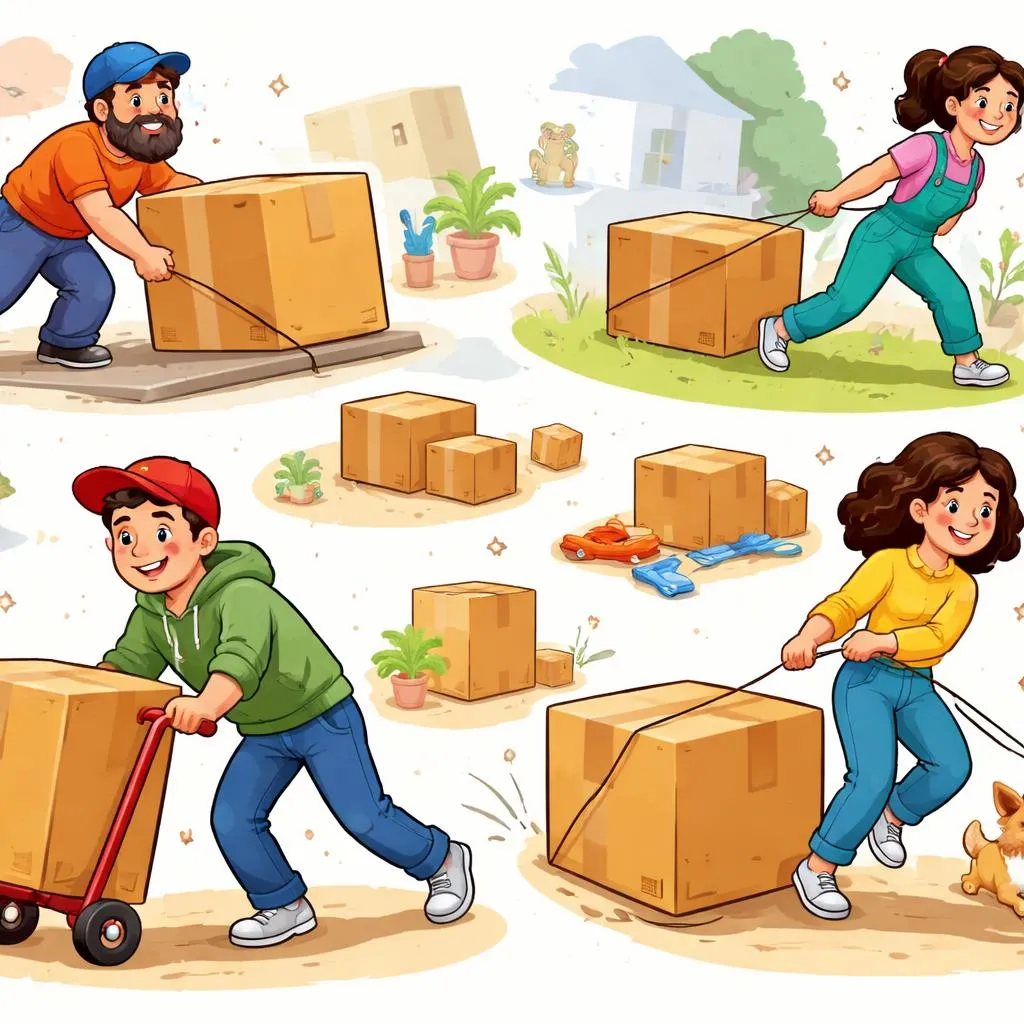

You pull a heavy suitcase. It scrapes on the floor. You pull harder.
That is dragging. Today we learn four words.
“Drag,” “dragger,” “dragging,” and “dragged.”
Each word shares the idea of pulling something along. Each does a different job.
Parents and children can learn these words together. They help with movement.
What Does “Same Word, Different Forms” Mean?
One action takes different shapes. The action here is pulling with effort.
“Drag” is a verb. “Please drag the chair closer.” Action.
“Drag” is also a noun. “The party was a drag.” Boring.
“Dragger” is a noun. “The dragger of the sled was a dog.” Person or thing that drags.
“Dragging” is a noun or adjective. “Dragging the box takes strength.” Activity. “A dragging feeling.” Describes.
“Dragged” is a past tense verb or adjective. “He dragged the log.” Past action. “The dragged rope.” Describes.
Same root. Different endings. Different jobs. The pulling stays.
Personal Pronouns Change Their Form
Pronouns change for grammar. “I” becomes “me.” “We” becomes “us.”
Our words change for role and time. “I drag the wagon.” Present.
“The dragger is slow.” Person. “Dragging is hard work.” Activity.
“She dragged it yesterday.” Past.
Pronouns help us speak faster. Word families help us talk about pulling.
When children know these four words, they describe moving heavy things.
From Verb to Noun to Adjective to Adverb – One Family, Many Words
“Drag” works as a verb. “Drag the file to the folder on your computer.” Action.
“Drag” also works as a noun. “This story is a drag.” Boring thing.
“Dragger” is a noun. “The dragger of the net was a fishing boat.” Puller.
“Dragging” is a noun. “Dragging the sled uphill was tiring.” Activity.
“Dragging” is also an adjective. “A dragging gait is slow.” Describes.
“Dragged” is a past verb. “The child dragged the blankie.” Past action.
“Dragged” is also an adjective. “The dragged branch left a trail.” Pulled along.
We have adverbs “draggingly” (rare). Skip.
Seven meanings. Very useful for daily life.
One Root, Many Roles – How Words Grow from Actions to Qualities
The root “drag” comes from Old Norse “draga” or Old English “dragan,” meaning to pull.
From that root, we add “-er” to name the person or thing that drags. “Dragger” means one who drags.
We add “-ing” to name the activity or to make an adjective meaning “slow.”
We add “-ed” for past tense or to make an adjective meaning “pulled.”
Help your child see this pattern. Drag is the action. Dragger is the puller. Dragging is the process. Dragged means already pulled.
Same Meaning, Different Jobs – Is It a Verb or a Noun?
Look at “drag” in a sentence. Ask: Is it an action? Or is it a boring thing?
“Please drag the table to the wall.” Action. Verb.
“This movie is a drag.” Boring thing. Noun.
Same word. Two jobs. Context tells you.
Now look at “dragger.” Always a noun. “The dragger of the cart was a donkey.”
“Dragging” is a noun or adjective. “Dragging is tiring.” Noun. “A dragging pace.” Adjective.
“Dragged” is past verb or adjective. “He dragged the hose.” Past verb. “The dragged branch.” Adjective.
Teach children to look at the endings. “-er” noun (puller). “-ing” noun or adjective. “-ed” past verb or adjective.
“Drag” alone can be verb or noun (boring).
Adjectives and Adverbs – When Do We Add -ly?
We add “-ly” to “dragging” to make “draggingly.” Very rare. “He walked draggingly.” Means slowly.
We do not add “-ly” to “drag,” “dragger,” or “dragged.”
For children, skip these adverbs. Focus on the main words.
Watch Out for Tricky Spelling Changes (Double Letters, y to i, and More)
Spelling has one note. “Drag” ends with “g.” Double the “g” before adding “-er” and “-ing” because it is consonant-vowel-consonant.
“Drag” → drag + er. Double the “g.” Dragger.
“Drag” → drag + ing. Double the “g.” Dragging.
For “dragged,” double the “g” and add “ed.” Dragged.
So the rule: Double the final “g” for -er, -ing, and -ed.
Practice with your child. Write “drag.” Double the “g,” add “er.” You get “dragger.” Double the “g,” add “ing.” You get “dragging.” Double the “g,” add “ed.” You get “dragged.”
No silent letters.
Let’s Practice – Can You Choose the Right Form?
Try these sentences. Fill in the blank with drag, dragger, dragging, or dragged.
Please _____ the heavy box across the floor. (action verb)
The _____ of the sled was a strong horse. (person or animal)
_____ a heavy suitcase is not fun. (activity)
The child _____ his stuffed animal by its ear. (past tense verb)
This long meeting is a _____. (noun, boring)
The _____ branch left a line in the dirt. (adjective)
She is _____ her feet because she is tired. (verb part with is)
The dog was a great _____. It pulled the cart. (person or animal)
Answers: 1 drag, 2 dragger, 3 Dragging, 4 dragged, 5 drag, 6 dragged, 7 dragging, 8 dragger.
Number 3 starts with a capital letter because it begins the sentence.
Number 5 uses “drag” as a noun meaning a boring thing.
Tips for Parents – Help Your Child Learn Word Families in a Fun Way
Drag a toy across the floor. “Let us drag this rope toy.”
Name the dragger. “You are the dragger of the wagon.”
Talk about dragging as an activity. “Dragging the laundry basket is easier than lifting.”
Use past tense. “Yesterday, you dragged your backpack all the way home.”
Play a computer game. “Drag and drop the icon into the folder.”
Draw a person dragging a heavy load. Label “dragger.”
Read a book about pulling. “The Little Red Caboose” has dragging.
Do not correct every mistake. If your child says “dragged” for “drag,” gently say “Yesterday you dragged. Today you drag.”
Celebrate when your child uses “drag” as a noun meaning boring. That is slang.
Explain that “drag” can also mean to pull on a cigarette, but that is not for kids.
Tomorrow you might drag a chair to the table. You will be the dragger of books. You will feel like dragging your feet if you are tired. You will remember when you dragged a big stick.
Your child might say “This is a drag.” (meaning boring) and you will find a fun activity.
Keep dragging safely. Keep naming the dragger. Keep practicing dragging. Keep using dragged for the past.
Your child will grow in language and in understanding effort. Dragging takes work. Words help us express it.