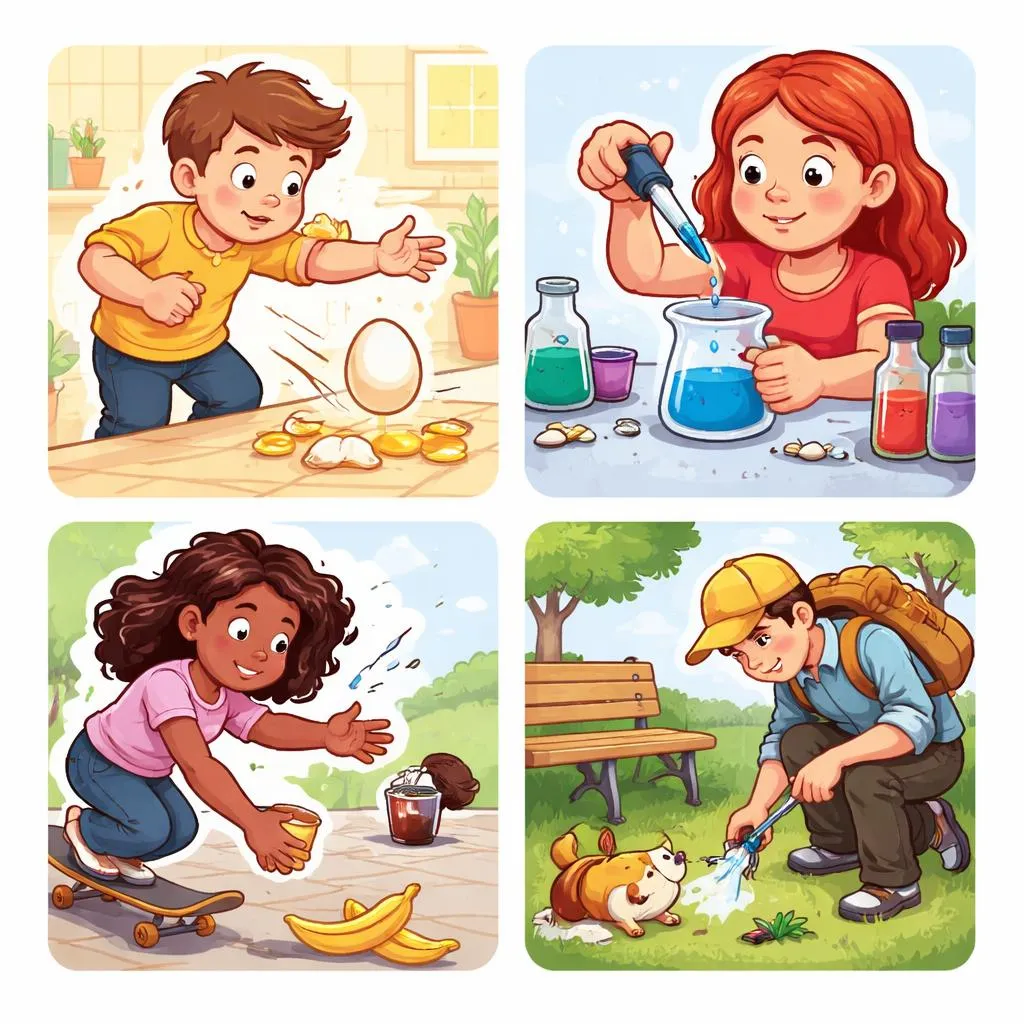

You hold a glass. It slips. It falls to the floor. It breaks.
You dropped it. Today we learn four words.
“Drop,” “dropper,” “dropping,” and “dropped.”
Each word shares the idea of falling or letting fall. Each does a different job.
Parents and children can learn these words together. They help with carefulness.
What Does “Same Word, Different Forms” Mean?
One action takes different shapes. The action here is letting something fall.
“Drop” is a verb. “Please do not drop the vase.” Action.
“Drop” is also a noun. “A drop of rain fell on my nose.” Small amount.
“Dropper” is a noun. “The medicine dropper measures liquid.” Tool.
“Dropping” is a noun or verb part. “Dropping a glass makes noise.” Activity. “I am dropping the letter.” Verb part.
“Dropped” is a past tense verb or adjective. “She dropped her keys.” Past action. “The dropped phone cracked.” Describes.
Same root. Different endings. Different jobs. The fall stays.
Personal Pronouns Change Their Form
Pronouns change for grammar. “I” becomes “me.” “We” becomes “us.”
Our words change for role and time. “I drop the ball.” Present.
“The dropper is full.” Tool. “Dropping is risky.” Activity.
“He dropped it yesterday.” Past.
Pronouns help us speak faster. Word families help us talk about accidents.
When children know these four words, they describe spills.
From Verb to Noun to Adjective to Adverb – One Family, Many Words
“Drop” works as a verb. “Drop the letter in the mailbox.” Action.
“Drop” also works as a noun. “A drop of water fell.” Tiny bit.
“Dropper” is a noun. “An eyedropper gives one drop at a time.” Measuring tool.
“Dropping” is a noun. “The dropping of the hammer made a dent.” Act.
“Dropped” is a past verb. “The waiter dropped the tray.” Past action.
“Dropped” is also an adjective. “The dropped ice cream melted on the ground.” Fallen.
We have no common adverbs. “Droppingly” is rare.
Six meanings. Very useful for science experiments.
One Root, Many Roles – How Words Grow from Actions to Qualities
The root “drop” comes from Old English “dropa,” meaning a small amount of liquid. The verb came later.
From that root, we add “-er” to name the tool. “Dropper” means a device that releases drops.
We add “-ing” to name the activity.
We add “-ed” for past tense or to make an adjective meaning “fallen.”
Help your child see this pattern. Drop is the action or tiny amount. Dropper is the tool. Dropping is the process. Dropped means already fallen.
Same Meaning, Different Jobs – Is It a Verb or a Noun?
Look at “drop” in a sentence. Ask: Is it an action? Or is it a tiny bit?
“Please drop the coin in the jar.” Action. Verb.
“A drop of paint stained the floor.” Tiny bit. Noun.
Same word. Two jobs. Context tells you.
Now look at “dropper.” Always a noun. “Use the dropper to add dye.”
“Dropping” is a noun or verb part. “Dropping is not allowed.” Noun. “I am dropping your toy.” Verb part.
“Dropped” is past verb or adjective. “The cat dropped the mouse.” Past verb. “The dropped cup.” Adjective.
Teach children to look at the endings. “-er” noun (tool). “-ing” noun or verb part. “-ed” past verb or adjective.
“Drop” alone can be verb or noun.
Adjectives and Adverbs – When Do We Add -ly?
We do not add “-ly” to these words. No “dropply.” No “dropperly.” No “droppingly.”
If you want to describe how someone drops, use a separate adverb. “She dropped the ball accidentally.” “He dropped it gently.”
This family stays simple. Focus on the verb and nouns.
Watch Out for Tricky Spelling Changes (Double Letters, y to i, and More)
Spelling has one note. “Drop” ends with “p.” Double the “p” before adding “-er,” “-ing,” and “-ed” because it is consonant-vowel-consonant.
“Drop” + “er” → double the “p.” Dropper.
“Drop” + “ing” → double the “p.” Dropping.
“Drop” + “ed” → double the “p.” Dropped.
So the rule: Double the final “p” for all endings.
Practice with your child. Write “drop.” Double the “p,” add “er.” You get “dropper.” Double the “p,” add “ing.” You get “dropping.” Double the “p,” add “ed.” You get “dropped.”
No tricks.
Let’s Practice – Can You Choose the Right Form?
Try these sentences. Fill in the blank with drop, dropper, dropping, or dropped.
Please do not _____ the camera. (action verb)
Use a medicine _____ to give the liquid. (tool)
_____ a heavy box can hurt your foot. (activity)
The child _____ her ice cream on the sidewalk. (past tense verb)
A _____ of water landed on my glasses. (noun, tiny bit)
The _____ pen leaked ink on the paper. (adjective)
The _____ of the hammer woke the baby. (noun, act)
She _____ the letter in the mailbox yesterday. (past tense verb)
Answers: 1 drop, 2 dropper, 3 Dropping, 4 dropped, 5 drop, 6 dropped, 7 dropping, 8 dropped.
Number 3 starts with a capital letter because it begins the sentence.
Number 6 uses “dropped” as an adjective describing the pen.
Tips for Parents – Help Your Child Learn Word Families in a Fun Way
Drop a soft toy. “Let us drop the bear onto the pillow.”
Show a dropper. “This medicine dropper releases one drop at a time.”
Talk about dropping as an action. “Dropping a glass is scary.”
Use past tense. “Yesterday, you dropped your spoon.”
Play a game. You hold an object. Your child says “drop it!” and you pretend to drop.
Make a “drop” science experiment. Use a dropper to make water drops on a penny.
Read a book about gravity. “Gravity Is a Mystery” by Franklyn Branley.
Do not correct every mistake. If your child says “dropped” for “drop,” gently say “Today you drop. Yesterday you dropped.”
Celebrate when your child uses “dropper.” That is a specific tool word.
Explain that “drop” can also mean to stop. “I will drop the subject.” Meaning stop talking about it.
Tomorrow you might drop a pencil. You will use a dropper in art. You will practice dropping gently. You will clean up a dropped snack.
Your child might say “I dropped my fork. Can I get a new one?” You will help.
Keep dropping safely. Keep using the dropper. Keep practicing dropping with care. Keep fixing dropped mistakes.
Your child will grow in language and in hand control. Dropping happens. Words help us talk about it and try again.