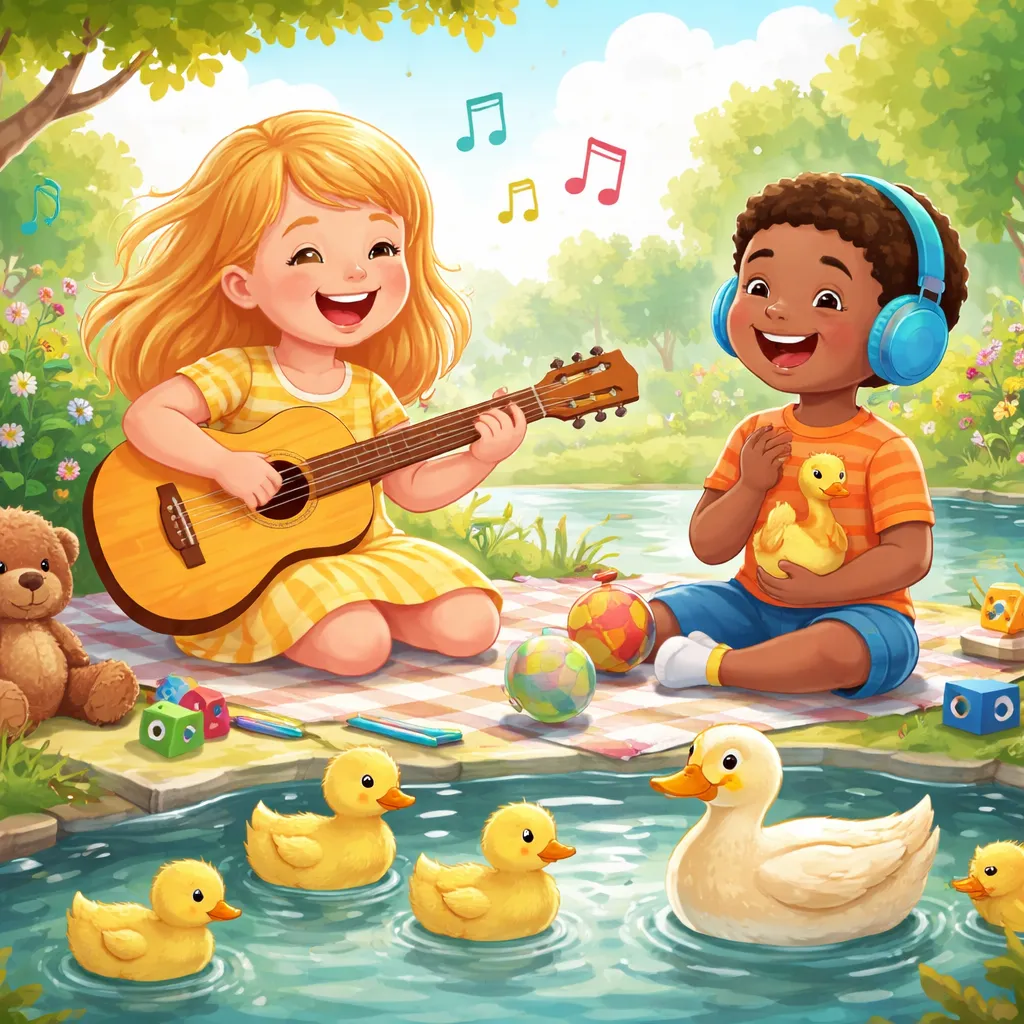

A mother duck leads her ducklings across the water. They follow in a line, one after another, learning as they go. A children’s song can lead a child through language learning in that same gentle, guided way. Today, we explore a beloved German nursery rhyme called “Alle meine Entchen,” which translates to “All My Ducklings.” This gentle song follows ducklings as they swim in the water. We will use this melody as a calm, flowing path into English. Together, we will learn new words, explore important sounds, and discover how a simple song can make language learning feel like following a mother duck across a peaceful pond. The ducklings follow together. Your child can learn English with that same sense of gentle guidance.
What is the rhyme? “Alle meine Entchen” is a cherished German nursery rhyme that has been sung for generations. It tells the story of ducklings swimming on the water, washing their feathers, and never going hungry. The song has a gentle, rocking rhythm. Children often use hand movements. They make a beak with their fingers. They paddle their hands like duck feet. They sway like ducklings on the water. The song creates a calm, nurturing atmosphere. When we bring this song to English learning, we keep its gentle, flowing spirit. We use the familiar melody to introduce English words in a way that feels like floating on calm water.
The lyrics of nursery rhymes To appreciate this song, we first look at the original German words. Then we see how they translate into English. This shows children that the same gentle story can be told in different languages. You do not need to know German to enjoy the calm, flowing rhythm of the words.
Original Version (German)
Alle meine Entchen Schwimmen auf dem See Schwimmen auf dem See Köpfchen in das Wasser Schwänzchen in die Höh
English Version
All my little ducklings Swim upon the lake Swim upon the lake Heads go in the water Tail feathers up on top
A second verse continues the story, showing the ducklings washing and eating.
Original Version (German)
Alle meine Entchen Waschen sich so fein Waschen sich so fein Ihr Köpfchen, ihr Köpfchen Und die Flügelein
Alle meine Entchen Essen gar so gern Essen gar so gern Das Körnlein, das Körnlein Und die Würmelein
English Version
All my little ducklings Wash themselves so fine Wash themselves so fine Their little heads, their little heads And their little wings
All my little ducklings Like to eat so much Like to eat so much The little grains, the little grains And the little worms
As you read these words, notice the gentle repetition. The rhythm moves like water. The story is simple and nurturing. Ducklings swim on the lake. They put their heads in the water. They wash their heads and wings. They like to eat grains and worms. This narrative invites children to learn about the daily life of ducklings.
Vocabulary learning This song offers a rich set of words that connect to water, animals, and daily actions. We can explore these words through conversation, pictures, and gentle play.
Start with the main characters: the ducklings. In German, it is Entchen. In English, we say “ducklings.” Ducklings are baby ducks. You can look at pictures of ducklings together. Notice their yellow feathers and webbed feet.
Here are the key words to focus on from the song:
Ducklings: Baby ducks. Explain that ducklings follow their mother and learn to swim.
Swim: To move through water. Make swimming motions with your hands.
Lake: A body of water. Show pictures of lakes. Compare to a pond or ocean.
Heads: The top part of the body. Touch your head. The ducklings put their heads in the water.
Tail feathers: The feathers at the back of a bird. Point to the back. Explain that they go up when the head goes down.
Wash: To clean. The ducklings wash themselves. Practice washing hands together.
Wings: The parts birds use to fly. Flap your arms like wings.
Eat: To take food. The ducklings like to eat.
Grains: Small seeds. Ducklings eat grains. Show rice or bread crumbs.
Worms: Small, soft creatures. Explain that birds eat worms.
Use these words in natural moments. At bath time, say “you wash your head, like the ducklings wash their heads.” When you see birds, ask “what do they like to eat?” These connections make the vocabulary meaningful.
Phonics points Phonics helps children understand the sounds that build English words. This song gives us several clear sounds to explore in a gentle, flowing way.
First, focus on the ‘sw’ blend at the beginning of “swim.” This is two consonants together. Say “s” like a snake, then quickly add “w.” Then add “im.” Practice with “sweet,” “swing,” and “swim.” This blend appears in many water-related words.
Next, notice the short ‘i’ sound in “ducklings” and “swim.” Say “i” like in “igloo.” Then say “ducklings” slowly. Practice with “sit,” “big,” and “wings.” This is a very common vowel sound.
The word “lake” contains the long ‘a’ sound. Say “ay” like in “day.” Then say “lake.” Practice with “make,” “cake,” and “lake.” This sound is bright and open.
Finally, look at the ‘sh’ sound in “wash.” This is a quiet, airy sound. Put your finger to your lips and say “shhh.” Then say “wash.” Practice with “ship,” “fish,” and “wash.” The song also has “feathers,” which contains the ‘th’ sound. Say “th” like in “think.”
Grammar patterns Even a simple song contains grammar that we can introduce gently. We do not need to use technical terms. Instead, we show how words work together through examples and play.
The song uses the present tense to describe what the ducklings do. “Swim,” “wash,” and “eat” describe actions that happen regularly. You can practice by describing what you do. “We swim.” “We wash.” “We eat.” This builds understanding of habitual actions.
Notice the word “all” in “all my ducklings.” This shows the whole group. You can practice with other “all” phrases. “All my toys.” “All my books.” This builds quantity vocabulary.
The phrase “so fine” means “very well.” The ducklings wash themselves so fine. You can practice using “so” for emphasis. “You sing so well.” “You run so fast.” This adds expressive language.
Also, look at the diminutive endings in English. “Ducklings” means small ducks. “Little heads” and “little wings” show affection. You can practice using “little” to show smallness or affection. “Little spoon.” “Little baby.” This builds gentle, affectionate language.
Learning activities Activities bring the song into the body and the imagination. They transform listening into active participation. These ideas are simple and require little preparation.
Duckling Swim Play the song and pretend to be ducklings. Paddle your hands like webbed feet. Move around the room. When the song says “heads go in the water,” bend down. When it says “tail feathers up,” wiggle your back. When it says “wash,” pretend to clean your head and wings. This activity builds listening skills and physical expression.
Bath Time Play During bath time, sing the song. Pretend to be ducklings washing. Say “we wash our heads, like the little ducklings.” Add rubber ducks to the bath. This connects the song to a daily routine.
Feeding Birds If you have a garden or park nearby, bring bread crumbs or birdseed. Watch the birds eat. Say “the birds eat grains, like the little ducklings.” This connects the song to real observation.
Printable materials Printable resources offer a quiet way to reinforce the song’s vocabulary. They are perfect for moments when children want to create or focus calmly.
Flashcards Create a set of flashcards. One card shows a duckling. One shows water for “swim.” One shows a lake scene. One shows a head and tail feathers. One shows soap bubbles for “wash.” One shows grains and worms for “eat.” Use these cards for a matching game. Sing a line from the song and ask your child to find the matching card. This builds word recognition.
Coloring Page Draw a simple scene from the song. Show a mother duck with several ducklings swimming on a lake. Children can color the water blue and the ducklings yellow. As they color, talk about the scene. “What are the ducklings doing?” “Where do they swim?” This keeps the language flowing naturally.
Duckling Puppets Create simple duckling puppets using paper bags or popsicle sticks. While making them, talk about the song. Use the puppets to act out the verses. This combines fine motor skills with language practice.
Educational games Games encourage repetition without boredom. They invite children to use the language in new and creative ways.
Duckling Says Play a game similar to “Simon Says.” Give commands using the song’s vocabulary. “The duckling says swim on the lake.” “The duckling says wash your head.” “The duckling says eat some grains.” If you give a command without saying “the duckling says,” the child does not move. This game builds listening skills.
Follow the Leader Line up like ducklings. One person is the mother duck. The ducklings follow. Walk around the room. When the mother says “swim,” paddle. When she says “wash,” pretend to wash. This builds listening and sequencing skills.
What Do They Eat? Gather pictures of different bird foods. Grains. Worms. Berries. Seeds. Ask your child to point to what ducklings like to eat. Then talk about what other birds eat. This builds vocabulary about animals and food.
As you share “Alle meine Entchen” with your child, remember that you are creating a sense of gentle guidance and togetherness. The ducklings swim together. They wash together. They eat together. They learn from their mother and from each other. Learning a new language can feel like that too. It is about following a gentle guide. It is about learning together, step by step, word by word. Let the peaceful ducklings be your guide. Sing the song during quiet moments. Let the calm rhythm of the water remind you both that language learning does not need to be rushed. It can be a gentle swim across a calm lake, with someone you trust leading the way.