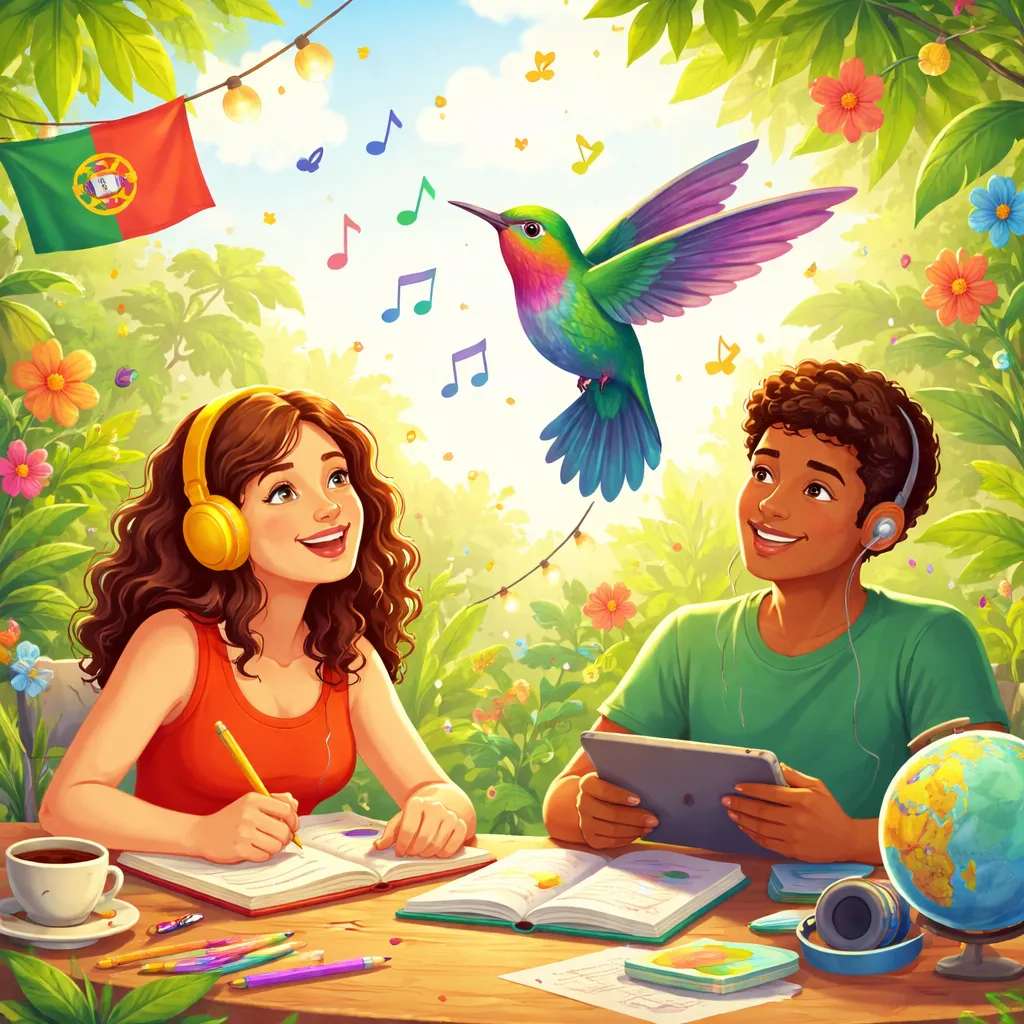

A hummingbird hovers in the air with delicate precision. A children’s song can hover in a child’s memory with that same gentle persistence. Today, we explore a traditional Portuguese rhyme called “O Beija-flor,” which means “The Little Hummingbird.” This graceful song follows a tiny hummingbird as he visits flowers. We will use this melody as a light, fluttering path into English. Together, we will learn new words, explore important sounds, and discover how a simple song can make language learning feel as delicate and joyful as a hummingbird’s flight. The hummingbird moves quickly but stays in one place. Your child can learn new words with that same focused, gentle energy.
What is the rhyme? “O Beija-flor” is a delicate nursery rhyme in Portuguese-speaking cultures. It tells the story of a little hummingbird who flutters from flower to flower. The song has a light, hovering rhythm. Children often use hand movements. They flutter their fingers like tiny wings. They pretend to sip nectar from flowers. They make soft buzzing sounds. The song celebrates the beauty of small things and the wonder of nature. When we bring this song to English learning, we keep its gentle, hovering spirit. We use the familiar melody to introduce English words in a way that feels like pausing to admire something small and beautiful.
The lyrics of nursery rhymes To appreciate this song, we first look at the original Portuguese words. Then we see how they translate into English. This shows children that the same graceful story can be told in different languages. You do not need to know Portuguese to enjoy the light, hovering rhythm of the words.
Original Version (Portuguese)
O beija-flor, o beija-flor Vai voar, vai voar De flor em flor, de flor em flor Vai beijar, vai beijar
English Version
The little hummingbird, the little hummingbird Will fly, will fly From flower to flower, from flower to flower Will kiss, will kiss
A second verse often continues the story, describing the hummingbird’s quick movements.
Original Version (Portuguese)
Tão pequenino, tão pequenino Rápido a voar, rápido a voar Busca o néctar, busca o néctar Vai saborear, vai saborear
English Version
So tiny, so tiny Fast to fly, fast to fly He seeks the nectar, he seeks the nectar Will taste, will taste
As you read these words, notice the light repetition. The rhythm moves like fluttering wings. The story is simple and graceful. A hummingbird flies from flower to flower. He kisses the flowers. He is tiny and fast. He seeks nectar to taste. This narrative invites children to appreciate small, delicate things.
Vocabulary learning This song offers a beautiful set of words that connect to nature, movement, and delicacy. We can explore these words through conversation, pictures, and gentle observation.
Start with the main character: the hummingbird. In Portuguese, it is beija-flor, which literally means “kiss-flower.” In English, we say “little hummingbird.” Hummingbirds are known for their tiny size, fast wings, and ability to hover. You can look at pictures or videos of hummingbirds together. Notice how their wings move so quickly.
Here are the key words to focus on from the song:
Hummingbird: A tiny bird that hovers near flowers. Explain that the name comes from the humming sound their wings make.
Fly: To move through the air. Make fluttering motions with your hands.
From flower to flower: Moving between flowers. This phrase shows movement and repetition.
Kiss: To touch gently. The hummingbird’s beak touches the flower like a kiss. This is a poetic word.
Tiny: Very small. The hummingbird is tiny. Show something tiny with your fingers.
Fast: Quick. The hummingbird flies fast. Move your hands quickly.
Seek: To look for. This is similar to “search.” The hummingbird seeks nectar.
Nectar: The sweet liquid inside flowers. Explain that this is the hummingbird’s food.
Taste: To try with the mouth. The hummingbird tastes the nectar.
Use these words in natural moments. When you see a flower, say “maybe a hummingbird will come to kiss the flower.” When your child eats something sweet, say “you taste the sweetness, like the hummingbird tastes nectar.” These connections make the vocabulary meaningful.
Phonics points Phonics helps children understand the sounds that build English words. This song gives us several clear sounds to explore in a light, gentle way.
First, focus on the ‘h’ sound at the beginning of “hummingbird.” This is a soft, breathy sound. Say “h h h” like a gentle sigh. Then say “hummingbird.” Practice with “happy,” “hello,” and “humming.” This sound is soft and quiet.
Next, notice the short ‘i’ sound in “little,” “tiny,” and “kiss.” This is a quick vowel sound. Say “i” like in “igloo.” Then say “little” slowly. Practice with “sit,” “wig,” and “kiss.” This is a very common sound.
The word “fly” contains the ‘fl’ blend and the long ‘i’ sound. First, the ‘fl’ blend. Say “f” and then quickly add “l.” Then add “y.” Practice with “flower,” “flap,” and “fly.” The long ‘i’ sound is like “eye.” This combination makes “fly” a fun word to say.
Finally, look at the ‘ng’ sound in “hummingbird.” The “ing” part has the ‘ng’ sound. Say “ing” like in “ring.” Practice with “sing,” “wing,” and “humming.” The song also has “flower,” which contains the ‘ow’ sound. Say “ow” like in “cow.”
Grammar patterns Even a simple song contains grammar that we can introduce gently. We do not need to use technical terms. Instead, we show how words work together through examples and play.
The song uses the future tense with the word “will.” “Will fly” means the hummingbird plans to fly. You can explain this simply. “Will” is a helper word that tells us something is going to happen. Practice by talking about your day. “You will see flowers.” “We will watch a video.” This gives children a tool to talk about future events.
The second verse introduces descriptive words. “So tiny” and “fast to fly” describe the hummingbird. These are adjectives and adverbs. You can practice using descriptive words. “The bird is tiny.” “It flies fast.” This builds vocabulary for description.
Notice the repetition of phrases. “From flower to flower” shows movement between places. This pattern is common in English. You can practice other “from ___ to ___” phrases. “From home to school.” “From morning to night.”
Also, look at the verb “seek.” This is a slightly formal word for “look for.” You can use both words to expand vocabulary. “The hummingbird seeks nectar. He looks for sweet food.”
Learning activities Activities bring the song into the body and the imagination. They transform listening into active participation. These ideas are simple and require little preparation.
Hummingbird Flight Play the song and pretend to be the hummingbird. Flutter your hands like tiny wings. Move from one flower to another. Use pillows or cushions as flowers. When the song says “will kiss,” gently touch each flower. When it says “fast to fly,” move quickly. This activity builds listening skills and gentle movement.
Flower Garden Create a simple flower garden using paper flowers or real flowers if available. Place them around the room. Pretend to be the hummingbird. Fly from flower to flower. Say “I fly to the red flower. I kiss the flower.” This connects the song to imaginative play.
Taste Test Explore the sense of taste together. Offer small tastes of different foods. Sweet, sour, salty. Talk about the hummingbird tasting nectar. Say “you taste the apple. The hummingbird tastes nectar.” This builds vocabulary and connects to the song.
Printable materials Printable resources offer a quiet way to reinforce the song’s vocabulary. They are perfect for moments when children want to create or focus calmly.
Flashcards Create a set of flashcards. One card shows the hummingbird. One shows fluttering wings for “fly.” One shows a row of flowers for “from flower to flower.” One shows lips kissing for “kiss.” One shows a small dot for “tiny.” One shows a drop of liquid for “nectar.” Use these cards for a matching game. Sing a line from the song and ask your child to find the matching card. This builds word recognition.
Coloring Page Draw a simple scene from the song. Show the little hummingbird hovering near a flower. Draw the flower with bright petals. Children can color the hummingbird in bright colors like green and red. As they color, talk about the scene. “What is the hummingbird doing?” “What color are the flowers?” This keeps the language flowing naturally.
Flower and Hummingbird Mobile Create a simple mobile. Cut out flower shapes and a hummingbird shape. Hang them from a hanger or stick. While creating the mobile, sing the song together. This combines fine motor skills with language practice.
Educational games Games encourage repetition without boredom. They invite children to use the language in new and creative ways.
Hummingbird Says Play a game similar to “Simon Says.” Give commands using the song’s vocabulary. “The hummingbird says fly to the window.” “The hummingbird says kiss the flower.” “The hummingbird says taste something sweet.” If you give a command without saying “the hummingbird says,” the child does not move. This game builds listening skills.
Flower Hunt Hide paper flowers around the room. Pretend to be hummingbirds. Sing the song while searching for flowers. When you find a flower, say “I found a flower! I kiss the flower.” Count the flowers together. This builds vocabulary and makes the song interactive.
Fast and Slow Game Practice moving fast and slow. Say “the hummingbird flies fast.” Move quickly. Say “the hummingbird hovers slowly.” Move slowly. Take turns giving instructions. This builds understanding of opposites and descriptive words.
As you share “O Beija-flor” with your child, remember that you are nurturing an appreciation for small wonders and gentle persistence. The little hummingbird is tiny, but he flies with purpose. He visits each flower. He tastes the nectar. Learning a new language can feel like being a hummingbird. Each word is a small flower to visit. Each sound is a drop of sweetness to taste. Let the graceful hummingbird be your guide. Sing the song when you explore new words together. Flutter from one activity to the next. Let the delicate spirit of the hummingbird remind you both that even the smallest steps in language learning can be beautiful, and every new word is a flower worth visiting.