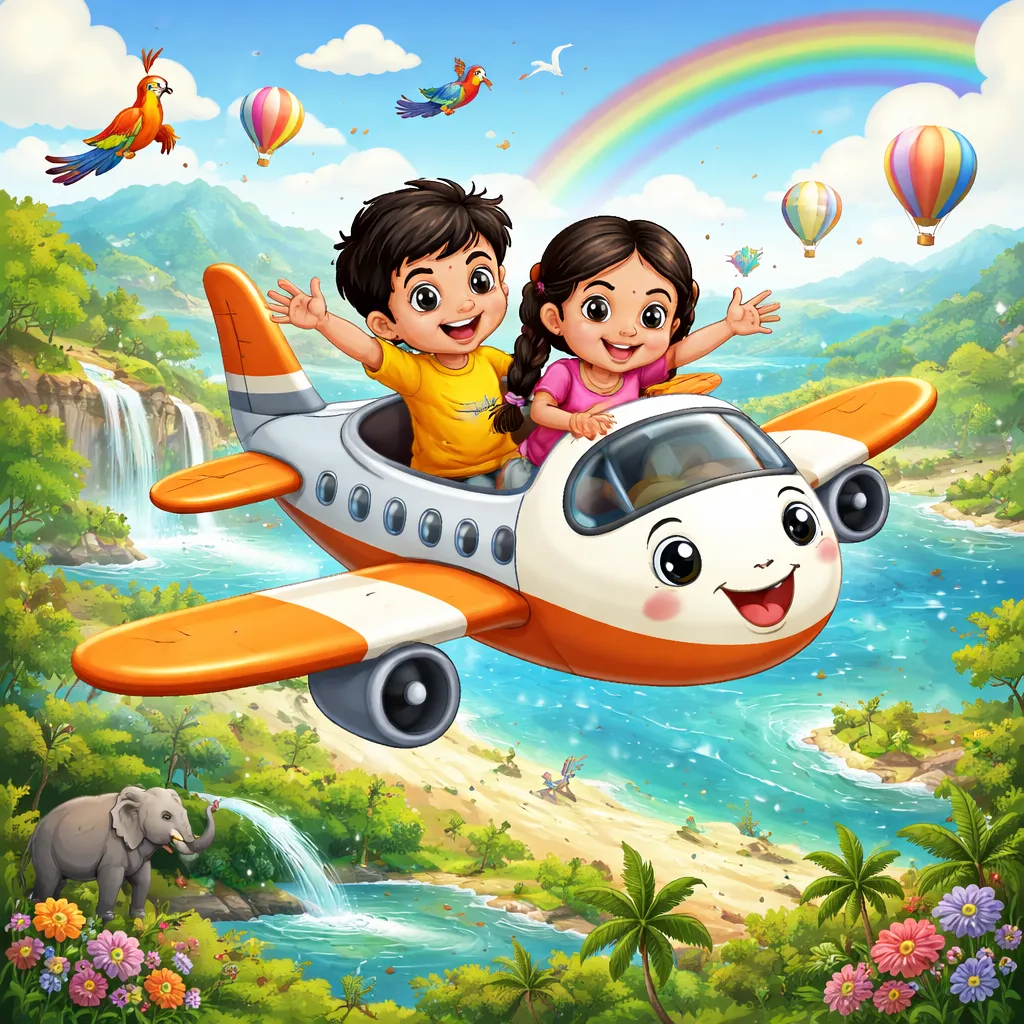

Have you ever looked up at the sky and seen a tiny silver bird leaving a fluffy white trail behind it? Have you wondered where it’s going? Who is inside? A plane is a machine full of stories, dreams, and faraway places. In India, there is a happy, bouncy song that makes you feel like you’re flying! Let’s climb aboard the Hindi Song: The Little Plane (हवाई जहाज).
About the Song Here is a joyful verse from this popular children’s song in Hindi and English: हवाई जहाज हवाई जहाज (Havai jahaz, havai jahaz) Airplane, airplane ऊपर उड़ जा (Upar ud ja) Fly up high पहाड़ों के पार (Pahadon ke paar) Over the mountains समुद्र के पार (Samudra ke paar) Over the sea ले चल मुझे अपने साथ (Le chal mujhe apne saath) Take me along with you नई जगह पर (Nayi jagah par) To a new place
This song’s original name is “हवाई जहाज” (Havai Jahaz), which is the Hindi word for “airplane.” It is a very popular and modern Indian children’s song. The song talks directly to the airplane as if it were a magical, friendly giant bird. The singer asks the plane to take them on an adventure, high above the world. It’s a musical ticket to a journey, filling you with excitement about seeing everything from the clouds.
What the Song is About The song is an invitation to fly! First, we call out to the airplane twice, like saying hello to a friend. Then, we give it a happy command: “Fly up high!” The song paints a picture of the plane soaring upward, leaving the ground far below. Next, we see the amazing view from the window. We fly over the tops of huge, rocky mountains that look small from the sky. We zoom over the wide, blue sea, watching the waves from above. The singer’s wish is simple and big: “Take me along with you to a new place!” The whole song is full of the bouncing, happy feeling of adventure and the wonder of seeing the whole world from above.
Who Made It & Its Story This song is part of the lively world of modern Indian children’s music, often created by teams of composers and singers for kids' TV shows and albums. While the specific creators’ names are not widely listed, the song’s popularity comes from its pure, joyful spirit. In India, a country with a rich history of travel, trade, and diverse landscapes, the idea of flying to see new places is very exciting. This Hindi Song: The Little Plane (हवाई जहाज) captures that excitement perfectly. It is loved for three main reasons. First, its tune is incredibly catchy, bouncy, and easy for children to sing and dance to. Second, it taps into every child’s sense of wonder about airplanes and the big, wide world. Third, it is simple and repetitive, making it easy to learn and remember, even for young children or those new to the Hindi language.
When to Sing It You can sing this song at the top of your lungs while running around the playground with your arms stretched out like wings, pretending to be the airplane. It’s perfect to hum in the backseat during a long family car ride, imagining your car is flying over the roads and trees. You could also sing it with friends when looking at a globe or a world map, pointing to the “new places” you’d like the plane to take you.
The Hindi Song: The Little Plane (हवाई जहाज) is so much more than just a fun tune to dance to. It’s like a passport that lets us travel to new words, discover how to talk about exciting actions, and learn about a colorful part of the world. Fasten your seatbelt—we’re about to learn!
What Children Can Learn
Vocabulary This song takes us on a trip through wonderful action and sight words. Soar: To fly or rise high in the air smoothly and gracefully. An eagle soars. A plane soars above the clouds.
Horizon: The line far away where the earth or sea seems to meet the sky. The sun sets on the horizon.
Journey: A trip from one place to another, especially a long or exciting one. Going to visit your grandparents can be a journey.
Vast: Very, very large and wide. The sky is vast. The desert is vast.
Destination: The place where someone or something is going. Your school is your destination in the morning. “The plane’s destination is Mumbai.”
Whizzing: Moving very fast, making a soft, quick sound like “whizz!” A toy car can go whizzing past. The plane goes whizzing through the air.
Language Skills This song is a fantastic teacher for the Present Continuous Tense. We use this tense to talk about actions happening right now. What Is It?: Think of the Present Continuous as the “Right Now” tense. It describes actions that are in progress at this moment. The plane isn’t just flying in general; in the song, it is flying right now on its adventure.
Finding the Secret: Look for the two-part formula: the verb “to be” (am, is, are) + a main verb ending in “-ing.” Ask yourself: “Is this action happening right this minute?”
Using It:
◦   Formula: [Person/Thing] + am/is/are + [verb-ing].

◦   Examples: “I am singing.” “The plane is flying.” “We are looking at the mountains.”

◦   In the song, the feeling is: “The airplane is soaring.” “It is whizzing over the sea.” “I am going to a new place.”
Sounds & Rhythm Fun Get ready to move! The Hindi Song: The Little Plane (हवाई जहाज) has a bright, bouncy, and very happy rhythm. It makes you want to jump and bounce. The Hindi words have repeating sounds, like “havai jahaz, havai jahaz,” which are fun to say. The melody is playful and jumps up and down, just like a playful plane in the sky. This energetic rhythm and catchy repetition make the song stick in your head instantly and fill you with energy. You can use this same bouncy, joyful rhythm to make up a song about any fast, fun vehicle, like a train, a boat, or even a speeding bicycle!
Culture & Big Ideas This song connects to the modern, vibrant spirit of India, a country where colorful festivals, long train journeys, and busy airports are all part of life. A child-friendly Indian festival full of color and joy is Holi, the festival of colors. During Holi, people playfully throw bright colored powders at each other, celebrating the arrival of spring with laughter and music, much like the song celebrates the joy of adventure. The Hindi Song: The Little Plane (हवाई जहाज) teaches three big ideas. First, The Joy of Exploration: It encourages curiosity about the world and the excitement of discovering new places. Second, The Power of Imagination: You don’t need a real ticket to travel; your mind can take you anywhere! Third, Broadening Horizons: Looking at the world from high above helps us see how everything is connected and makes our own world feel bigger and full of possibilities.
Values & Imagination Close your eyes and listen to the song. Can you feel the rumble of the engines? Can you see the patchwork of fields and rivers below getting smaller? Can you imagine the taste of a new fruit in a faraway market? This song teaches you to dream big and be brave about new experiences. It tells you that the world is a beautiful book, and travel is a way to read its pages. A simple idea: The next time you see a plane in the sky, make a wish about a place you’d love to visit one day. Then, draw a picture of what you think that place looks like. You’ve just started your adventure.
Your Core Takeaways The Hindi Song: The Little Plane (हवाई जहाज) is a joyful celebration of flight, imagination, and the wide world. You learned action words like “soar” and “whizzing.” You discovered how to use the Present Continuous tense (is flying, are going) to talk about actions happening right now. You felt the song’s bouncy, energetic rhythm that makes you want to dance. You also learned how the song connects to the colorful joy of Indian festivals like Holi. Most importantly, the song encourages you to be curious, to use your imagination to explore, and to always be excited about the adventures that wait over the horizon.
Your Practice Missions
- Be a “Right Now” Reporter. For five minutes, walk around your home and pretend you are a news reporter describing live action. Say what people or things are doing right now using “is ___ing” or “are ___ing.” For example: “Mom is reading a book. The clock is ticking. I am exploring!” This practices the Present Continuous tense.
- Design Your Dream Plane Ticket. Take a piece of paper and draw a pretend airplane ticket. For the destination, write or draw the name of a place you dream of visiting (real or imaginary). Decorate the ticket with things you’d see from the plane window on the way there. Then, hold your ticket and sing the song, pointing to your destination on a map or globe.