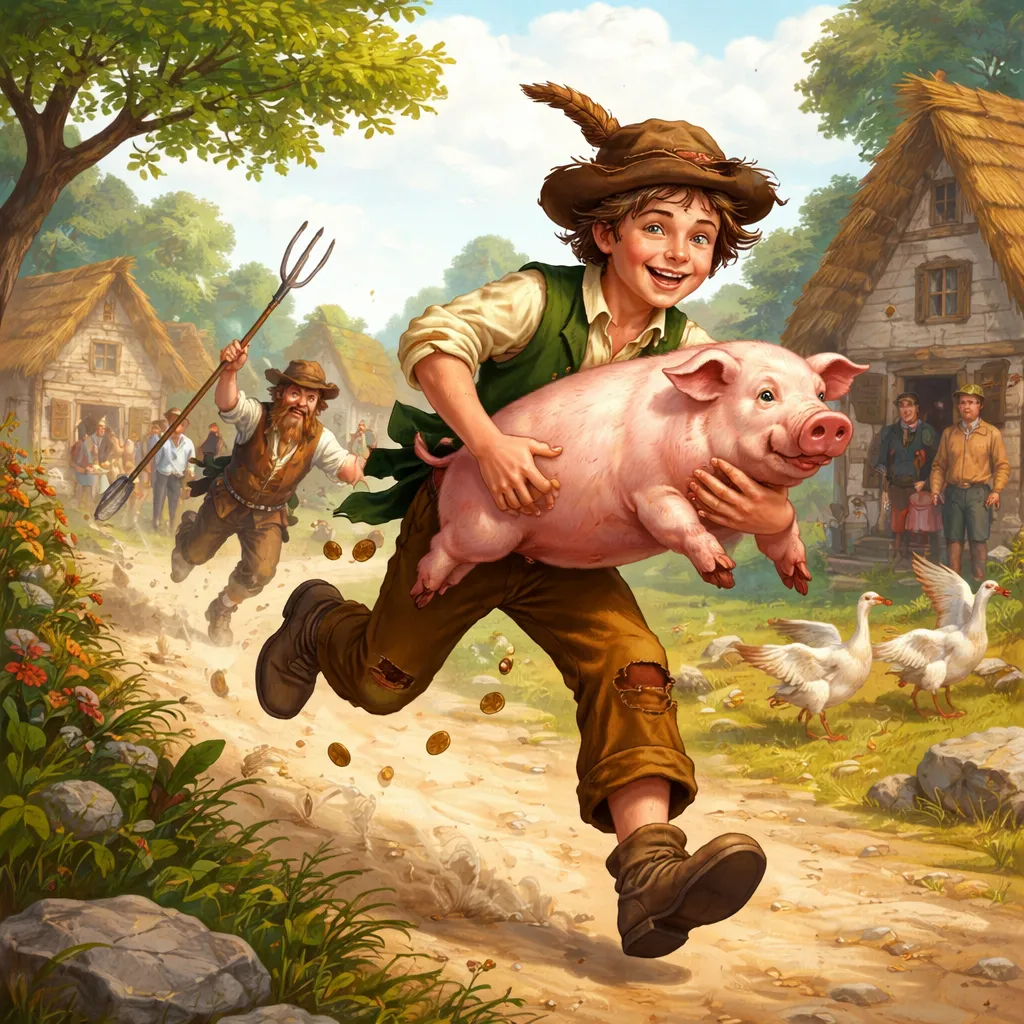

Have you ever wanted something that wasn’t yours? Maybe a shiny toy or the last piece of cake? There’s a very old song about a boy who gave in to that feeling. It tells a quick, sharp story about a bad choice and what happened next. Let’s learn about the song “Tom, Tom, the Piper’s Son.”
About the Song
Here is the most common version of this well-known rhyme.
Tom, Tom, the piper’s son, Stole a pig and away he run; The pig was eat, And Tom was beat, And Tom went crying down the street.
This short song is a traditional English nursery rhyme. It is like a tiny, cautionary play in just a few lines. The song tells the story of a boy, the son of a musician, who commits a theft, faces the consequences, and is left very unhappy. It is a very old rhyme from England, first seen in print over 200 years ago. The version we sing today is shorter; older versions had more verses describing Tom’s capture. It comes from the rich tradition of English folk rhymes that were used not just for fun, but also to teach clear lessons about right and wrong in a memorable way.
What the Song is About
The song paints a vivid, action-packed picture. First, we meet Tom. He is introduced as “the piper’s son,” meaning his father plays music, perhaps at fairs. Then, we see Tom’s action. He sees a fat, pink pig. He looks left and right, grabs the pig, and runs away as fast as he can, clutching the squealing animal.
But the story doesn’t end there. The next scene shows the result. The pig that Tom stole has been eaten—probably at a feast, but not by Tom. Then, we see Tom himself. He has been caught. Someone, likely the pig’s angry owner, has beaten him as punishment. The final image is of Tom, alone and miserable. He is walking—or perhaps limping—slowly down the dusty street, tears streaming down his face, crying loudly from the pain and the shame.
Who Made It & Its Story
“Tom, Tom, the Piper’s Son” is a traditional folk rhyme, so its original author is lost to history. It was shared in streets and homes long before it was written in a book. The rhyme might be connected to much older ballads or real events from a time when stealing livestock was a serious crime. The “piper” refers to a traveling musician, a common figure in old English towns and fairs, which places the story in a specific historical setting.
This rhyme has stayed popular for three strong reasons. First, it tells a complete, dramatic story with a clear beginning, middle, and end, all in a few seconds. Second, the rhythm is incredibly catchy and energetic, matching Tom’s running. Third, it delivers a straightforward moral lesson about theft and punishment that children understand immediately. The cause (stealing) and effect (beating and crying) are perfectly clear.
When to Sing It
This song is perfect for active, dramatic play. You can sing it while running around in a game of tag, pretending to be Tom running away. You can sing it as a short, sharp story-song during a discussion about making good choices. You can also chant it while jumping rope or bouncing a ball, using the strong beat to keep time.
What Children Can Learn
This fast-paced rhyme is a small package full of big lessons. Let’s look closely at everything it teaches.
Vocabulary
The song introduces strong, action-oriented words. A “piper” is a person who plays a pipe, a simple wind instrument. “Son” means a male child. To “steal” is to take something that does not belong to you without permission. A “pig” is a farm animal. “Away he run” is old-fashioned for “away he ran.” “Eat” is an old, short form for “eaten.” To “beat” (past tense: beat) here means to hit as punishment. “Crying” means producing tears from your eyes, usually because you are sad or hurt.
Let’s use these words! You can say, “The piper played a happy tune.” Or, “It is wrong to steal.” You might explain, “The cake was all eaten.” New word: Consequence. This is the result or effect of an action. Tom faced the consequence for stealing the pig. Every choice has a consequence.
Language Skills
This song is a fantastic, concentrated lesson in the Simple Past Tense, especially irregular verbs. We use the simple past to talk about completed actions in the past. The song is a story, so it’s all in the past tense.
Look at the key verbs: “Stole a pig” (past of steal), “away he run” (an old form of ran, past of run), “The pig was eat” (old form of eaten, past participle of eat), “Tom was beat” (past of beat), “Tom went crying” (past of go). Almost every verb is irregular! This makes the song a powerful, memorable tool for learning these important verb changes. We don’t say “stealed” or “runned”; we say stole and ran. The song drills this pattern into our memory through its strong rhythm.
Sounds & Rhythm Fun
Listen to the driving beat of the words. The main rhymes are “son” with “run,” and the brilliant, quick triple rhyme of “eat,” “beat,” and “street.” This creates a tight, memorable package.
The rhythm is fast, urgent, and galloping, like Tom’s fleeing footsteps. Try clapping it quickly: TOM, TOM, the PIPE-er’s SON, STOLE a PIG and aWAY he RUN. The melody, if sung, is usually simple, repetitive, and a bit cheeky or dramatic. This energetic, runaway rhythm makes the story exciting and the words easy to memorize. You can write your own quick-consequence song! Use the same galloping beat. Try: “Jack, Jack, the baker’s lad, took a pie and that was bad; The pie was gone, and Jack was led, to sit and think on his bed.”
Culture & Big Ideas
This rhyme comes from a time in British history when life was stricter and punishments for theft, especially of valuable livestock, could be harsh and immediate. It reflects a society where rules were clear and breaking them had definite, often physical, consequences. The “piper” also gives us a glimpse into village life, where traveling entertainers were common.
The song teaches three clear, important ideas. First, it’s about actions and consequences. Tom’s action (stealing) leads directly to two consequences: the loss of the pig and his own punishment. Second, it deals with theft and dishonesty. The song clearly frames stealing as a wrong act that brings trouble. Third, it shows remorse and facing results. Tom ends up “crying down the street,” which shows he is sad and regretful, completing the moral cycle of bad choice, punishment, and regret.
Values & Imagination
Let your imagination fill in the gaps in Tom’s story. What did the pig look like? Was it big and muddy? Why did Tom want it so badly? Was he hungry? Was he showing off? Who caught him? A fierce farmer? The town sheriff? What did the beating involve? A scolding? A slap? How did Tom feel as he walked away? Ashamed? Sorry? Angry? Imagine you are a townsperson watching Tom cry. Would you feel sorry for him? Would you think he deserved it? Draw a comic strip of the song with three panels: Tom stealing, Tom getting caught, and Tom crying alone.
The song helps us think about honesty and earning what we want. A good idea is to play the “Better Choice” game. Take Tom’s story. What could he have done instead of stealing? Maybe he could have offered to help the piper or the farmer to earn a penny to buy some food. With a friend or family member, act out the scene again, but this time, have Tom make a good choice. This practice helps us think of solutions before we act.
This old rhyme, therefore, is a powerful little engine of learning. It’s a grammar drill disguised as a chase scene. It’s a vocabulary lesson wrapped in a drama. It’s a moral fable set to a running beat. From the first mention of the piper’s son to the final image of tears on the street, it doesn’t waste a single word. Every line pushes the story forward and etches a lesson into memory. The song “Tom, Tom, the Piper’s Son” might seem simple, but its simplicity is its strength. It teaches us that stories have power, that actions have weight, and that the words we use to describe the past have their own special shape. It reminds us that sometimes, the oldest songs carry the clearest echoes of truth about how to live with others.
Your Core Takeaways
You are now an expert on the swift story of “Tom, Tom, the Piper’s Son.” You know it’s a traditional English rhyme about theft and punishment. You’ve learned strong verbs like “stole” and “beat,” and you’ve mastered several important irregular past tense verbs. You’ve felt its runaway rhythm and created a new rhyming tale of cause and effect. You’ve also thought deeply about the song’s timeless messages about the direct link between our choices and their consequences, and the importance of honesty.
Your Practice Missions
First, hold a “town square trial.” With a friend or family member, act out the full story. One person is the narrator singing the rhyme. One person is Tom, acting out the stealing, running, and crying. One person is the farmer/judge who announces the punishment (“You are beat!”). This makes the sequence of events physical and memorable.
Second, become a “rhyme reformer.” Your job is to give Tom a happier ending by changing his first action. Create a new version of the rhyme. Start the same, but change the second line. For example: “Tom, Tom, the piper’s son, worked all day till work was done; He earned a penny, bought a treat, and happily walked down the street.” Say your new version out loud to someone. This practices creative language use and reinforces positive choices.