
Have you ever received a gift that was so big or so strange that it made you laugh? What if someone gave you a gift every day for almost two weeks, and each day the gift was bigger and weirder? There is a very old, very funny song about exactly that. It’s a musical puzzle about receiving a mountain of presents. Let’s explore the song “The Twelve Days of Christmas.”
About the Song
This is a traditional English Christmas carol. The lyrics are a long list of gifts given on each of the twelve days of Christmas. Let’s read the whole song.
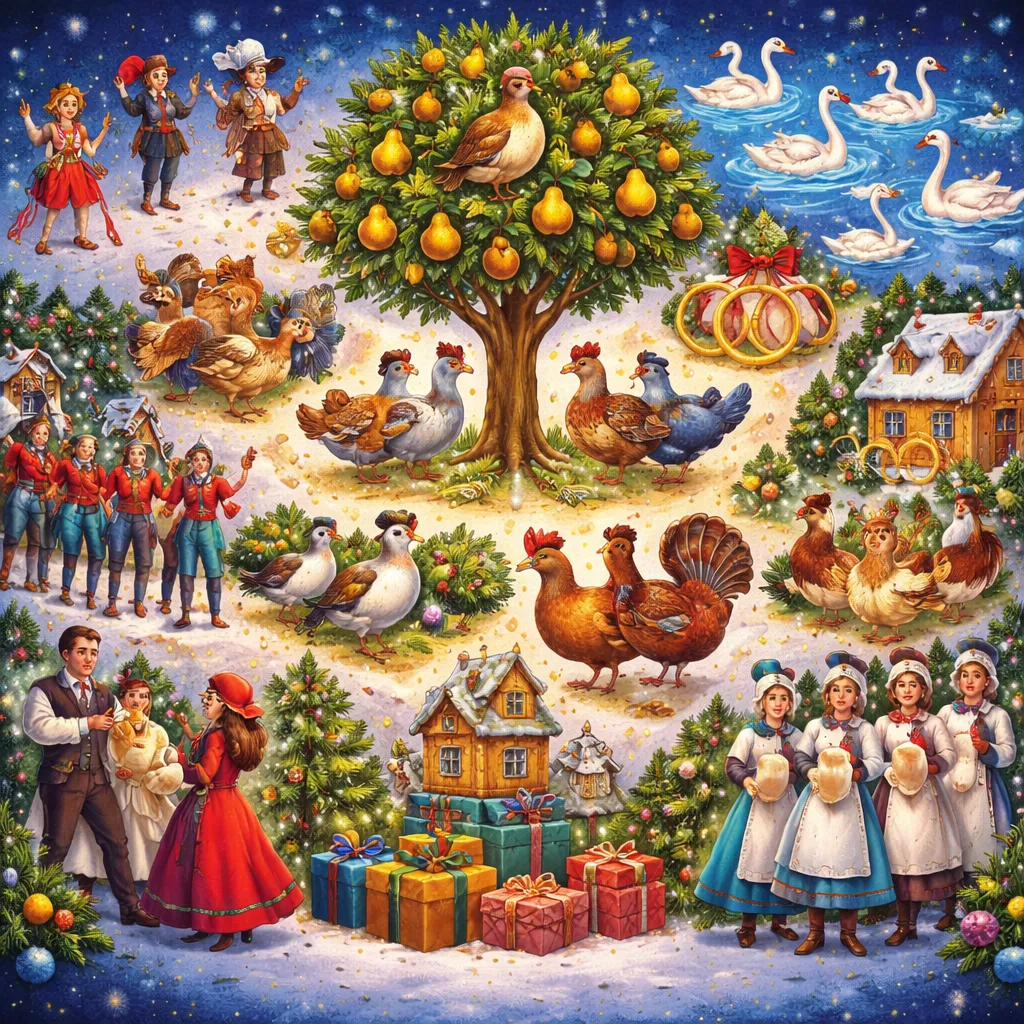
On the first day of Christmas, my true love sent to me a partridge in a pear tree. On the second day of Christmas, my true love sent to me two turtle doves, and a partridge in a pear tree. On the third day of Christmas, my true love sent to me three French hens, two turtle doves, and a partridge in a pear tree. On the fourth day of Christmas, my true love sent to me four calling birds, three French hens, two turtle doves, and a partridge in a pear tree. On the fifth day of Christmas, my true love sent to me five golden rings, four calling birds, three French hens, two turtle doves, and a partridge in a pear tree. On the sixth day of Christmas, my true love sent to me six geese a-laying, five golden rings, four calling birds, three French hens, two turtle doves, and a partridge in a pear tree. On the seventh day of Christmas, my true love sent to me seven swans a-swimming, six geese a-laying, five golden rings, four calling birds, three French hens, two turtle doves, and a partridge in a pear tree. On the eighth day of Christmas, my true love sent to me eight maids a-milking, seven swans a-swimming, six geese a-laying, five golden rings, four calling birds, three French hens, two turtle doves, and a partridge in a pear tree. On the ninth day of Christmas, my true love sent to me nine ladies dancing, eight maids a-milking, seven swans a-swimming, six geese a-laying, five golden rings, four calling birds, three French hens, two turtle doves, and a partridge in a pear tree. On the tenth day of Christmas, my true love sent to me ten lords a-leaping, nine ladies dancing, eight maids a-milking, seven swans a-swimming, six geese a-laying, five golden rings, four calling birds, three French hens, two turtle doves, and a partridge in a pear tree. On the eleventh day of Christmas, my true love sent to me eleven pipers piping, ten lords a-leaping, nine ladies dancing, eight maids a-milking, seven swans a-swimming, six geese a-laying, five golden rings, four calling birds, three French hens, two turtle doves, and a partridge in a pear tree. On the twelfth day of Christmas, my true love sent to me twelve drummers drumming, eleven pipers piping, ten lords a-leaping, nine ladies dancing, eight maids a-milking, seven swans a-swimming, six geese a-laying, five golden rings, four calling birds, three French hens, two turtle doves, and a partridge in a pear tree.
This song is a traditional English cumulative Christmas carol. It is a musical game and a memory challenge. The song describes a series of increasingly grand and unusual gifts given by a “true love” over the twelve days of the Christmas season. The song is very old, first published in England in 1780, but it is likely even older. It comes from a time when the Christmas celebration lasted from December 25th to January 5th, known as the Twelve Days of Christmas. The song might have started as a memory-and-forfeit game for parties, where players had to remember all the gifts in order or pay a penalty.
What the Song is About
The song paints a funny and overwhelming picture. Someone is telling us about the incredible gifts their “true love” gave them. The gifts start small on the first day: a single partridge bird sitting in a pear tree. On the second day, the gift is two turtle doves, but the singer also gets another partridge in a pear tree again! This pattern continues.
Each new day brings a new, often larger, group of gifts. The singer receives birds like French hens, calling birds, geese, and swans. Then come rings, people (like maids, ladies, lords, pipers, and drummers), and even animals doing actions like laying eggs or swimming. The list of gifts gets longer and longer each day because the singer gets all the previous days’ gifts again! By the twelfth day, the singer is describing a huge, noisy, crowded scene with a partridge, doves, hens, birds, rings, geese, swans, maids, ladies, lords, pipers, and drummers—all gifts from their very generous true love.
Who Made It & Its Story
“The Twelve Days of Christmas” is a traditional folk carol, so its original author is unknown. It was first published in a book of children’s songs in England in 1780. The song likely originated as a “memory and forfeit” game. Children would sit in a circle and take turns singing the verses. If a player made a mistake in the long, cumulative list, they had to pay a forfeit, like giving up a small toy or performing a silly task. This made it a fun, challenging party game during the long Christmas celebrations.
This carol has remained popular for three wonderful reasons. First, it is a fantastic and fun memory challenge. Remembering the order and the growing list of gifts is a brain-teasing game that children love. Second, its cumulative structure is satisfying and funny. The idea of getting all those gifts, especially all those birds and people, becomes sillier and more delightful as the song goes on. Third, it connects to a specific and rich historical tradition—the twelve days of Christmas festivities—giving us a window into how people celebrated long ago.
When to Sing It
This song is perfect for long, cozy holiday gatherings. You can sing it as a group challenge during a family Christmas party, seeing who can remember the next gift without looking. You can sing it slowly, one verse per day, during the actual Twelve Days of Christmas (from December 25 to January 5) as a fun countdown. You can also sing it on a long winter car trip, taking turns with each verse to pass the time.
What Children Can Learn
This playful, cumulative carol is a treasure chest of learning. Let’s unwrap all twelve days of knowledge inside.
Vocabulary
The song teaches us a wonderful and unusual set of words, mostly about birds and people. A “partridge” is a plump, ground-nesting bird. A “pear tree” is a tree that grows pears. “Turtle doves” are small, gentle birds known for their soft cooing. “French hens” are a breed of chicken. “Calling birds” are thought to be songbirds, like canaries. “Geese a-laying” are geese that are laying eggs. “Swans a-swimming” are large, graceful white birds that swim. “Maids a-milking” are young women who milk cows. “Ladies dancing” are women dancing. “Lords a-leaping” are noblemen jumping high. “Pipers piping” are musicians playing pipes (flutes). “Drummers drumming” are musicians playing drums.
Let’s use these words! You can say, “I saw a swan swimming on the lake.” Or, “The drummer drummed a loud beat.” New word: Cumulative. This means increasing by adding one thing after another. The song has a cumulative structure.
Language Skills
This song is a masterful lesson in using ordinal numbers and cardinal numbers in a list. Ordinal numbers show order (first, second, third). Cardinal numbers tell us how many (one, two, three). The song uses both perfectly.
Look at the pattern: “On the first day… a partridge” (ordinal: first, cardinal: one implied). “On the second day… two turtle doves” (ordinal: second, cardinal: two). The song also practices enumerating a list in a specific order. This is a great exercise in sequencing and memory. Furthermore, the song uses the past tense (“my true love sent to me”) to tell a story about gifts that were already given. This helps us practice storytelling about past events.
Sounds & Rhythm Fun
Listen to the repetitive, building melody of the song. The tune is the same for each verse, which makes it easier to learn. The real challenge is the words! The song uses a steady, marching rhythm that helps you keep track of the growing list.
The rhythm is moderate and steady, like a calm walk. Try clapping the beat: On the FIRST day of CHRISTmas, my TRUE love SENT to ME. The melody is simple and repeats, acting as a frame for the challenging list of words. This repetitive musical structure is what makes the cumulative list possible to sing—the tune is a reliable guide for your memory. You can create your own cumulative song! Use the same tune. Try: “On the first day of summer, my best friend gave to me, a shiny shell from beside the sea…” Then add a new summer gift each day, repeating all the previous ones.
Culture & Big Ideas
“The Twelve Days of Christmas” is deeply tied to the traditional Christian celebration of Christmas, which lasts from Christmas Day (December 25) to the eve of Epiphany (January 5). In the past, this was a major festive season with parties, feasts, and games. The song reflects the spirit of extended celebration and extravagant gift-giving that was part of that season.
The song conveys three interesting ideas. First, it’s about abundance and generosity. The “true love” is incredibly generous, giving more and more each day. It celebrates the joy of giving. Second, it highlights tradition and ritual. The song itself became a ritual game, and it marks a specific traditional season. Third, it’s a fun lesson in patience and delayed gratification. The gifts start small and build up, teaching that the best things sometimes come to those who wait, and that celebration can be a long, unfolding joy.
Values & Imagination
Imagine you are the person receiving these gifts. Where do you put a partridge in a pear tree? In your garden? What do you do with twelve drummers drumming in your house? It would be so loud! How do you feed all those birds? Imagine the chaos and the fun. What does your “true love” look like? Why are they giving you all this? Draw a picture of the scene on the twelfth day. Can you fit a partridge, doves, hens, calling birds, rings, geese, swans, maids, ladies, lords, pipers, and drummers into one drawing? Try! It will be a wonderfully crowded, happy mess.
The song encourages creativity, generosity, and celebrating over time. A lovely idea is to have a “Twelve Days of Kindness” challenge. Instead of getting gifts, give one small act of kindness each day for twelve days. It could be making a card, helping with a chore, or saying something nice. Keep a list, just like in the song. This turns the song’s theme of receiving into a practice of giving, spreading the holiday spirit in a personal way.
This carol, therefore, is much more than a long list of strange gifts. It is a vocabulary lesson in birds and performers. It is a math and language lesson in ordinal numbers and listing. It is a music lesson in repetitive, cumulative structure. From the first simple partridge to the final booming drummers, it takes us on a journey of increasing joy and absurdity. “The Twelve Days of Christmas” teaches us that celebration can be a game, that generosity can be wonderfully over-the-top, and that sometimes the fun is in the remembering, the waiting, and the shared challenge of singing it all the way through without a mistake.
Your Core Takeaways
You are now an expert on the carol “The Twelve Days of Christmas.” You know it is a traditional English cumulative song about gifts given over the twelve-day holiday. You’ve learned words like “partridge,” “turtle doves,” and “drummers,” and you’ve mastered ordinal and cardinal numbers in a list. You’ve felt its steady, repetitive rhythm and even created your own cumulative verse. You’ve also discovered the song’s connection to historical Christmas traditions, its themes of generosity and patience, and its origin as a fun memory game.
Your Practice Missions
First, host a “Memory Challenge” party. Gather your family. Try to sing the entire song together. If someone makes a mistake, they get a fun “forfeit” like singing a silly sound or dancing for ten seconds. See if you can get from the first day to the twelfth without anyone forgetting a gift! This is how the song was originally played.
Second, design your own “Twelve Days” gift set. Think of a theme you love, like space, animals, or art. Create a new list of twelve gifts for that theme. For example: “On the first day of school, my teacher gave to me, a brand new shiny pencil.” Draw or write your list on a long piece of paper. Then, try to sing your new version to the tune of the original song. This practices creativity, memory, and applying the song’s structure in a new way.