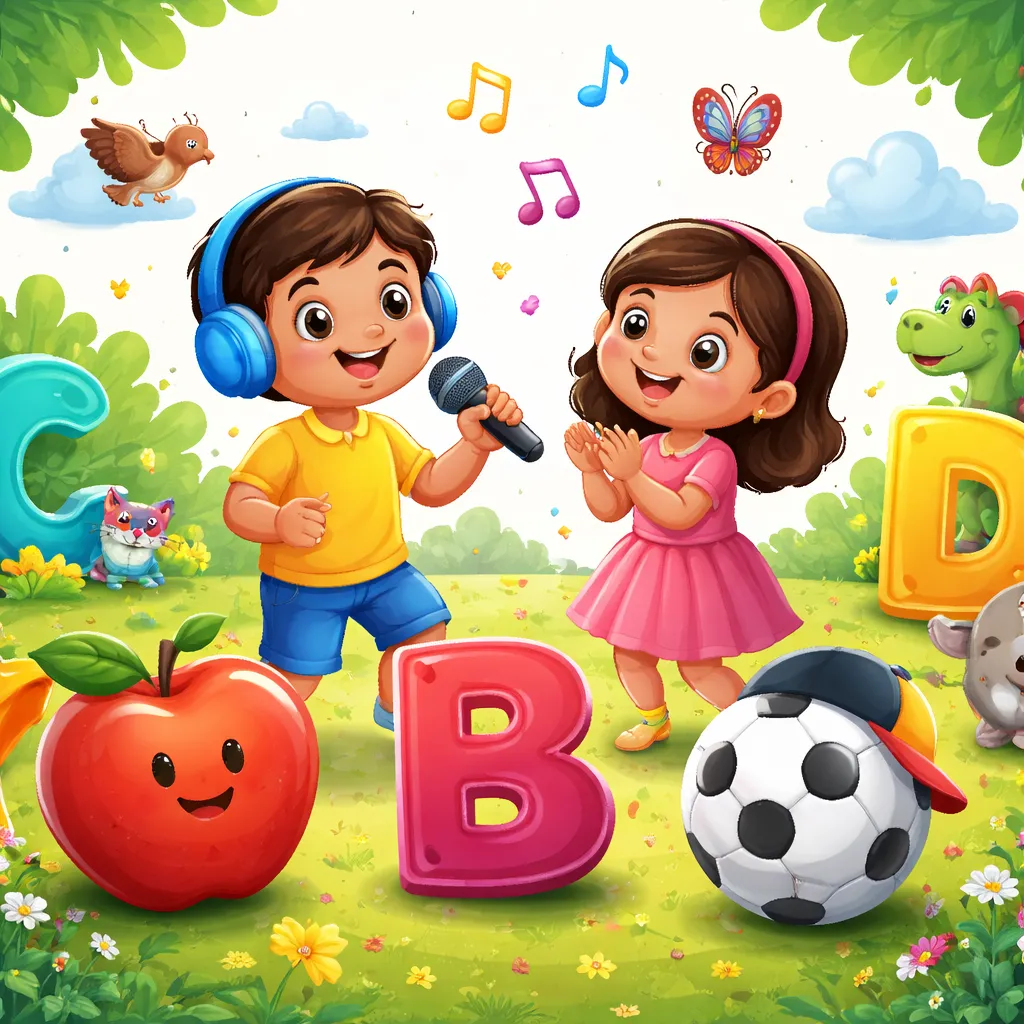

A is for apple. B is for ball. C is for cat. These are the first steps into reading. A children’s song can turn those letters into a joyful foundation. Today, we explore a beloved Hindi children’s song that teaches the English alphabet, often called “ए फॉर एप्पल, बी फॉर बॉल” (A for Apple, B for Ball). This cheerful song introduces each letter with a simple word. We will use this melody as a gentle, letter-filled path into English. Together, we will learn new words, explore important sounds, and discover how a simple song can make language learning feel like singing your ABCs. A for apple, B for ball. Your child can learn English letters with that same joyful, singing spirit.
What is the rhyme? “A for Apple, B for Ball” is a popular children’s song in India that helps young learners master the English alphabet. It is often sung with the same tune as the classic “Alphabet Song.” The song associates each letter with a simple, familiar word. Children love the repetition and the colorful pictures that come with each letter. The song has a steady, learning rhythm. Children often use hand movements. They point to letters. They act out the words. The song creates a joyful, foundational atmosphere. It introduces the building blocks of English reading and writing. When we bring this song to English learning, we keep its steady, foundational spirit. We use the familiar melody to introduce English letters in a way that feels like singing a happy tune.
The lyrics of nursery rhymes To appreciate this song, we first look at the original Hindi version. Then we see the English version. This shows children that the same alphabet learning song can be told in different languages. You do not need to know Hindi to enjoy the steady, alphabetical rhythm of the words.
Original Version (Hindi)
ए फॉर एप्पल बी फॉर बॉल सी फॉर कैट डी फॉर डॉग ई फॉर एग एफ फॉर फैन जी फॉर गर्ल एच फॉर हैंड
English Version
A for Apple B for Ball C for Cat D for Dog E for Egg F for Fan G for Girl H for Hand
The song continues through the alphabet:
I for Igloo J for Jug K for Kite L for Lion M for Monkey N for Nest O for Orange P for Parrot Q for Queen R for Rabbit S for Sun T for Tiger U for Umbrella V for Violin W for Watch X for Xylophone Y for Yacht Z for Zebra
As you read these words, notice the steady, repeating rhythm. The song groups letters with familiar words. This narrative invites children to sing along and learn.
Vocabulary learning This song offers a wonderful set of words that connect to letters and common objects. We can explore these words through conversation, pictures, and letter play.
Start with the main concept: the alphabet. In Hindi, it is अंग्रेजी वर्णमाला (angrezi varnamala). In English, we say “alphabet.” The alphabet is the set of letters we use to write English words.
Here are the key words to focus on from the song (first set):
Apple: A sweet red or green fruit. Show an apple.
Ball: A round toy that bounces. Show a ball.
Cat: A small, furry pet. Show a picture of a cat.
Dog: A loyal animal that barks. Show a picture of a dog.
Egg: A food from chickens. Show an egg.
Fan: A device that blows air. Show a fan.
Girl: A female child. Point to a girl.
Hand: The part at the end of your arm. Show your hand.
Use these words in natural moments. When you eat an apple, say “A for apple.” When you play with a ball, say “B for ball.” These connections make the vocabulary meaningful.
Phonics points Phonics helps children understand the sounds that build English words. This song gives us several clear sounds to explore in a steady, alphabetical way.
First, focus on the short vowel sounds. A says “a” like in “apple.” E says “e” like in “egg.” I says “i” like in “igloo.” O says “o” like in “orange.” U says “u” like in “umbrella.” Practice each vowel sound separately.
Next, notice the consonant sounds. B says “buh” like in “ball.” C says “cuh” like in “cat.” D says “duh” like in “dog.” Practice saying each letter sound clearly.
The song pairs each letter with a word that starts with that sound. This is called “initial sound” or “beginning sound.” You can practice finding other words that start with the same sound. “A: apple, ant, animal.” This builds phonemic awareness.
Finally, look at the letter names and their sounds. Sometimes the name is different from the sound. For example, “C” is called “see,” but it makes a “cuh” sound. This helps children understand the difference.
Grammar patterns Even a simple song contains grammar that we can introduce gently. We do not need to use technical terms. Instead, we show how words work together through examples and play.
The song uses the pattern “A for Apple.” “For” means “stands for.” You can practice with other “for” phrases. “B for ball.” “C for cat.” This builds understanding of representation.
Notice that the words are nouns. “Apple,” “ball,” “cat” are all names of things. You can practice naming things. “This is an apple.” “This is a ball.” This builds noun vocabulary.
The repetition of the pattern helps with memorization. You can practice repeating the pattern. “A for apple. B for ball.” This builds memory and fluency.
Also, look at how the song goes through the alphabet in order. This teaches sequencing. You can practice putting things in order. “First A, then B, then C.” This builds sequencing skills.
Learning activities Activities bring the song into the body and the imagination. They transform listening into active participation. These ideas are simple and require little preparation.
Alphabet March Play the song and march in place. For each letter, say the letter and the word. When you reach Z, raise your hands in the air. This activity builds listening skills and letter recognition.
Letter Hunt Go on a letter hunt. Find objects that start with A. Apple. Ant. Arrow. Find objects that start with B. Ball. Book. Bird. This builds letter-sound connection.
Alphabet Book Create an alphabet book. For each letter, draw a picture. A for apple. B for ball. C for cat. This combines fine motor skills with language practice.
Printable materials Printable resources offer a quiet way to reinforce the song’s vocabulary. They are perfect for moments when children want to create or focus calmly.
Flashcards Create a set of alphabet flashcards. One card for each letter, with a picture. A: apple. B: ball. C: cat. Use them for a matching game. Sing a line from the song and ask your child to find the matching card. This builds word recognition.
Coloring Page Draw the letters A to Z with pictures. A with an apple. B with a ball. Children can color each letter and picture. As they color, say the letter and word. “A for apple.” This keeps the language flowing naturally.
Alphabet Chart Create a simple alphabet chart. Hang it on the wall. Point to letters and sing the song together. This builds letter recognition and literacy.
Educational games Games encourage repetition without boredom. They invite children to use the language in new and creative ways.
Letter Says Play a game similar to “Simon Says.” Give commands using the song’s vocabulary. “A says clap your hands.” “B says jump once.” “C says touch your nose.” If you give a command without naming a letter, the child does not move. This game builds listening skills and letter recognition.
Letter Match Match the letter to the picture. A to apple. B to ball. This builds letter-sound connection.
Alphabet Race Say a letter. Your child runs to find that letter on a chart or flashcard. “Find A!” This builds speed and recognition.
As you share “ए फॉर एप्पल, बी फॉर बॉल” with your child, remember that you are building the foundation for all future reading and writing. A for apple. B for ball. C for cat. These 26 letters are the building blocks of the English language. Learning them is the first step to reading books, writing stories, and speaking with confidence. Let this alphabet song be your guide. Sing it every day. Point to letters everywhere. Let the joyful spirit of the ABCs remind you both that every letter you learn is a key to a new world, and the alphabet is the first door.