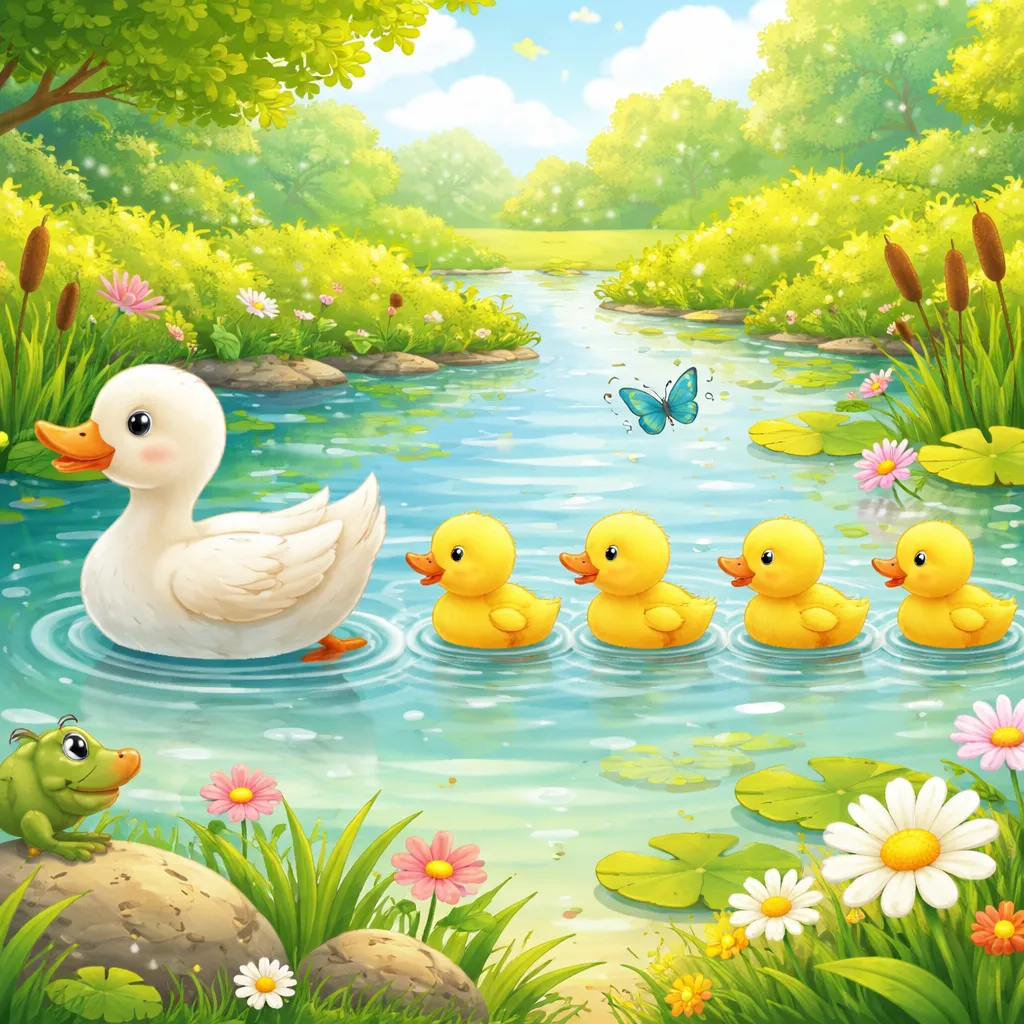

What is the Rhyme "Five Little Ducks"? "Five Little Ducks" is a gentle and beloved English nursery rhyme that tells a sweet story about a mother duck and her five little ducklings. The little ducks go over the hills and far away. One by one, they do not come back. The mother duck calls out to them with a loving "quack, quack, quack." Finally, all five little ducks return home. This simple story captures young hearts with its repetition and happy ending. The English song: Five Little Ducks teaches counting backward in a natural, playful way. Children learn numbers without any pressure. They feel the sadness as each duck goes away and the joy when they all come home. The song builds emotional understanding along with early math skills.
The Complete Lyrics of the Nursery Rhyme Let us look at the words together. The verses follow a clear pattern that makes counting easy and fun.
Five little ducks went out to play, Over the hills and far away. Mother duck said, "Quack, quack, quack, quack!" But only four little ducks came back.
Four little ducks went out to play, Over the hills and far away. Mother duck said, "Quack, quack, quack, quack!" But only three little ducks came back.
Three little ducks went out to play, Over the hills and far away. Mother duck said, "Quack, quack, quack, quack!" But only two little ducks came back.
Two little ducks went out to play, Over the hills and far away. Mother duck said, "Quack, quack, quack, quack!" But only one little duck came back.
One little duck went out to play, Over the hills and far away. Mother duck said, "Quack, quack, quack, quack!" But no little ducks came back.
Sad mother duck went out one day, Over the hills and far away. Mother duck said, "Quack, quack, quack, quack!" And all five little ducks came back!
Vocabulary Learning from the Song This English song: Five Little Ducks introduces children to important words about family, numbers, and nature. Each word builds their understanding of the world.
First, we meet the duck family. "Mother duck" is the mama. "Little ducks" are her babies. This teaches family relationships in a gentle way. You can talk about how mother animals take care of their babies, just like people do.
The song teaches number words from five down to one. "Five little ducks" then "four little ducks" then "three," "two," and "one." Counting backward is harder than counting forward. This song makes it feel natural and fun.
Preposition words appear in the song. "Over the hills" shows movement across and beyond. "Far away" means a long distance. "Back" means returning to where you started. These words help children describe location and movement.
The sound word "quack" teaches animal sounds. Ducks say "quack." This is part of a child's early understanding of the world. You can ask what other animals say. Cows say moo. Sheep say baa. Pigs say oink.
Phonics Points to Practice Let us listen for special sounds in the song. Phonics helps children connect letters to the sounds they hear. This English song: Five Little Ducks gives us many sounds to explore.
Listen to the "d" sound at the beginning of "ducks" and "day." It is a soft sound made with the tongue behind the teeth. Say "five little ducks" slowly. Feel how your tongue moves for the "d." Practice other "d" words like "dog," "door," and "daddy."
The "qu" sound in "quack" is special. It sounds like "kw" together. Put your lips together and say "quack." Practice other "qu" words like "quick," "quiet," and "queen."
Listen to the short "i" sound in "little" and "hills." This is a very common sound in English. You can hear it in words like "sit," "pig," and "fish." Pointing out these sound patterns builds strong phonemic awareness.
The "ck" sound at the end of "duck" and "quack" and "back" appears many times. It is a sharp, quick sound. Practice other "ck" words like "truck," "stick," and "block."
Grammar Patterns We Can Learn This counting song teaches important grammar in a very natural way. The English song: Five Little Ducks introduces past tense verbs, prepositions, and the concept of subtraction.
All the actions in the song happened already. The ducks "went out." Mother duck "said." The ducks "came back." These are past tense verbs. You can talk about your own day using past tense. "We went to the park." "Grandma said hello." "Daddy came home." This helps children understand how we talk about things that already happened.
The song teaches prepositions of place. "Over the hills" and "far away" and "back" show location and direction. You can practice using prepositions in daily life. "The toy is under the table." "Let's go to the store." "Come back home."
The counting pattern teaches subtraction naturally. Five ducks go away. One does not come back. That leaves four. This is beginning math thinking. Children understand the concept of "one less" without any formal teaching.
Learning Activities to Do at Home Bringing this English song: Five Little Ducks into your daily life is simple and joyful. Here are some activities you can try with materials you already have.
A wonderful activity is the "Duck Counting" game. Find five small toys that can be ducks. Yellow bath ducks are perfect. But any small toys will work. Line them up as you sing. As each duck does not come back, hide one behind your back. When all five are gone, show your empty hands with a sad face. Then at the end, bring them all back with a happy smile. This makes the numbers real and visible.
Another activity is the "Over the Hills" adventure. Use a cushion or pillow as a hill. Let your child make five little ducks (their fingers or small toys) go over the hill. As you sing each verse, one duck stays behind the hill. At the end, all come back. This builds understanding of the story sequence.
You can also go on a "Duck Hunt" outside. Visit a pond or park where ducks live. Count how many ducks you see. Sing the song together while watching real ducks. This connects the song to the living world.
Printable Materials for Learning Creating simple printables can make this English song: Five Little Ducks more visual and engaging. You can make these materials together with your child.
Finger puppets are perfect for this song. Draw and cut out five little duck shapes and one mother duck shape. Attach small paper strips to fit around fingers. As you sing each verse, put one little duck puppet away. At the end, bring them all back. This builds fine motor skills and makes counting tangible.
A counting chart is another useful tool. Draw a simple picture of five ducks on a pond. Next to it, draw four ducks, then three, then two, then one, then none. Then draw all five ducks with mother duck. Your child can point to each picture as you sing the corresponding verse. This builds sequencing skills.
You can also create coloring pages. Draw mother duck and five little ducks. Let your child color them while you sing. Count the ducks together as you color. "How many ducks have we colored? Five! Now let's count them again."
Educational Games for Deeper Learning Games make learning active and exciting. They encourage children to use the language from the English song: Five Little Ducks in new and creative ways.
The "Duck Counting" game with fingers is always fun. Hold up five fingers as you start the song. As each duck does not come back, put one finger down. When you get to no ducks, show a fist with all fingers down. At the happy ending, pop all five fingers back up. This builds fine motor skills and number awareness.
The "Where Did the Ducks Go?" game encourages imagination. After singing, ask your child, "Where do you think the little ducks went?" Over the hills to play? To see a friend? To find food? This extends the song into creative storytelling. It shows children that songs can inspire their own ideas.
The "New Animal" game creates new versions. Ask your child, "What if it was five little kittens?" Sing together, "Five little kittens went out to play." What sound does mother cat make? "Meow, meow, meow!" Try five little puppies, five little bunnies, or five little bears. This shows children how language patterns can be flexible and fun. Each new version builds vocabulary and confidence.
The "Duck Family" game connects to real life. Talk about how the mother duck called her babies and they came back. Ask your child, "If I call you, will you come back?" Play a game of hide and seek where you call and your child comes running. This builds trust and connection while reinforcing the loving message of the song.