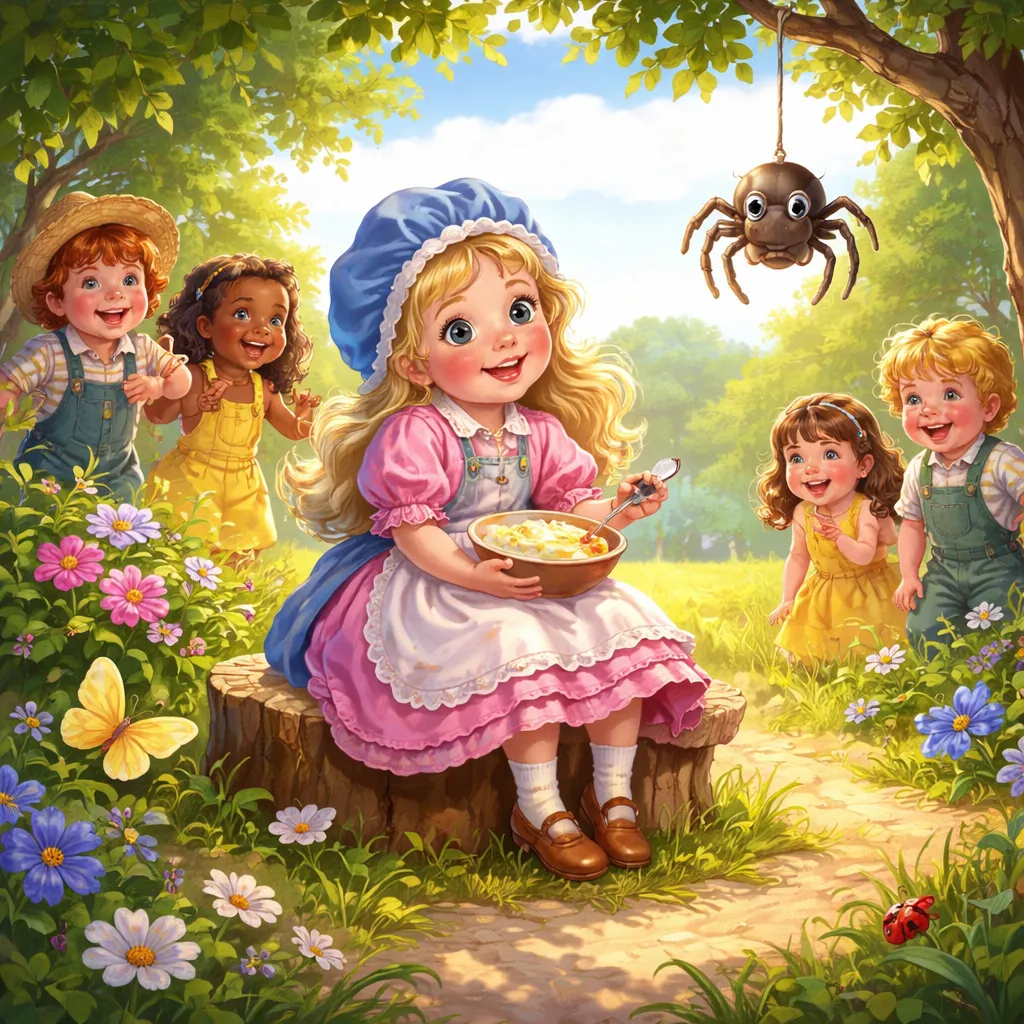

What is the Rhyme "Little Miss Muffet"? "Little Miss Muffet" is a classic English nursery rhyme that tells a short story about a little girl and a spider. Miss Muffet sits on a tuffet, eating her curds and whey. Along comes a spider who sits down beside her. Miss Muffet gets frightened and runs away. The English song: Little Miss Muffet has been known to children for hundreds of years. The simple story has a clear problem and reaction. A peaceful meal is interrupted by a surprise visitor. The little girl feels scared and leaves. Children understand this feeling completely. Many have felt startled by an unexpected bug or creature. The rhyme gives words to that experience and shows a common reaction. Running away is what Miss Muffet chooses to do.
The Complete Lyrics of the Nursery Rhyme Let us look at the words together. The rhyme is short and easy to remember.
Little Miss Muffet Sat on a tuffet, Eating her curds and whey. Along came a spider, Who sat down beside her, And frightened Miss Muffet away.
Vocabulary Learning from the Song This English song: Little Miss Muffet introduces children to interesting old words and common feelings. Each word builds their understanding of language and stories.
First, we meet "Little Miss Muffet." "Miss" is a title for a girl or woman. "Muffet" is a made-up name that sounds fun to say. Children learn that characters in stories can have special names.
"A tuffet" is an old word for a small seat or mound of grass. Most children do not know this word, which makes it interesting to learn. You can explain that a tuffet is like a little cushion or a grassy hill to sit on.
"Curds and whey" is an old-fashioned food. Curds are the solid parts of milk that has soured. Whey is the liquid left behind. You can explain that this is something like cottage cheese or yogurt. Children today might eat similar foods with different names.
The song teaches feeling words. "Frightened" means scared or afraid. This is an important emotion word. You can talk about times when your child feels frightened. A loud noise. A dark room. A surprising bug. This builds emotional vocabulary.
Phonics Points to Practice Let us listen for special sounds in the song. Phonics helps children connect letters to the sounds they hear. This English song: Little Miss Muffet gives us many sounds to explore.
Listen to the "m" sound at the beginning of "Miss" and "Muffet." It is a humming sound made with lips together. Say "Little Miss Muffet" slowly. Feel how your lips press together for each "m." Practice other "m" words like "mommy," "milk," and "moon."
The "s" sound appears in "Miss" and "sat" and "spider." It is a soft sound made by pushing air through the teeth. Practice other "s" words like "sun," "sand," and "sing."
Listen to the "t" sound in "tuffet" and "sat." It is a quick sound made with the tongue behind the teeth. Practice other "t" words like "toy," "table," and "tickle."
The "sp" blend in "spider" is important. Say "spider" slowly. First you hear the "s," then quickly the "p." Practice other "sp" words like "spoon," "spin," and "spot."
The "fr" blend in "frightened" is another consonant blend. Say "frightened" slowly. First the "f," then the "r." Practice other "fr" words like "frog," "from," and "fruit."
Grammar Patterns We Can Learn This short story song teaches important grammar in a very natural way. The English song: Little Miss Muffet introduces past tense verbs, prepositions, and cause and effect.
The song uses past tense throughout. Miss Muffet "sat" on a tuffet. She was "eating" her food. A spider "came" and "sat" down. The spider "frightened" her away. These are all past tense verbs. You can talk about your own day using past tense. "We sat on the grass." "A bug came near." "You felt frightened." This helps children understand how we talk about things that already happened.
The preposition "on" shows where Miss Muffet sat. "On a tuffet." "Beside her" shows where the spider sat. You can practice using these location words. "The toy is on the table." "Sit beside me."
The song shows cause and effect. The spider came. Miss Muffet got frightened. She ran away. This simple sequence teaches children how events connect. You can talk about cause and effect in daily life. "The sun came out, so we went outside." "You were hungry, so we ate lunch."
Learning Activities to Do at Home Bringing this English song: Little Miss Muffet into your daily life is simple and joyful. Here are some activities you can try with materials you already have.
A wonderful activity is the "Snack Time Story." Give your child a snack like yogurt or cottage cheese (similar to curds and whey). Sit together on a cushion or small stool (a tuffet). Pretend to be Miss Muffet eating peacefully. Then have a toy spider "surprise" you. React with surprise and run away playfully. This brings the story to life through taste and touch.
Another activity is the "Spider Discussion." Talk about spiders with your child. Are all spiders scary? What do spiders do? Many spiders are helpful and eat bugs. You can look at pictures of spiders and learn their names. This builds knowledge about nature and reduces fear through understanding.
You can also have a "Feelings Faces" activity. Draw different faces showing emotions. Happy, sad, surprised, frightened. Talk about times when you feel each emotion. When Miss Muffet saw the spider, she felt frightened. When does your child feel frightened? This builds emotional intelligence.
Printable Materials for Learning Creating simple printables can make this English song: Little Miss Muffet more visual and engaging. You can make these materials together with your child.
Story sequencing cards are perfect for this rhyme. Draw simple pictures on separate cards. Miss Muffet sitting on a tuffet eating. A spider coming near. The spider sitting beside her. Miss Muffet running away scared. Your child can arrange the cards in order and retell the story. This builds sequencing and narrative skills.
A Miss Muffet coloring page is always popular. Draw a little girl sitting on a cushion, holding a bowl. Add a spider nearby. Let your child color the scene. Write "Little Miss Muffet" at the top. Display their artwork proudly.
You can also create simple word cards. Write words from the rhyme on cards. "Miss," "Muffet," "tuffet," "curds," "whey," "spider," "frightened," "away." Show each card as you sing that word. This builds early reading skills in a gentle, supportive way.
A feelings chart helps with emotional vocabulary. Draw simple faces showing different feelings. Label them happy, sad, angry, surprised, frightened. Point to frightened and talk about Miss Muffet. This builds emotional awareness.
Educational Games for Deeper Learning Games make learning active and exciting. They encourage children to use the language from the English song: Little Miss Muffet in new and creative ways.
The "New Character" game encourages creativity. Ask your child, "What if a different creature came to visit Miss Muffet?" A butterfly? A ladybug? A mouse? Create new verses. "Along came a butterfly, who sat down beside her, and surprised Miss Muffet away." Try different creatures and different reactions. This shows children how to adapt the story pattern.
The "Brave Miss Muffet" game explores different endings. Ask your child, "What if Miss Muffet was not frightened? What would she do?" Maybe she would say hello to the spider. Maybe she would share her curds and whey. Create a new brave version together. This builds problem-solving and shows that stories can change.
The "Spider Feelings" game builds empathy. Ask your child, "How do you think the spider felt?" Maybe the spider was just looking for a friend. Maybe the spider felt sad when Miss Muffet ran away. This helps children see situations from different points of view.
The "Find the Tuffet" game uses location words. Hide a small cushion or pillow (the tuffet) somewhere in the room. Give your child hints using location words. "Look under the table." "Look beside the chair." "Look on the bed." This builds understanding of prepositions.
The "Snack Tasting" game connects to curds and whey. Offer your child different snack foods. Yogurt, cottage cheese, applesauce. Talk about which one might be like curds and whey. This builds descriptive language and connects the song to real foods.
The "Run Away" game adds movement. Pretend to be Miss Muffet eating peacefully. When you say "spider," everyone jumps up and runs to a safe spot. This builds listening skills and gross motor movement.
The "Spider Web" craft extends learning. Use paper plates and yarn to make spider webs. Add a small paper spider. Hang them around the room. This builds fine motor skills and connects to the spider in the story.
The "Brave Conversation" helps with fears. After talking about Miss Muffet's fear, ask your child about things that frighten them. Listen without judgment. Talk about ways to feel braver. Holding a grown-up's hand. Learning about the thing. Taking deep breaths. This builds emotional intelligence and coping skills.