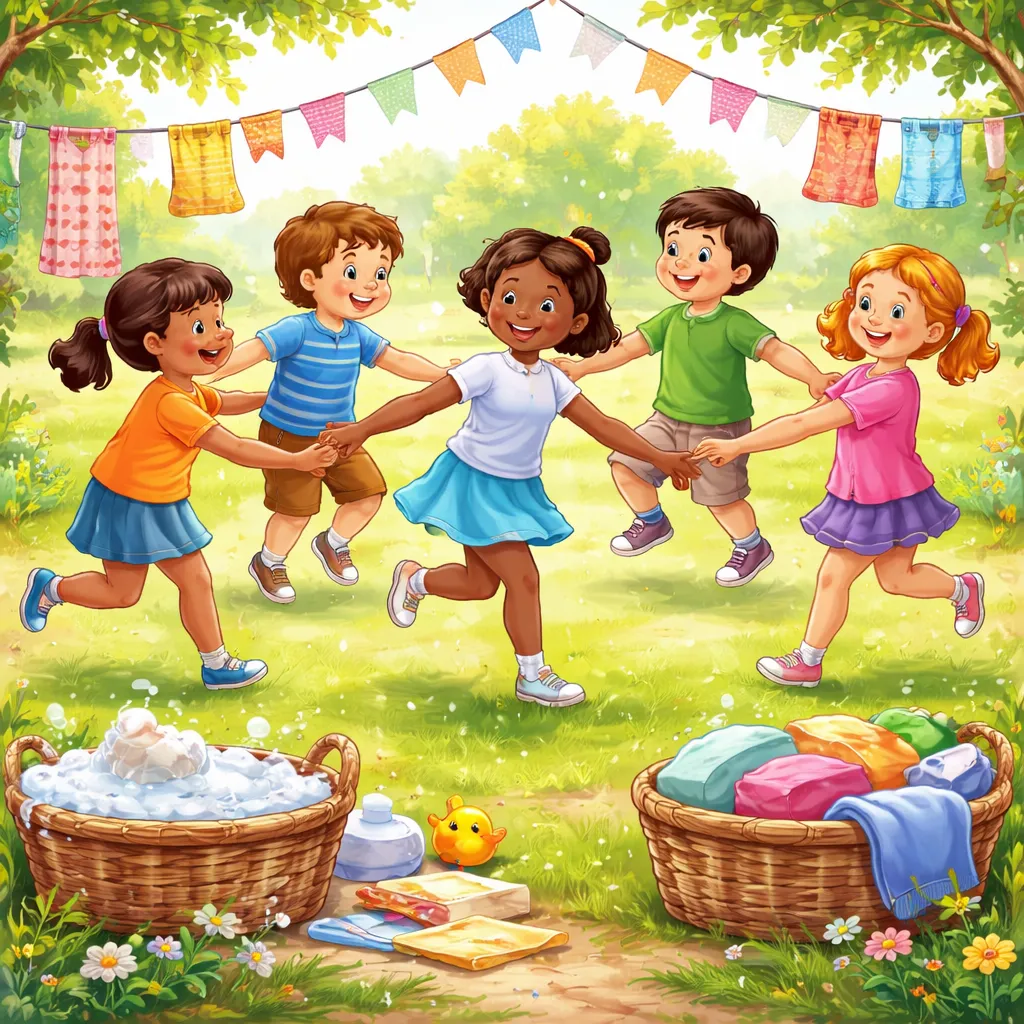

What is the Song "Looby Loo"? "Looby Loo" is a cheerful English nursery rhyme and circle game that children have enjoyed for generations. The song invites children to take different body parts and wash them in an imaginary wash tub. The English song: Looby Loo has a gentle, bouncy melody that makes everyone want to join in. Children stand in a circle and do the actions together. The song teaches body parts and bathing routines in a playful way. After washing each part, everyone dances around in a circle. The repetition makes it easy to learn. The silly name "Looby Loo" makes children smile. This song turns bath time preparation into a fun group activity that children love to repeat.
The Complete Lyrics of the Nursery Rhyme Let us look at the words together. The song has verses for different body parts.
Here we go Looby Loo, Here we go Looby Light, Here we go Looby Loo, All on a Saturday night.
You put your right hand in, You put your right hand out, You give your hand a shake, shake, shake, And turn yourself about.
Chorus: Here we go Looby Loo, Here we go Looby Light, Here we go Looby Loo, All on a Saturday night.
You put your left hand in... You put your right foot in... You put your left foot in... You put your head in... You put your whole self in...
Vocabulary Learning from the Song This English song: Looby Loo introduces children to body parts, action words, and the concept of washing. Each word builds their understanding of language and daily routines.
First, the song teaches body parts. "Right hand" and "left hand" teach hand identification and left/right discrimination. "Right foot" and "left foot" teach the same for feet. "Head" is also introduced. "Whole self" means your entire body.
The song has fun nonsense words. "Looby Loo" and "Looby Light" are playful sounds that make the song bouncy and fun. Children love saying these silly words.
The phrase "all on a Saturday night" sets the scene. Saturday night might be bath night in some families. This connects the song to a real weekly routine.
The song teaches action words. "Put in" means to place inside the imaginary tub. "Put out" means to take out. "Shake" means to move quickly. "Turn about" means to spin around.
Phonics Points to Practice Let us listen for special sounds in the song. Phonics helps children connect letters to the sounds they hear. This English song: Looby Loo gives us many sounds to explore.
Listen to the "l" sound at the beginning of "Looby" and "Light." It is a light sound made with the tongue touching the roof of the mouth. Say "Looby Loo" slowly. Feel your tongue move. Practice other "l" words like "lamb," "leaf," and "lullaby."
The "h" sound appears in "here" and "hand." It is a gentle breath sound. Put your hand in front of your mouth and say "here." Feel the air. Practice other "h" words like "happy," "house," and "hello."
Listen to the "r" sound in "right" and "round." It is a rolling sound made with the tongue. Practice other "r" words like "rabbit," "red," and "run."
The "sh" sound in "shake" is important. Put your finger to your lips and say "shhh." Practice other "sh" words like "shoe," "ship," and "fish."
The long "i" sound in "right" and "night" says its own name. You can hear it in words like "kite," "bike," and "sky."
Grammar Patterns We Can Learn This washing song teaches important grammar in a very natural way. The English song: Looby Loo introduces imperatives, prepositions, and the phrase "here we go."
The song uses imperatives throughout. "Put your right hand in." "Give your hand a shake." "Turn yourself about." These are commands telling you what to do. Children hear imperatives every day. "Wash your hands." "Brush your teeth." "Come to dinner." The song adds playful imperatives to the mix.
The song uses prepositions of location. "In" and "out" show where to put your body parts. You can practice using these prepositions. "The soap is in the dish." "Take your hands out of the water."
The phrase "here we go" is used to start the song and each chorus. It means we are beginning. You can use this phrase in daily life. "Here we go, time for bath!" "Here we go, let's read a story."
Learning Activities to Do at Home Bringing this English song: Looby Loo into your daily life is simple and joyful. Here are some activities you can try with materials you already have.
A wonderful activity is the "Bath Time" connection. Sing the song during actual bath time. Pretend the bathtub is the "Looby Loo" tub. Wash each body part as you sing. Right hand, left hand, right foot, left foot, head. At the end, your whole self is in the tub! This turns bath time into a fun sing-along.
Another activity is the "Circle Dance" game. Stand in a circle with family members or stuffed animals. Walk around the circle during the chorus. Stop and do the actions for each verse. This builds social skills and coordination.
You can also have a "Saturday Night" celebration. If Saturday is a special night in your family, sing this song to mark the occasion. Talk about what makes Saturday special. This builds family traditions and anticipation.
Printable Materials for Learning Creating simple printables can make this English song: Looby Loo more visual and engaging. You can make these materials together with your child.
Body part cards are perfect for this song. Draw simple pictures of each body part on separate cards. Right hand, left hand, right foot, left foot, head. Hold up each card as you sing that verse. This builds vocabulary and following directions.
A coloring page is always popular. Draw children in a circle dancing, with an imaginary wash tub in the middle. Add bubbles and soap. Let your child color the scene. Write "Looby Loo" at the top. Display their artwork proudly.
You can also create simple word cards. Write words from the song on cards. "Looby," "Loo," "Light," "Saturday," "night," "right," "left," "hand," "foot," "head," "whole," "self," "shake," "turn." Show each card as you sing that word. This builds early reading skills.
A bubble counting page helps with numbers. Draw bubbles in the wash tub. Count them together. How many bubbles? This builds number sense.
Educational Games for Deeper Learning Games make learning active and exciting. They encourage children to use the language from the English song: Looby Loo in new and creative ways.
The "New Body Parts" game encourages creativity. Ask your child, "What other body parts could we wash?" Elbow? Knee? Nose? Create new verses. "You put your elbow in, you put your elbow out, you give your elbow a shake, shake, shake, and turn yourself about." This shows children how to extend the pattern.
The "Washing Routine" conversation builds life skills. Why do we wash our bodies? To get clean. To stay healthy. When do we wash? Every day, especially before bed. This builds understanding of hygiene.
The "Left and Right Practice" is valuable. Many children confuse left and right. Put a small sticker on your child's right hand. Practice putting the right hand in during the song. Then switch to the left. This builds left/right discrimination.
The "Saturday Night" discussion explores days of the week. What day is it today? What do we do on different days? Make a weekly calendar with special activities for each day. This builds time concepts.
The "Imaginary Tub" pretend play is creative fun. Pretend there is a big wash tub in the middle of the room. Mime washing your body parts. Splash pretend water. This builds imagination.
The "Shake It Out" game adds movement. After washing each part, shake it vigorously. Shake hands, shake feet, shake your head. This builds gross motor skills and body awareness.
The "Turn About" practice helps with balance. Practice turning around slowly, then faster. Make sure you don't get dizzy! This builds balance and coordination.
The "All on a Saturday Night" family tradition can be real. Make Saturday nights special with a bath, then singing this song, then a story. This builds loving family routines.