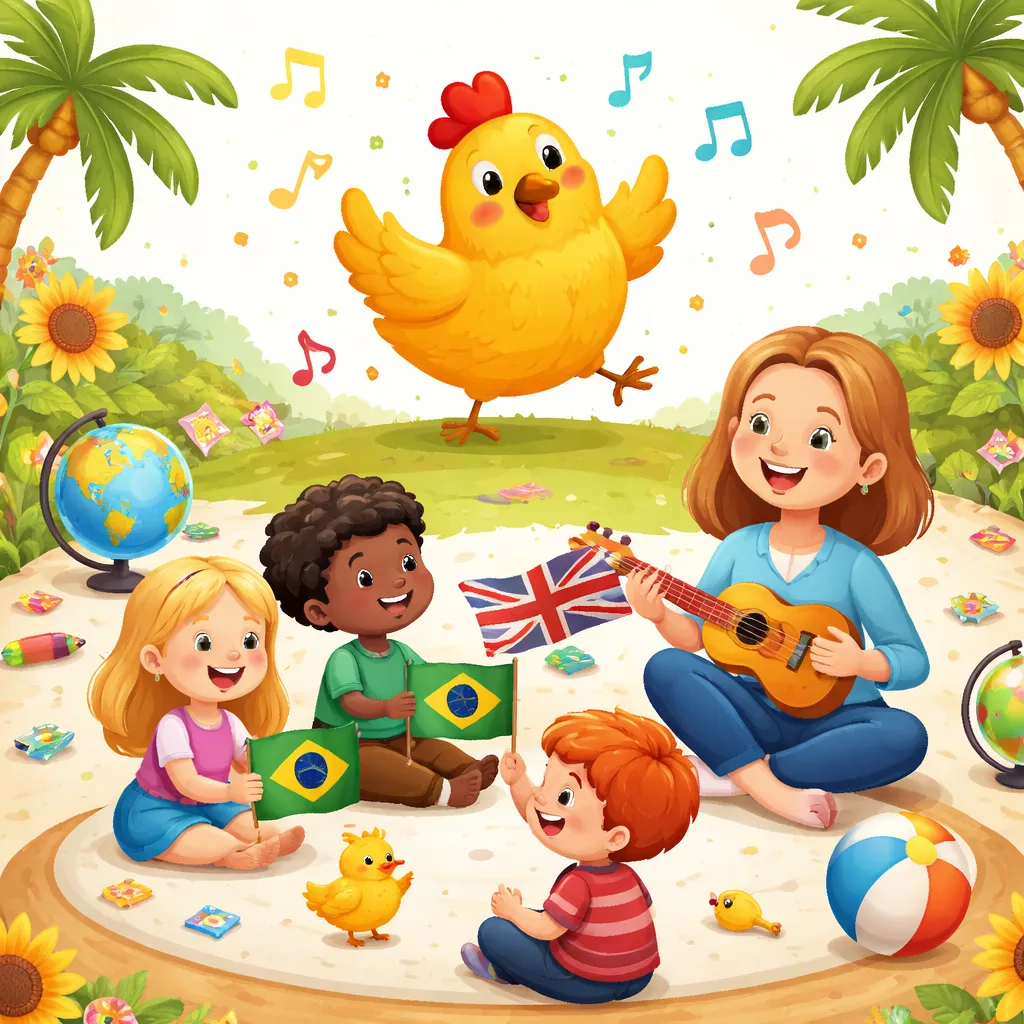

Children learn best when they feel joy. A simple song can create that joy while introducing new words and sounds. Today, we explore a traditional Portuguese rhyme called “A Galinha,” which means “The Little Chicken.” This gentle song tells a story of a mother hen caring for her chicks. We will use this melody as a bridge to English. Together, we will learn vocabulary, practice important sounds, and discover how a song can make language learning feel natural and warm. The goal is not to teach a lesson but to share a moment of connection through music and words.
What is the rhyme? “A Galinha” is a cherished nursery rhyme in Portuguese-speaking families. It describes a little chicken walking with her chicks. The song has a gentle, rocking rhythm. It often includes hand movements. Children open and close their hands to show the chicks pecking. They flap their arms like wings. The song creates a calm, nurturing atmosphere. It speaks to a child’s natural curiosity about animals and families. When we bring this song to English learning, we keep its gentle spirit. We use the familiar melody to introduce English words in a way that feels like storytelling, not instruction.
The lyrics of nursery rhymes To understand the heart of this song, we first look at the original Portuguese words. Then we see how they translate into English. This shows children that the same kind story can be told in different languages. You do not need to know Portuguese to enjoy the soft rhythm of the words.
Original Version (Portuguese)
A galinha, a galinha Vai andar, vai andar Com seus pintinhos, com seus pintinhos Vai cuidar, vai cuidar
English Version
The little chicken, the little chicken Will walk, will walk With her little chicks, with her little chicks Will care for them, will care for them
A second verse often continues the story, showing the chicks learning and growing.
Original Version (Portuguese)
Os pintinhos, os pintinhos Vão comer, vão comer Milho e grão, milho e grão Vão crescer, vão crescer
English Version
The little chicks, the little chicks Will eat, will eat Corn and grain, corn and grain Will grow, will grow
As you read these words, notice the soft repetition. Each line repeats, giving children time to absorb the sound and meaning. The story is gentle and loving. A mother chicken walks with her chicks. She cares for them. The chicks eat and grow. This simple narrative is easy for a child to understand and remember.
Vocabulary learning This song offers a rich set of words that connect to family, nature, and daily life. We can explore these words through conversation, pictures, and simple actions.
Start with the main character: the chicken. In Portuguese, it is galinha. In English, we say “little chicken.” The word “little” adds tenderness. You can look at pictures of chickens together. Talk about the sounds they make. Cluck like a chicken. Let your child try.
Here are the key words to focus on from the song:
Chicken: The mother bird. Show pictures of a hen with her chicks. Explain that the chicken takes care of her babies.
Walk: Moving step by step. Walk slowly together around the room. Pretend you are the chicken.
Chicks: Baby chickens. This word is short and easy to say. Show pictures of fluffy yellow chicks.
Care for: To look after someone. This is an important concept. Talk about how you care for your child. Ask how the chicken cares for her chicks.
Eat: What the chicks do. Connect this to mealtime. Say “the chicks eat corn. You eat your food too.”
Corn and grain: The food the chicks eat. If you have corn at home, show it to your child. Talk about how chickens love corn.
Grow: How the chicks get bigger. Show how small chicks become big chickens.
Use these words in natural moments. When you see a bird outside, say “that bird is walking like the little chicken.” When you care for your child, say “I care for you, just like the chicken cares for her chicks.” These connections make the vocabulary meaningful.
Phonics points Phonics helps children understand the sounds that build English words. This song gives us several clear sounds to explore in a relaxed, gentle way.
First, focus on the ‘ch’ sound at the beginning of “chicken” and “chicks.” This is a soft, airy sound. Put your finger to your lips and say “ch ch ch.” Practice with “cheese,” “chair,” and “chicken.” This sound appears in many words children enjoy.
Next, notice the short ‘i’ sound in “chicks.” This is a quick vowel sound. Say “ick” like in “sick.” Then say “chicks” slowly. Compare it to the long ‘e’ sound in “eat.” This helps children hear the difference between vowel sounds.
The word “grow” contains the ‘gr’ blend. This is two consonants together. Say “g” and then quickly add “r.” Then add “ow.” Practice with “green,” “grass,” and “grow.” This blend builds confidence with consonant combinations.
Finally, look at the ‘c’ sound in “care” and “corn.” This is a hard ‘c’ sound, like in “cat.” Say “c c c” with the back of your tongue. Practice with “car,” “cup,” and “corn.” The song also has “walk,” which ends with the ‘lk’ blend. This is a silent ‘l’ sound. Say “talk” and “walk” together. Notice how the ‘l’ is quiet.
Grammar patterns Even a simple song contains grammar that we can introduce gently. We do not need to use technical terms. Instead, we show how words work together through examples and play.
The song uses the future tense with the word “will.” “Will walk” means the chicken plans to walk. You can explain this simply. “Will” is a helper word that tells us something is going to happen. Practice by talking about your day. “We will read a story.” “We will have a snack.” This gives children a tool to talk about future events.
Notice the repetition of phrases. “The little chicken, the little chicken” repeats the noun. This repetition adds rhythm and makes the phrase easy to remember. Children can use this pattern themselves. They might say “my mommy, my mommy” to show affection.
Also, look at the preposition “with” in “with her little chicks.” “With” shows togetherness. You can practice by holding a toy and saying “I am with the toy.” Then hold your child’s hand and say “I am with you.” This teaches relationship words in a concrete way.
The possessive pronoun “her” appears in “her little chicks.” This shows ownership. You can practice by pointing to your child’s toy and saying “your toy.” Then point to your own and say “my toy.” This introduces the concept of possession simply.
Learning activities Activities bring the song into the body and the imagination. They transform listening into active participation. These ideas are simple and require little preparation.
The Chicken Walk Play the song and pretend to be the mother chicken. Walk slowly around the room. When the song says “with her little chicks,” gather your child behind you. When it says “will care for them,” pretend to tidy the nest or give food. When the chicks’ verse comes, switch roles. Let your child be the chicken caring for you. This activity builds listening skills and connection.
Nest Building Create a simple nest using pillows or blankets. Gather small toy chicks or yellow pom-poms. Pretend to be the chicken. Walk to the nest. Care for the chicks. Feed them pretend corn. Talk about what you are doing. “I am walking to the nest.” “I care for the chicks.” This connects the song to imaginative play.
Growth Discussion Talk about how the chicks grow. After singing the song, look at pictures of baby animals and their parents. Show a baby chick and a hen. Talk about how you grow too. Show photos of your child as a baby and now. This connects the song to a real-life concept.
Printable materials Printable resources offer a quiet way to reinforce the song’s vocabulary. They are perfect for moments when children want to create or focus calmly.
Flashcards Create a set of flashcards. One card shows the chicken. One shows the action “walk.” One shows a baby chick. One shows a heart to represent “care for.” One shows corn. One shows a child growing taller. Use these cards for a matching game. Sing a line from the song and ask your child to find the matching card. This builds word recognition.
Coloring Page Draw a simple scene from the song. Show the mother chicken walking with two little chicks. Draw some corn on the ground. Add a sun in the sky. Children can color while listening to the song. As they color, talk about the scene. “What is the chicken doing?” “What are the chicks eating?” This keeps the language flowing naturally.
Song Mini-Book Print the lyrics on several small pages. Leave space for drawings. On the page for “will walk,” your child can draw the chicken walking. On the page for “will care for them,” they can draw the chicken with her chicks. Fold the pages together to make a book. Read and sing the book together. This gives children ownership of the song.
Educational games Games encourage repetition without boredom. They invite children to use the language in new and creative ways.
Chicken Says Play a game similar to “Simon Says.” Give commands using the song’s vocabulary. “The chicken says walk slowly.” “The chicken says care for your chicks.” “The chicken says eat the corn.” If you give a command without saying “the chicken says,” the child does not move. This game builds listening skills.
Hide the Chicks Hide small toy chicks around the room. Sing the song together while searching. When a chick is found, say “I found a chick!” Count how many chicks you find. This builds anticipation and makes the vocabulary part of an active experience.
Family Match Create cards with animal families. One card shows a chicken and chicks. Another shows a dog and puppies. Another shows a cat and kittens. Match the parent to the baby. Say the names together. “Chicken and chicks.” “Dog and puppies.” This extends the vocabulary beyond the song.
As you share “A Galinha” with your child, remember that you are doing more than teaching English. You are creating a shared experience of warmth and care. The little chicken walks with her chicks. She feeds them. She watches them grow. Your child can learn language in that same gentle rhythm. Let the song be a soft companion. Sing it during quiet moments. Hum it on a walk. Let the caring spirit of the little chicken remind you both that language learning grows best in a place of love and patience.