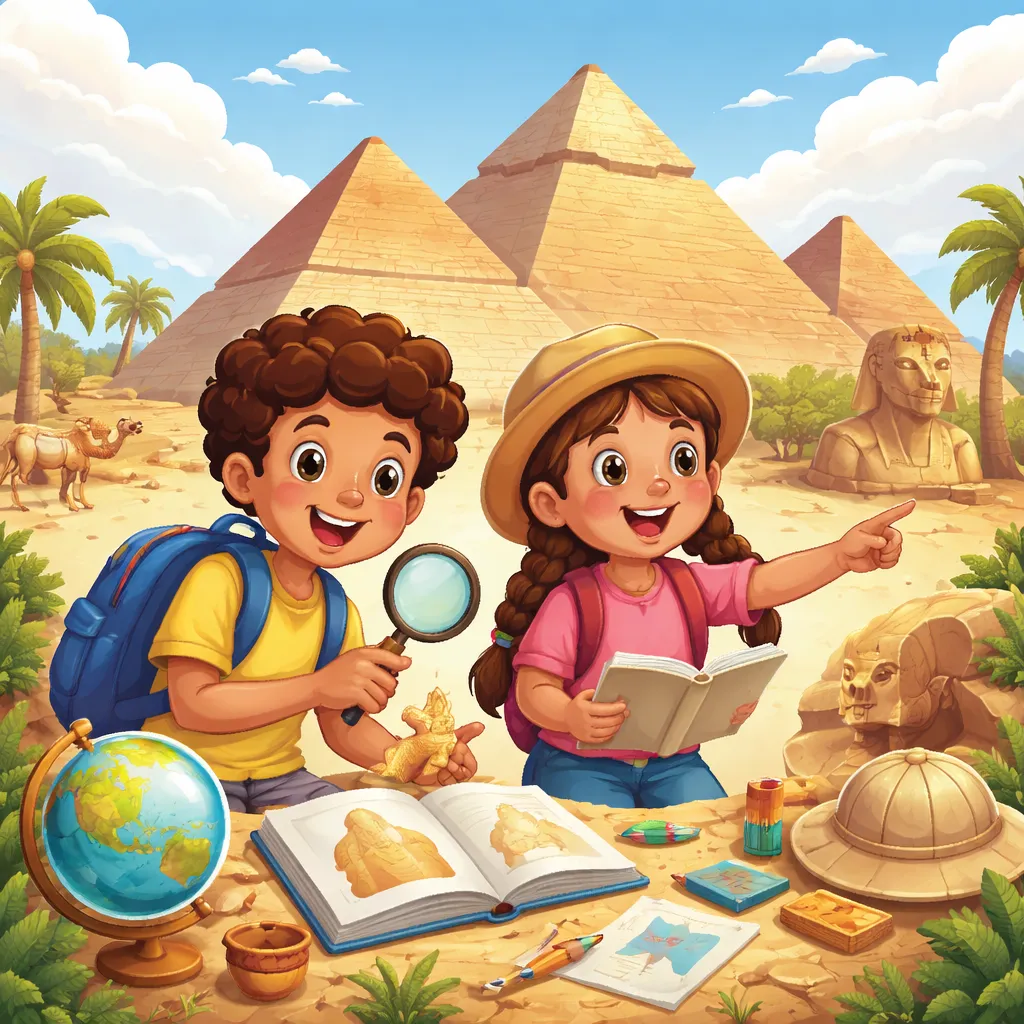

Why Should Kids Learn About The Pyramids of Egypt for English Practice?
Learning English opens doors to many worlds. One of those worlds is history. The Pyramids of Egypt are a great topic. They combine wonder with useful English words. Kids feel excited by big, ancient stones. Parents enjoy teaching real content. This article helps you guide your child. We will explore the pyramids together. You will learn new words. You will find games and flashcards. Let us start this journey.
What is The Pyramids of Egypt?
The Pyramids of Egypt are ancient stone buildings. People built them as tombs for pharaohs. Pharaohs were kings in ancient Egypt. These pyramids sit near Cairo today. The most famous ones are at Giza. The Great Pyramid is the largest. It stood as the tallest human-made structure for thousands of years. Kids often see pictures of these triangles in the sand. But pyramids hold more than old stones. They hold stories. They show how people worked together long ago. When we learn about pyramids, we learn new nouns. We learn verbs like “build,” “protect,” and “discover.” This topic makes English feel alive.
Meaning and Explanation
The word “pyramid” means a shape. It has a square base. It has four triangle sides. Those sides meet at a point on top. In Egypt, pyramids meant power. They meant life after death. Egyptians believed pharaohs became gods. The pyramid helped the pharaoh rise to the sky. So the meaning goes beyond stone. It connects to belief and science. For English learners, “pyramid” is a useful noun. You can see pyramid shapes in many places. A party hat is a pyramid. A roof can be a pyramid. Even some tents look like pyramids. Teach your child to spot the shape. Then say the word out loud. Repeat it three times. This builds memory.
Categories or Lists of Pyramids
Not all pyramids are the same. We can put them into categories.
First, there are step pyramids. The Step Pyramid of Djoser is the oldest. It looks like giant stairs. Second, there are true pyramids. These have smooth sides. The Great Pyramid of Giza is a true pyramid. Third, there are small pyramids. People built these for queens. Fourth, there are bent pyramids. The Bent Pyramid changes angle halfway up. Builders learned from mistakes. Each category teaches new adjectives. Use “stepped,” “smooth,” “small,” and “bent.” Ask your child to draw each type. Label the drawing in English. This turns learning into art.
Daily Life Examples
You can talk about pyramids every day. Here are simple examples.
At breakfast, cut a sandwich into a triangle. Say, “This sandwich looks like a pyramid.” In the park, find a pile of sand. Shape it into a small pyramid. Say, “Let us build a pyramid.” At home, stack boxes. Make a step pyramid. Say, “Step pyramids rise level by level.” When reading a book, look for pyramid pictures. Ask, “What do you see?” When shopping, notice cheese wedges. Say, “A cheese wedge is a pyramid shape.” These small moments teach English naturally. You do not need a classroom. You just need curiosity.
Printable Flashcards
Flashcards help kids remember words. You can print them at home. Use thick paper for better handling. Here are eight words for your pyramid set.
Pyramid – a stone tomb with triangle sides. Pharaoh – an Egyptian king. Desert – a dry, sandy place. Stone – hard material from the ground. Tomb – a place for a dead body. Ancient – very, very old. Build – to make something. Discover – to find something new.
Make one card per word. On the front, write the word. On the back, put a simple drawing. Or paste a printed picture. For “pyramid,” draw a triangle with a square base. For “pharaoh,” draw a crown. Practice with your child every evening. Show the front. Ask, “What is this?” If they forget, show the picture. Say the word slowly. Let them repeat. This builds confidence.
Learning Activities or Games
Games make English stick. Try these five activities at home.
Activity one: Pyramid Spelling Say a word from the flashcard set. Your child spells it aloud. For each correct letter, they draw one stone. After ten correct words, they finish a small pyramid drawing. Celebrate with a high five.
Activity two: Build a Sentence Give your child three words. For example: pyramid, ancient, build. Ask them to make a sentence. A good sentence is: “People built ancient pyramids.” Keep sentences short. Praise every effort.
Activity three: Pyramid Hide and Seek Hide a small toy near a pyramid shape in your home. It could be near a lamp shade or a folded towel. Say, “Find the treasure near the pyramid.” Your child searches. When they find it, they say, “The pyramid is here.”
Activity four: Describe the Picture Find a photo of the Pyramids of Egypt online. Look at it together. Ask three questions. “What color is the pyramid?” “Are the stones big or small?” “What do you see next to the pyramid?” Answer in full sentences. For example: “The pyramid is yellow. The stones are big. I see sand next to the pyramid.”
Activity five: Pyramid Story Time Sit on the floor. Start a story. Say, “Once upon a time, a child visited the Pyramids of Egypt.” Then ask your child, “What did the child see?” Let them add one sentence. You add the next sentence. Keep going for five minutes. Write down the story. Read it aloud together. This builds speaking and listening.
Printable Materials for Home Learning
You do not need expensive books. Make your own materials. Print a large pyramid outline. Let your child write new words inside the triangle. Every time they learn a word, they add it to the pyramid. When the pyramid is full, they earn a small prize. A sticker or an extra story works well.
Print a simple map of Egypt. Mark the location of Giza. Write “The Pyramids of Egypt” next to the mark. Hang the map on the wall. Point to it during breakfast. Say, “That is where the great pyramids stand.”
Print a matching game. On one sheet, draw three pyramids. On another sheet, write “pharaoh,” “desert,” and “stone.” Your child draws a line from the word to the correct picture. This uses visual and written memory together.
Educational Games for Two Players
Play these games with your child. You both learn together.
Game: Pyramid Question and Answer You ask a question. Your child answers. Then switch. Sample questions: “Where are the Pyramids of Egypt?” Answer: “Near Cairo.” “Who built the pyramids?” Answer: “Ancient Egyptians.” “What shape is a pyramid?” Answer: “A square base and triangle sides.” Keep the mood light. Clap after each correct answer.
Game: Pyramid Scavenger Hunt Write five clues on small papers. Each clue describes a pyramid word. Example clue: “I am a dry, sandy place. Pyramids stand on me. What am I?” Answer: desert. Hide the clues around a room. Your child finds each clue and says the answer. After all five, they shout, “I found the Pyramids of Egypt!”
Game: Action Verbs Say a verb related to pyramids. Examples: build, climb, discover, protect. Your child acts it out. For “build,” they stack pretend stones. For “climb,” they move hands like climbing. Then they say a verb, and you act. This removes fear of mistakes. It adds laughter.
Learning Tips for Parents
You are your child’s best teacher. Keep sessions short. Ten minutes a day works well. Repeat words often. Use a gentle voice. Do not correct every small error. Instead, model the correct word. If your child says, “Pyramid is big stone,” you say, “Yes, the pyramid has many big stones.” Add one new word each day. Connect pyramids to your child’s interests. Do they like animals? Talk about cats in ancient Egypt. Do they like vehicles? Talk about how workers moved stones. Do they like drawing? Let them draw a pyramid sunset. Always end with a positive sentence. “You learned three new words today. Well done.”
Why This Topic Works for English Learning
The Pyramids of Egypt capture attention. Children remember pictures of giant stones. Parents enjoy sharing real history. The topic provides many nouns. It provides action verbs like “build” and “protect.” It provides adjectives like “ancient” and “smooth.” You can use the same topic for weeks. One day, learn shapes. Another day, learn colors of the desert. Another day, learn numbers by counting pyramid stones. The topic grows with your child. Start simple. Add details later. This keeps English fresh and exciting.
Bring Pyramids into Your Weekly Routine
Choose one evening as “Pyramid Night.” Light a candle. Turn off other lights. Sit on a blanket on the floor. Look at pyramid pictures by flashlight. Whisper new words. “Pharaoh. Tomb. Desert.” Then build a small pyramid from sugar cubes or blocks. Count each cube in English. After building, say, “We built a pyramid together.” Clean up together. Say, “Tomorrow we will learn another word.” This routine creates happy memories. Happy memories make language learning last. The Pyramids of Egypt are not just old stones. They are a bridge to English for your child. Cross that bridge one word at a time.