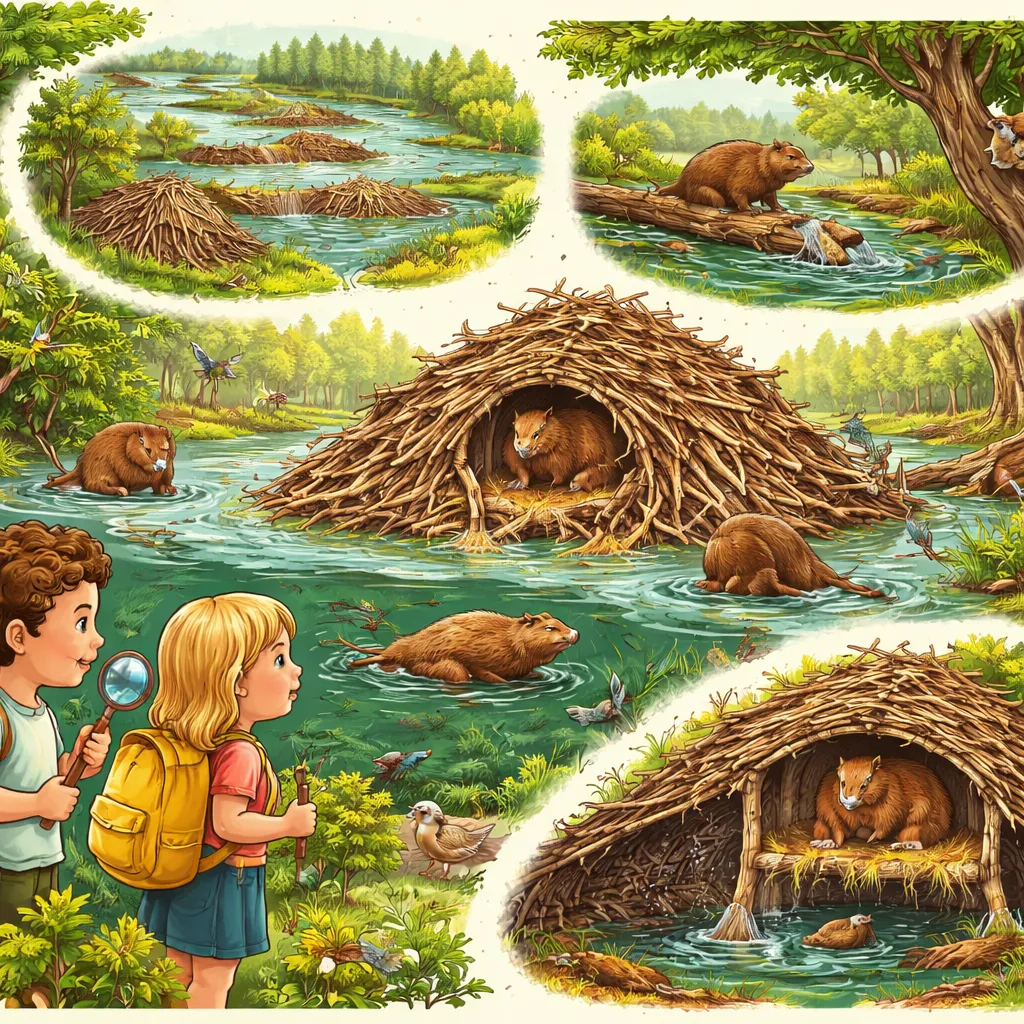

Have you ever seen a picture of a beaver in a pond, with a stick in its mouth? Or maybe you’ve seen a pile of logs and branches blocking a stream—that’s a beaver dam! Beavers are amazing builders and swimmers. Learning about beavers is an adventure that takes us to ponds and streams, where we see how they change the world around them. Let’s get ready to start learning about beaver power and skill!
English Language Learning
Vocabulary and Spelling Our talented builder is called a beaver. The word "beaver" is a noun. A noun names a person, place, or thing. So, a beaver is a thing—a busy, living animal. Spelling "beaver" is fun: B-E-A-V-E-R. The 'B' starts the word, the 'E' and 'A' are in the middle, and it ends with 'V-E-R'. B-E-A-V-E-R spells beaver.
Sound and Pronunciation Let’s say the word correctly. It sounds like this: /ˈbiː.vɚ/. We can say it in two clear parts. First, say "bee". It sounds just like the insect, a bee! Next, say "ver". It rhymes with "her". Now, put it together! "Bee" "ver". Beaver! Great! The word "beaver" has two beats, or two syllables. Clap your hands twice: Bea-ver. It’s a busy, working word.
Related Words Learning about beavers is more fun with new words! Here are some important ones. Home: The stick and mud house a beaver family lives in is called a lodge. The wall of sticks and mud they build in a stream is a dam. Baby: A baby beaver is called a kit. Action: Beavers are famous for gnawing on trees with their strong teeth.
A Famous Saying There is a common phrase: "As busy as a beaver." This means someone is working very hard and is very active. It comes from the beaver’s constant work building and repairing its dam and lodge. It reminds us that hard work and perseverance are great qualities. Say the saying with me: "As busy as a beaver." What is something you work hard on?
Now you know the word "beaver"! Are you ready to dive into some amazing facts? Let’s swim from words to wonderful knowledge!
Animal Knowledge
Who Are They? – Family and Group What kind of animal is a beaver? Beavers are mammals. They have fur, are warm-blooded, and mother beavers feed their babies milk. They are the second-largest rodent in the world, after the capybara. They are in their own family, Castoridae. There are two species: the North American beaver and the Eurasian beaver.
What Do They Look Like? – Amazing Bodies Beavers are about the size of a large dog. They have thick brown fur, a flat, paddle-shaped tail, and webbed back feet. Their most famous features are their large, orange front teeth and their flat tail. Their teeth are their super tools! Their front teeth, called incisors, never stop growing. They are orange because they have a special, extra-strong coating. They use them to gnaw through trees. Their tail helps them steer in the water, store fat, and slap the water as a warning. Beavers have special adaptations for water life. They have clear eyelids that act like goggles underwater. Their nose and ears close when they dive. Their fur is waterproof and keeps them warm in cold water.
Where Do They Live and How? – Home and Habits Beavers live in North America, Europe, and parts of Asia. Their homes are near ponds, lakes, rivers, and streams. They need water deep enough to swim and dive in. Beavers are herbivores. This means they only eat plants. They eat tree bark, leaves, twigs, and aquatic plants. In winter, they store sticks underwater near their lodge to eat. Beavers are very social and live in family groups called colonies. A colony is usually two parents, the year’s kits, and the previous year’s young. They are most active at night. They are famous for building dams to create deep, safe ponds.
A Beaver’s Life Story – Growing Up A baby beaver is called a kit. Beavers are mammals, so kits are born live from their mother. A mother beaver usually has two to four kits at a time. Both parents take care of the kits. The kits are born with fur and can swim within 24 hours! The parents and older siblings teach the kits how to find food, build, and stay safe. Kits stay in the lodge for the first month. They drink their mother’s milk but soon start eating plants. They stay with their family for about two years, helping with the younger kits and the dam, before leaving to start their own family.
How Do They "Talk"? – Communication Beavers talk with sounds and body language. They can whine, grunt, and hiss. Kits make a high-pitched cry to call their mother. Their most famous signal is a tail slap. When a beaver senses danger, it slaps its flat tail hard on the water. The loud "crack!" warns every beaver in the area to dive to safety. Their best senses are their excellent hearing and sense of smell. They have good ears to hear warnings. Their nose helps them find food and recognize their family members.
Are They Okay? – Taking Care of Them Beaver populations are now stable in many areas, but they were once hunted almost to extinction for their fur. Today, they are protected and are making a great comeback. The main threats in the past were hunting and trapping. Now, the biggest problem is sometimes conflict with people when beavers flood roads or farmland with their dams. You can be a beaver friend! You can learn about their important role in creating wetlands, which are homes for many other animals. You can support groups that find smart, kind ways to solve conflicts between beavers and people, like installing special pipes in dams to control water levels.
Life Connections and Inspiration
How to Be With Them – Safety and Love Beavers are wild animals. They are strong, have sharp teeth, and can be scared easily. We must always admire them from a safe and respectful distance. The rule is: Watch from far away. We can look for signs of beavers, like chewed trees or dams, from the shore. Never try to touch a beaver or get close to a lodge or dam. If you see a beaver, watch quietly. If it slaps its tail, it is scared, and you should move away. We show our love by protecting the clean waterways and forests they need. We can appreciate that their hard work creates homes for fish, frogs, birds, and many other creatures.
Super Qualities We Learn from Them Beavers teach us incredible lessons. One super quality is teamwork and perseverance. Beavers work together as a family to build and maintain their home. They don’t give up, even when the job is big. They teach us the power of working together and sticking with a task until it’s done. Another quality is creative problem-solving and engineering. Beavers are nature’s engineers. They solve the problem of shallow water by building dams. They remind us to look at problems, think creatively, and use the resources we have to build solutions. Think about it: How can you use teamwork to get a big job done at home or school? What is a problem you could solve by building or creating something?
Take Action! – Your "Beaver Dam" Project Let’s do a fun and creative activity! Your project is to build a model beaver dam. Find a shallow plastic tub or a baking dish. Use playdough or mud to make the sides of a "stream." Collect small sticks, twigs, and leaves. Now, try to build a dam across your stream to hold back water. You can use pebbles and more mud to plug the holes. Slowly pour water on one side. Does your dam hold? This shows how beavers use what they find in nature to solve a problem. Remember, real beavers are much stronger and more skilled!
Closing Learning about beaver wonders is a fantastic adventure! We learned the word "beaver" and how to say its two-part name. We discovered amazing facts about their ever-growing teeth, their flat tails, and their life as nature’s engineers. We know that beavers are hardworking, family-oriented animals who create entire ecosystems. You can use your new words to share the story of these incredible builders. You can use your knowledge to appreciate the importance of wetlands and wildlife. The animal world is full of creative and persistent teachers. Always remember to respect wildlife from a safe distance, work well with others, and use your creativity to solve problems. Keep exploring with curiosity, build your dreams with perseverance, and be a friend to the natural world. Your caring actions and hardworking spirit make you a true friend to the amazing beaver.