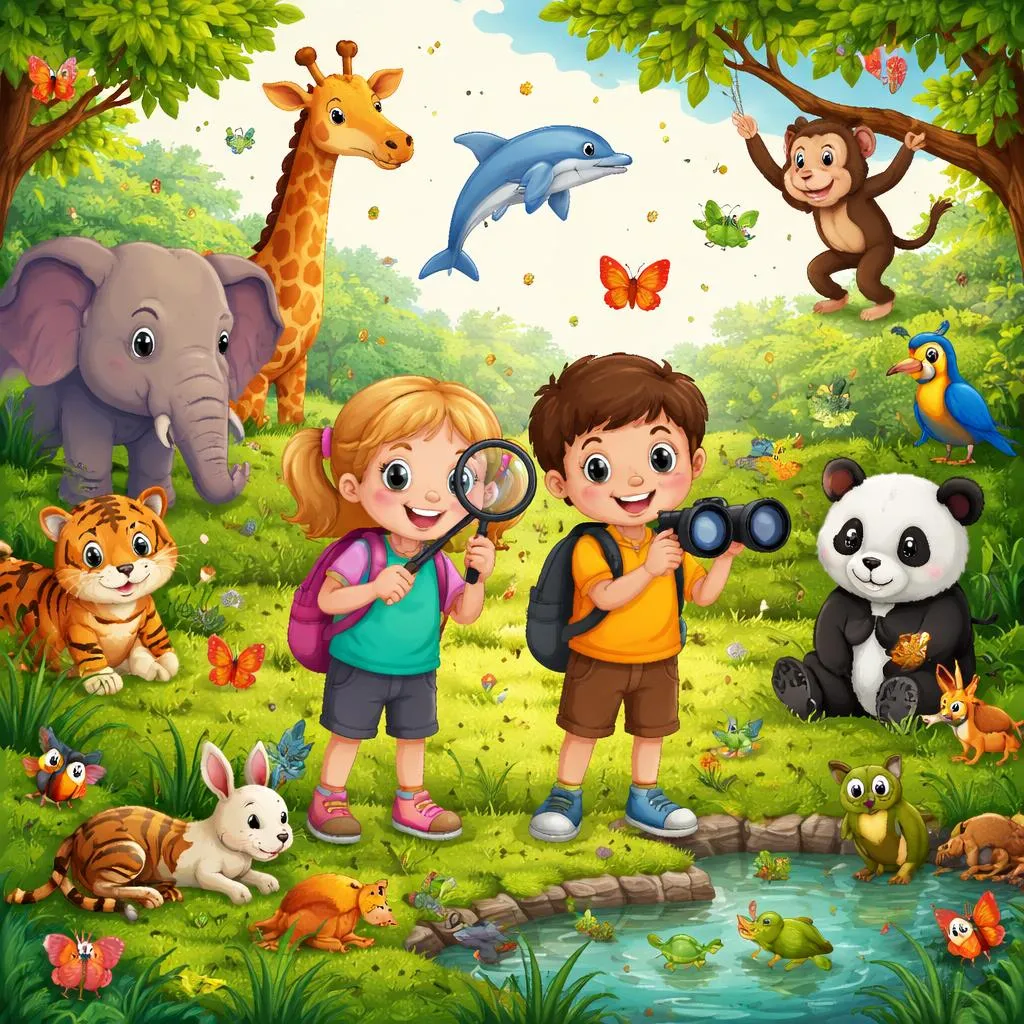

What is all animals?
Hello, animal adventurers. Today, we are going to talk about a huge and wonderful topic. We are going to talk about all animals. This means every single living creature that is not a plant, fungus, or tiny germ. Animals are all around us. Some are big, some are tiny. Some have fur, some have feathers, some have scales.
Think of the word "animals" as a giant umbrella. Under this umbrella, you find your pet dog, a bird in the sky, a fish in the ocean, a butterfly in the garden, and even an ant on the sidewalk. Learning about all animals helps us understand the amazing variety of life on Earth. It teaches us to care for our planet and all its creatures. Let's start our big adventure to meet the animal kingdom.
Meaning and explanation
So, what makes an animal an animal. All animals are living things that can move on their own, at least at some point in their lives. They need to eat food for energy. They can sense the world around them. And most importantly, all animals are made of many tiny cells.
The study of all animals is called zoology. But you do not need to be a scientist to be an animal lover. When we learn the names of all animals in English, we are building a big, beautiful word collection. We learn that a baby dog is a puppy. A baby cat is a kitten. Knowing these words helps us talk about the world, read stories, and share what we see. It connects us to nature and to each other.
Categories or lists
We can organize all animals into big groups to help us learn about them. Scientists do this, and we can too, in a simpler way.
Mammals: These animals usually have fur or hair. Mothers feed their babies milk. They are warm-blooded. Dogs, cats, elephants, bats, whales, and humans are all mammals.
Birds: These animals have feathers, wings, and beaks. Most birds can fly. They lay eggs. Eagles, robins, penguins, ostriches, and parrots are birds.
Fish: These animals live in water. They have gills to breathe underwater and fins to swim. They are usually covered in scales. Goldfish, sharks, clownfish, and salmon are all fish.
Reptiles: These animals have scaly skin. They are cold-blooded and often lay eggs on land. Snakes, lizards, turtles, crocodiles, and alligators are reptiles.
Amphibians: These animals can live both in water and on land. They start life in water with gills and then develop lungs. Frogs, toads, and salamanders are amphibians.
Insects: This is the biggest group of all animals. Insects have six legs, three body parts, and often have wings. Butterflies, ants, bees, ladybugs, and grasshoppers are insects.
Other Invertebrates: These are animals without a backbone. This group includes many creatures like spiders (arachnids), worms, jellyfish, and octopuses.
Daily life examples
You can find and talk about all animals every day. Here are two fun places to look.
In Your Own Home and Backyard: Your pet is an animal. Watch your dog or cat. What do they do. Do they play, sleep, or eat. Look out the window. You might see a squirrel, a bird, or a spider in its web. You can say, "I see a bird. It is one of all animals that can fly." Even a little ant on the kitchen counter is part of the big family of all animals. Your home is a mini zoo.
On a Trip to the Zoo, Aquarium, or Farm: This is the best classroom for learning about all animals. At the zoo, you see mammals, birds, and reptiles from around the world. At the aquarium, you see fish and other sea animals. On a farm, you see animals that give us food and help with work, like cows, sheep, and horses. Read the signs, say the names, and watch how they behave. You are meeting members of the animal kingdom face to face.
Printable flashcards
Printable flashcards are a super way to learn about all animals. You can create "Animal Group" sorting cards.
Make cards with pictures of different animals. Then, make header cards that say "Mammal," "Bird," "Fish," etc. Kids can sort the animal pictures under the correct group header. Is a dolphin a mammal or a fish. It is a mammal. This activity teaches classification in a hands-on way.
Another great printable is a "Habitat Match" game. Create cards with pictures of habitats: Ocean, Forest, Desert, Savanna, Polar Ice. Then, provide animal cards. Kids must place the polar bear on the Polar Ice card and the camel on the Desert card. This teaches where different members of all animals live.
You can also make "Baby Animal" matching cards. One card shows an adult dog. The matching card shows a puppy. Do the same for cat/kitten, cow/calf, and so on. This expands vocabulary in a fun, personal way.
Learning activities or games
Let's play "Animal Charades." Write the names of many animals from all groups on small pieces of paper. Players take turns picking a paper and acting out the animal without talking. Can the others guess "butterfly" from flapping arms. Can they guess "elephant" from a trunk motion. This game is full of laughter and movement.
Try the "Animal Alphabet" game. Sit in a circle. The first player says, "I'm going on a safari and I see an antelope." The next player says, "I'm going on a safari and I see an antelope and a bear." The game continues through the alphabet, each player repeating the list and adding a new animal. It is a fantastic memory game and vocabulary builder for all animals.
Create a "Classroom Animal Encyclopedia" project. Assign each child or small group a different animal group (mammals, insects, etc.). Their job is to draw or find pictures of 3-5 animals from that group. They write (or dictate) one simple fact about each one. "A bat is a mammal that can fly." The teacher collects all the pages and binds them into a book for the reading corner. This collaborative project makes everyone an expert on a part of the animal kingdom and creates a shared resource they can be proud of. It beautifully demonstrates the diversity and wonder of all animals.