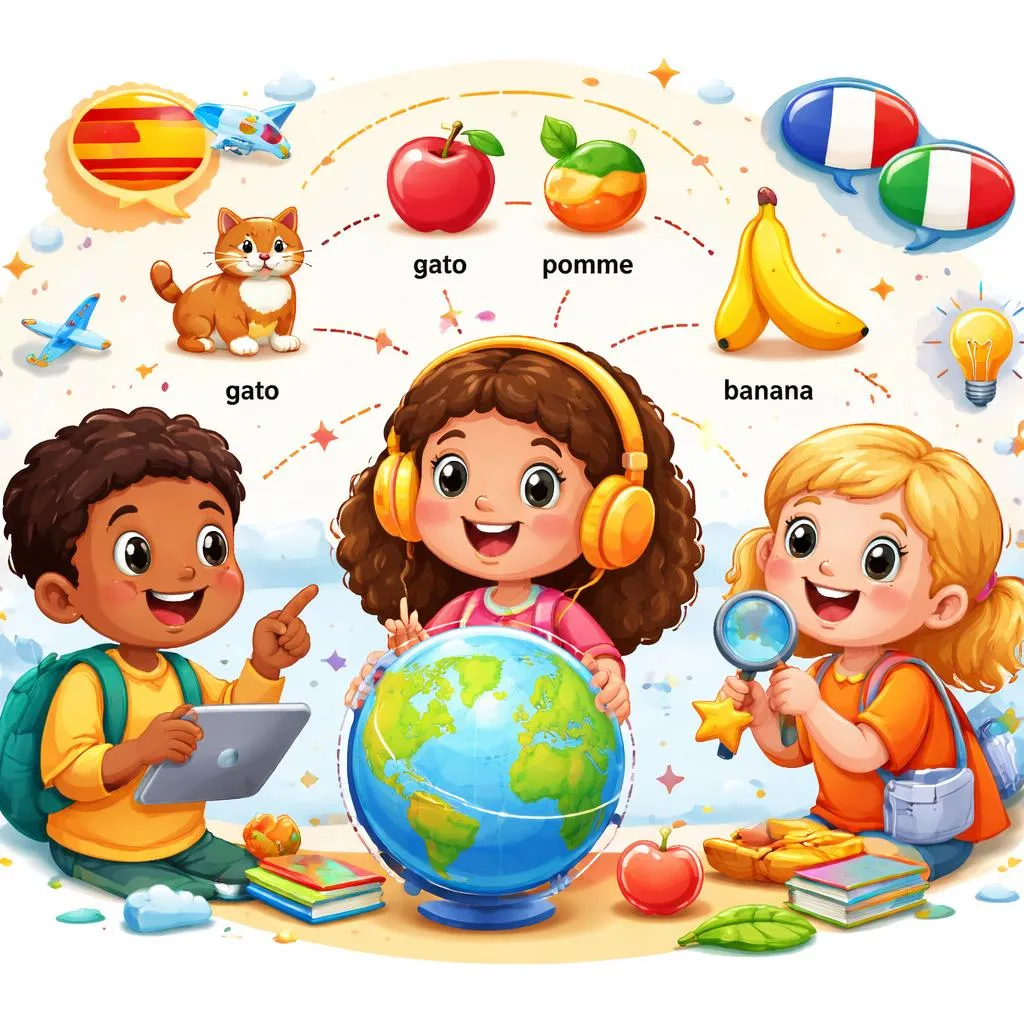

What is cognates?
Hello, word detectives. Today we are going to uncover a wonderful secret about languages. This secret is all about special words called cognates. This might be a new word for you. Let me explain.
Cognates are words in two different languages that look almost the same. They sound very similar. And they mean the exact same thing. It is like meeting a long-lost twin. You see the word in English. Then you see its twin in Spanish or French. You can tell they are from the same family.
Think of the word "animal." In Spanish, it is "animal." In French, it is "animal." They are cognates. They are brothers from another language mother. Knowing about cognates is like having a superpower. It helps you guess the meaning of new English words if you know another language. It makes learning much faster and more fun.
Meaning and explanation
So, what makes a word a cognate? The most important thing is the shared history. Many, many years ago, English borrowed thousands of words from languages like Latin, French, and Greek. Other languages, like Spanish, Italian, and French, also came from Latin. This is why they share so many word twins.
When we find cognates, we are finding a connection. We are seeing that languages are not completely separate. They are part of a big, friendly family. The word "family" itself is a cognate. In Spanish: familia. In Italian: famiglia. In French: famille. See how they are all related.
Cognates are usually nouns, adjectives, or verbs. They are often words for ideas, technology, science, and things in nature. They are the building blocks that languages love to share. Learning about cognates shows us that the world of words is connected in amazing ways.
Categories or lists
Let's look at some common groups of English-Spanish cognates. This is one of the biggest and most helpful groups for many learners. Remember, the spelling might change a little, but the words are clearly family.
Group 1: Perfect Cognates. These words are spelled exactly the same in English and Spanish. The pronunciation is a little different, but they look identical. Animal - animal
Color - color
Doctor - doctor
Hotel - hotel
Radio - radio
Tiger - tigre
Piano - piano
Group 2: Very Close Cognates. These words are almost the same. Often, English words end in "-ty" and Spanish words end in "-dad" or "-tad". City - ciudad
University - universidad
Activity - actividad
Curiosity - curiosidad
Electric - eléctrico
Music - música
Class - clase
Group 3: Other Language Friends. English has cognates with many languages, not just Spanish. English & French: Restaurant (restaurant), Garage (garage), Ballet (ballet).
English & German: Kindergarten (kindergarten), Hamburger (Hamburger), Waltz (Walzer).
English & Italian: Pizza (pizza), Volcano (vulcano), Piano (piano).
Daily life examples
You can be a cognate detective every day. Here are two places to look.
At the Supermarket: Walk down the aisles. Look at product names and signs. You will see cognates everywhere. The "Dairy" section. In Spanish, dairy products are "lácteos." Not a perfect match, but the word "yogurt" is a cognate. Look at a cereal box. The word "vitamins" is there. In Spanish: "vitaminas." The juice might say "natural." In Spanish: "natural." Your grocery trip is a vocabulary lesson.
In Your School Books: Open a science or social studies book. Look for big, important words. Words like "planet," "continent," "ecosystem," "government," "revolution." These are very often cognates. "Planet" in Spanish is "planeta." "Continent" is "continente." These words are shared because the ideas are big and important across languages. Finding them helps you understand your schoolwork better.
Printable flashcards
Printable cognate flashcards are a fantastic learning tool. You can create a "Word Twin" matching game.
Make cards in pairs. One card has the English word in a blue speech bubble. The matching card has the Spanish (or other language) cognate in a green speech bubble. For example, a blue card says "ELEPHANT." A green card says "ELEFANTE." Kids can mix all the cards and try to find the matching pairs. This is a visual and fun way to build vocabulary in both languages.
You can also make "Cognate Sorting" cards. Create a set of word cards. Some are true cognates (like "radio"). Some are false friends (like "embarrassed" which does NOT mean "embarazada" in Spanish). And some are regular English words. Kids have to sort the cards into "Cognate" and "Not a Cognate" piles. This teaches them to be careful and not just guess.
Another idea is a "Cognate Word Wall" poster. Print out a large tree. The trunk is labeled "COGNATES." The branches are labeled with endings like "-tion", "-al", "-ist". Print leaf-shaped cards with word pairs. The "-tion" branch gets leaves that say "nation - nación", "information - información". This shows the patterns in a beautiful, visual way.
Learning activities or games
Let's play some cognate games. First, play "Cognate Bingo." Make bingo cards with pictures representing cognates. A picture of an elephant, a piano, a tiger, a hotel. The caller holds up a word card. They can say the word in English OR in the other language. If a player has the picture for that word, they mark it. "I have 'elefante'! That's my elephant picture!" The first to get a line shouts "Cognate Bingo!"
Try the "Cognate Scavenger Hunt." Give kids a page from a magazine, a flyer, or a simple book. Give them a list of common cognate endings to look for: "-tion", "-al", "-ist", "-or". Set a timer. How many cognates can they circle in two minutes. Words like "professional," "director," "artist." This turns them into active word hunters in real texts.
Finally, play "False Friend Alert." This is an important game. Make a set of cards with word pairs. Some are true cognates ("animal - animal"). Some are false friends ("exit - éxito" which means success, not a way out). In teams, players draw a card. They must decide if the pair are true friends (thumbs up) or false friends (thumbs down and make a buzzer sound "Ehhh! False friend!"). This game is silly but teaches a critical lesson about not guessing blindly with cognates.