
What is english pronouns?
Hello, word helpers. Today, we are going to learn about a very smart group of words. We are going to learn about English pronouns. Pronouns are words that take the place of a noun. A noun is a person, place, or thing. So, instead of saying a person's name or a thing's name again and again, we use a pronoun.
Think of a sentence. "Leo has a blue bike. Leo rides the blue bike every day." Saying "Leo" and "the blue bike" two times sounds funny. It is repetitive. Now, let's use English pronouns. "Leo has a blue bike. He rides it every day." The word "he" takes the place of "Leo." The word "it" takes the place of "the blue bike." Much better. Pronouns are like word shortcuts. They make our talking and writing smoother and faster. Let's learn all about these helpful shortcuts.
Meaning and explanation
So, what is the real job of English pronouns. Their main job is to replace nouns to avoid repetition. This makes our language flow nicely. Imagine telling a long story and using the full name of every person and thing every single time. It would be very long and boring. Pronouns keep our stories fun and easy to follow.
Pronouns also help us connect ideas. They point back to a noun we already mentioned. This noun is called the antecedent. In our sentence, "Leo" is the antecedent for "he." The "blue bike" is the antecedent for "it." Pronouns must match their antecedent in number (one or more) and gender. If the antecedent is one boy, we use "he." If it is one girl, we use "she." If it is a thing, we use "it." This matching is very important for clear English pronouns.
Categories or lists
There are different types of English pronouns. They are like different tools in a toolbox, each for a specific job. Let's look at the most important ones.
Subject Pronouns: These pronouns are the stars of the sentence. They do the action. I, you, he, she, it, we, they. I play. You read. He runs. She sings. It works. We learn. They jump.
Object Pronouns: These pronouns receive the action. They come after the verb. Me, you, him, her, it, us, them. Mom helps me. I see you. She calls him. We listen to her. I like it. They join us. Watch them.
Possessive Pronouns: These pronouns show ownership. They stand alone. Mine, yours, his, hers, its, ours, theirs. This book is mine. Is that pencil yours? The red ball is his. The house is theirs.
Possessive Adjectives: These are like possessive pronouns, but they come right before a noun. They describe who owns the thing. My, your, his, her, its, our, their. This is my book. Where is your bag? That is his ball. I like her dress.
Reflexive Pronouns: These pronouns reflect the action back to the subject. Myself, yourself, himself, herself, itself, ourselves, yourselves, themselves. I hurt myself. He taught himself. They enjoyed themselves.
Daily life examples
You use English pronouns all the time without thinking. Let's listen to three everyday moments.
At Home in the Morning: Your mom might say, "Did you brush your teeth?" The word "you" is a subject pronoun. You might answer, "Yes, I brushed them." The word "I" is a subject pronoun, and "them" is an object pronoun for "teeth." Your sister might shout, "That's my hairbrush!" The word "my" is a possessive adjective. You might reply, "No, it's mine!" The word "mine" is a possessive pronoun. A whole pronoun conversation before school.
Playing a Game with Friends: You are playing tag. You shout, "I will tag you!" ("I" subject, "you" object). Your friend runs and says, "You can't catch me!" ("You" subject, "me" object). Someone else yells, "We are winning!" ("We" subject). Another says, "Look at them run!" ("Them" object). The game is full of action and English pronouns.
Reading a Storybook Aloud: Open any picture book. "Once upon a time, there was a little bear. He lived in a big forest." The word "he" is a subject pronoun for the bear. "The bear loved honey. He ate it every day." The word "it" is an object pronoun for honey. Stories use pronouns on every page to tell the tale smoothly.
Printable flashcards
Printable flashcards are a super way to learn English pronouns. You can create a "Pronoun Match-Up" game.
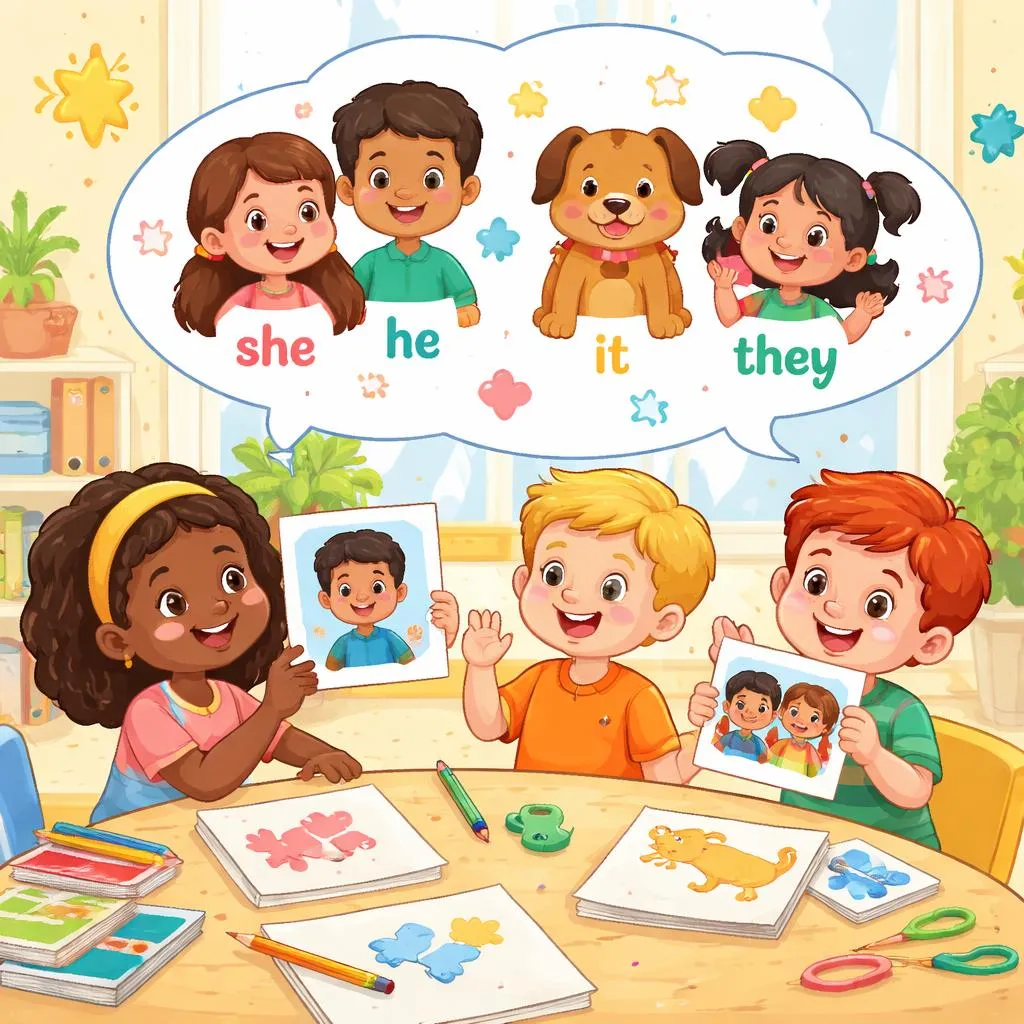
Make two sets of cards. Set A has pictures or names. A picture of a single boy with "Leo" written below. A picture of a group of girls. A picture of a cat. Set B has the matching subject and object pronouns. For the boy: "He / Him." For the girls: "They / Them." For the cat: "It / It." Kids match the picture to the correct pronoun pair. This builds a strong visual link.
Another great printable is a "Pronoun Family Tree" poster. Draw a simple family tree with stick figures. Label the figures with pronouns instead of names. The figure for "I" or "Me" is the child holding the poster. The parent figures are "He/Him" and "She/Her." Sibling figures are "He/Him" or "She/Her." A pet figure is "It." This personalizes the grammar and makes it about their own world.
You can also make "Sentence Builder" strips. Create strips of paper with parts of sentences. One strip says "I see." Another strip says "my friend." Another says "him." Another says "at the park." Kids can move the strips around to form correct sentences. "I see my friend at the park." or "I see him at the park." This hands-on activity shows how pronouns replace noun phrases.
Learning activities or games
Let's play some active games to practice English pronouns. First, play "Pronoun Toss." Get a soft ball. Stand in a circle. The first player holds the ball and says a sentence with a subject pronoun. "I like pizza." Then they toss the ball to another player and say an object pronoun. "I throw it to you!" The catcher must then make a new sentence. "You threw the ball to me!" This combines movement with quick grammar thinking.
Try the "Pronoun Detective" hunt. Give each child a clipboard and a simple checklist. Their mission is to find examples of different English pronouns in the classroom. Can they find something that is "hers"? (A girl's coat). Can they find something that is "ours"? (The class pet). Can they see someone helping "him"? They write or draw what they find. This activity connects grammar to their real environment.
Create a "Silly Story Swap" game. Write a very short, simple story with blanks where nouns should be. "___ went to the store. ___ bought some milk. Then ___ drank ___." Prepare two sets of cards. Set 1 has nouns (The cat, My grandma, A robot). Set 2 has pronouns (She, He, It). Kids pick a noun card to start the story, then a pronoun card to continue it. The story becomes, "The cat went to the store. It bought some milk. Then it drank it." This hilarious game clearly shows how pronouns replace nouns to avoid silly repetition, making the concept memorable and fun.