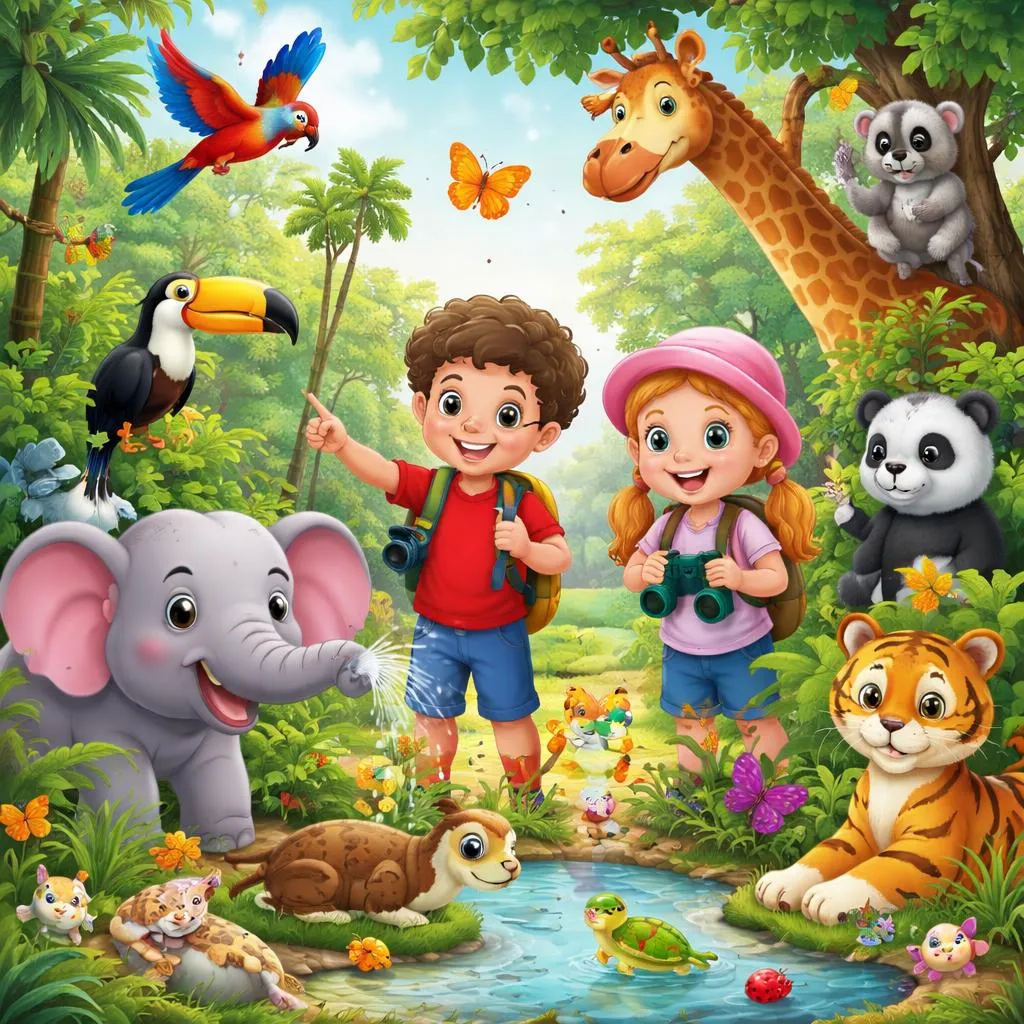

What is animals?
Hello, young explorers! Are you ready for a wonderful adventure? Today, we are going to talk about some of the most incredible friends on our planet. We are going to talk about animals! The word "animals" means all the living creatures that are not plants. They are all around us, big and small, furry and scaly, loud and quiet.
Animals are amazing because they can move. A bird flies in the sky. A fish swims in the water. A cheetah runs on the land. Even a tiny ant can walk and carry food. Animals also need to eat food to get energy. They cannot make their own food from sunlight like plants do. They must find it. Some animals eat plants. Some animals eat other animals. Some animals eat both!
There are so many different kinds, or examples, of animals. Scientists think there are millions of types! Learning about them helps us understand the beautiful world we share. It teaches us to be kind and caring. So, let's put on our explorer hats and start learning about some fantastic examples of animals.
Meaning and explanation
When we say "examples of animals," we are showing you different members of the animal family. Think of it like introducing you to new friends. Each friend has a name and special things about them. A lion is one example. A butterfly is another example. A dolphin is one more example. Together, they show us how diverse life is.
Animals can be grouped in helpful ways. One big way is by whether they have a backbone. Animals with backbones are called vertebrates. Your pet dog, a songbird, a frog, and a goldfish are all examples of vertebrates. The backbone helps give their body shape and protects important nerves.
Animals without backbones are called invertebrates. Many of these animals have a hard shell on the outside or a soft body. A snail, a spider, a jellyfish, and a ladybug are all examples of invertebrates. They might look very different from us, but they are still important animals in nature.
We can also group animals by what they eat. Plant-eaters are herbivores. A panda eating bamboo and a deer eating grass are examples of herbivores. Meat-eaters are carnivores. A tiger hunting and an eagle catching a fish are examples of carnivores. Animals that eat both plants and meat are omnivores. You are an omnivore! So are bears, raccoons, and many birds.
Categories or lists
Let's organize our animal friends into some big groups. Here are many exciting examples of animals from each category.
First, meet the mammals. Mammals are animals that usually have hair or fur. Baby mammals drink milk from their mothers. Humans are mammals! Other wonderful examples are cats, dogs, elephants, bats, whales, and kangaroos. Dolphins and whales are special mammals that live in the ocean.
Next, look up at the birds. Birds have feathers, wings, and beaks. Most birds can fly. Great examples of birds are robins, penguins, owls, flamingos, and parrots. Penguins are birds that use their wings to swim, not fly!
Now, see the reptiles. Reptiles usually have dry, scaly skin. They often lay eggs on land. Snakes, lizards, turtles, and crocodiles are all cool examples of reptiles. They love to sit in the sun to warm up.
Don't forget the amphibians. These animals can live both in water and on land. They often have smooth, moist skin. Frogs, toads, and salamanders are common examples of amphibians. They start life in water and then can move to land.
Of course, we have the fish. Fish live in water their whole life. They breathe using gills and have fins to swim. A clownfish, a shark, a seahorse, and a goldfish are all examples of fish.
Finally, let's talk about insects and more. Insects have six legs. Butterflies, ants, bees, and dragonflies are examples of insects. Spiders and scorpions have eight legs; they are called arachnids. There are more insects on Earth than any other animal!
Daily life examples
You can find examples of animals everywhere you look in your daily life. Let's explore three simple places.
At home, you might have pets. A pet dog is a playful friend. A pet cat might like to nap in the sun. A pet fish swims in its tank. A pet rabbit hops around. These animals live with us. We feed them, play with them, and take care of them. They teach us about friendship and responsibility.
When you go outside, look around. In your garden or a park, you might see birds like sparrows or crows. You might see a squirrel running up a tree. On a flower, you could see a busy bee or a colorful butterfly. In a pond, you might see ducks or tadpoles. These are wild animals that share our neighborhoods. Watching them is a fun way to learn.
On a trip to a farm or a zoo, you can see many more amazing examples of animals. A farm has animals like cows, pigs, sheep, and chickens. They give us food like milk and eggs. A zoo has animals from all over the world, like tall giraffes, striped zebras, powerful lions, and funny monkeys. These places let us see animals we might not see every day.
Printable flashcards
Learning is more fun with pictures! You can use printable animal flashcards. These cards have a photo of an animal on one side and its name on the other.
You can print cards for different themes. Make a set for "Pets." One card shows a dog, another shows a cat, another shows a hamster. Make a set for "Jungle Animals" with a tiger, a snake, and a parrot. Make a set for "Ocean Animals" with a dolphin, an octopus, and a starfish.
Here is a fun game to play with your flashcards. Play "Animal Sound Guess." Hold up a card, like a cow. Can your friend make the "moo" sound? Then switch. You make the "oink" sound for the pig card, and your friend has to find the right flashcard. This game connects the animal's picture, name, and sound.
Another game is "Habitat Match." Print pictures of different homes: a forest, an ocean, a desert, a farm. Now, take your animal flashcards. Your job is to place each animal in its correct home. Does the camel go in the ocean? No! It belongs in the desert. Does the shark go on the farm? No! It belongs in the ocean. This teaches you where different examples of animals live.
Learning activities or games
Let's play some active games to learn about animals. First, play "Animal Charades." Write names of different animals on small papers. Put them in a hat. One player picks a paper and acts out that animal without talking. Can the others guess if it's a hopping kangaroo, a slithering snake, or a flying eagle? This game is full of laughter and movement.
Another great activity is "Create Your Own Animal." Use your imagination. Draw or make a brand new animal with craft supplies. What is its name? Is it a "Flufflefoot" or a "Sparklewing"? What does it eat? Where does it live? Does it have fur, feathers, or scales? Tell a story about your animal. This activity lets you use everything you've learned to invent a new example of an animal.
Finally, let's sing an "Animal Action Song." Songs help us remember. Sing to the tune of "The Wheels on the Bus." "The lion in the jungle says roar, roar, roar... The fish in the ocean swims swish, swish, swish... The monkey in the tree says ooh, ooh, ahh... All day long." Make up your own verses for your favorite examples of animals. Singing and moving makes learning unforgettable.