
Meaning
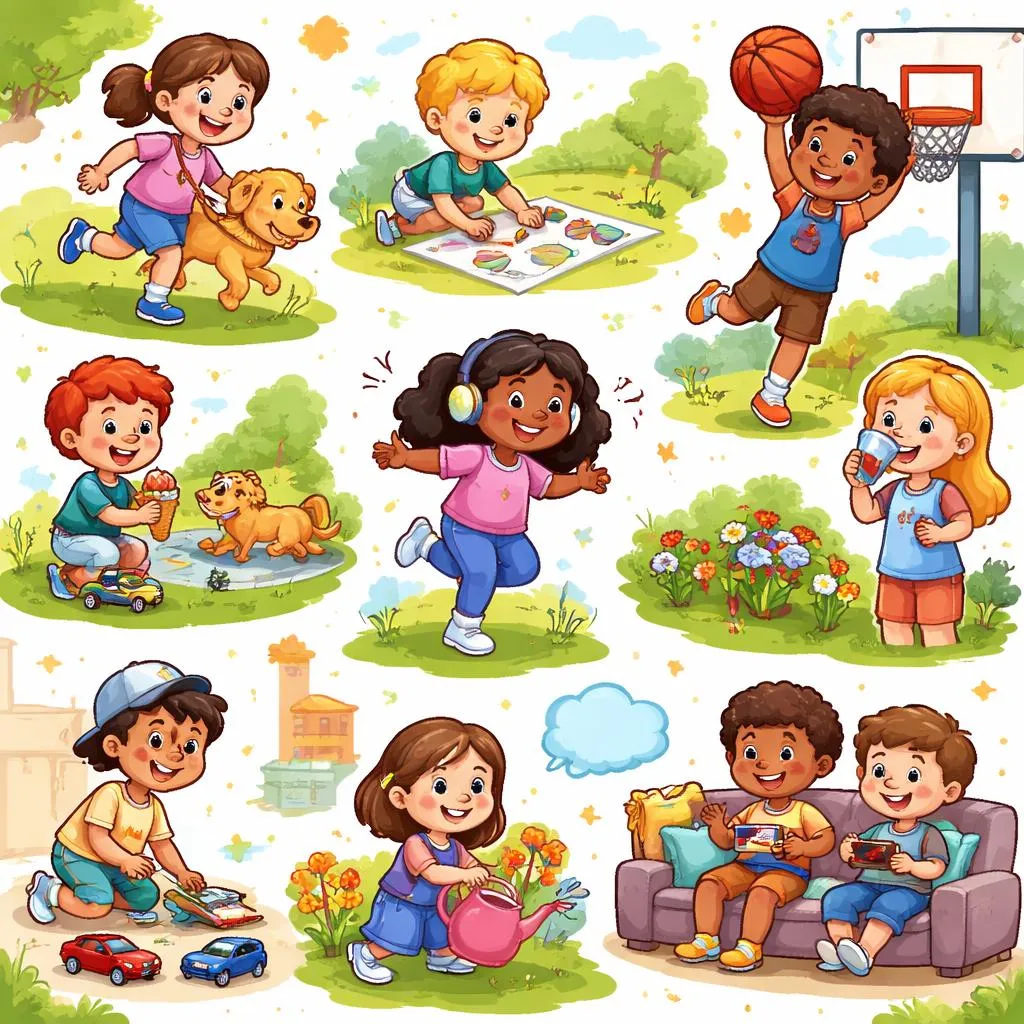
Hello, young learners. Today, we are going to learn about the most exciting and important words in any sentence. We are going to learn about common verbs. Verbs are action words. They tell us what someone or something does. Without verbs, nothing would happen in our sentences. We would just have names of people and things sitting there, doing nothing.
Think of a sentence as a little movie. The subject is the star of the movie. The verb is the action the star is doing. "The dog barks." The star is the dog. The action is "barks." "I jump." The star is "I." The action is "jump." These action words are common verbs. They are the engines that make our sentences go. Let's learn the engines that power our everyday talk.
Conjugation
The word "conjugation" might sound tricky, but it is simple. It just means changing the verb a little to match the subject and the time. For most common verbs, the rules are easy. Let's look at the verb "to play."
For the present, with I, you, we, they, we use the base form: I play, you play, we play, they play. With he, she, it, we usually add an 's': he plays, she plays, it plays.
For the past, for regular common verbs, we add "-ed": I played, you played, he played, we played, they played.
For the future, we use "will" plus the base form for everyone: I will play, you will play, he will play, we will play, they will play. This is how we make our action words fit perfectly into our stories about now, before, and later.
Present tense
We use the present tense to talk about habits, things we do regularly, and things that are true now. Let's look at our common verbs in action in the present.
I eat breakfast. You go to school. He reads a book. She writes her name. It rains a lot. We like ice cream. They watch a movie. These are all actions that happen in the present time, as routines or facts.
Some other super common verbs in the present are: have, do, see, say, get, make, know, think, want, need. I have a red ball. She does her homework. We see a bird. He says hello. They get a prize. You make a drawing. I know the answer. She thinks it is fun. He wants a cookie. I need a pencil. Using these common verbs helps you talk about your daily life.
Past tense
We use the past tense to talk about actions that are finished. They already happened. For most common verbs, we add "-ed" to make the past.
I walked to the park. You played a game. He jumped high. She cooked dinner. It worked well. We cleaned the room. They called my name. See the pattern. Walked, played, jumped, cooked, worked, cleaned, called. All with "-ed."
Some very common verbs are irregular in the past. This means they do not add "-ed." You must remember them. I went to the store. You ate a sandwich. He saw a movie. She did her work. It was fun. We had a party. They came to visit. The past forms are: went, ate, saw, did, was, had, came. These are some of the most important common verbs to know.
Future tense
We use the future tense to talk about actions that will happen later. The most common way is to use the word "will" before the base form of the verb.
I will help you. You will learn fast. He will read the story. She will write a letter. It will be sunny. We will win the game. They will visit us tomorrow. The verb after "will" never changes. It is always the base form, like help, learn, read, write, be, win, visit.
We can also use "going to" to talk about the future. I am going to run. You are going to sing. He is going to draw. We are going to build a fort. Using these common verbs with "will" or "going to" helps you share your plans and dreams.
Questions
We use common verbs to ask questions all the time. To ask a yes or no question in the present or past, we often use the helper verbs "do," "does," or "did."
Do you like pizza? Does he play soccer? Did they go home? Do we have milk? Does it hurt? After "do," "does," or "did," we use the base form of the main verb. Do you like? Does he play? Did they go?
We can also ask questions that start with "what," "where," "when," "why," and "how." What do you see? Where did she go? When will we eat? Why do they laugh? How does it work? These question words plus our common verbs help us find out all kinds of information about the world.
Other uses
Common verbs are not just for one time. We can use the "-ing" form of verbs to talk about actions happening right now. I am eating. You are reading. He is running. This is called the present continuous. The common verb "be" (am, is, are) helps the main action verb.
We use the base form of a verb for commands or instructions. Sit down. Eat your vegetables. Please listen. Look at this. Run fast. These are direct ways to tell someone to do an action.
Some common verbs team up with other words to make special meanings. These are called phrasal verbs. Turn on the light. Stand up. Sit down. Pick up the toy. These little phrases are very common in everyday English. The verb "get" has many friends: get up, get dressed, get in the car. Learning these teams is a fun next step.
Learning tips
A great way to learn common verbs is to connect them to your body. Act them out. When you say "jump," actually jump. When you say "clap," clap your hands. This connects the word to the action in your brain and body. It is called Total Physical Response and it is very effective for kids.
Make a "Verb of the Day" poster. Each day, pick one common verb. Write it in big letters. Draw a picture of someone doing that action. Then, write three sentences using the verb in the present, past, and future. "I eat. I ate. I will eat." Put the posters on your wall. Soon you will have a gallery of action words.
Listen for verbs in your favorite songs and cartoons. Many children's songs are full of actions. "If you're happy and you know it, clap your hands." "The wheels on the bus go round and round." Be a verb detective and see how many you can spot.
Educational games
Let's play "Verb Charades." This is a classic and fun game. Write many common verbs on small pieces of paper: swim, eat, sleep, laugh, cry, dance, write, read, fly, drive. Players take turns picking a paper and acting out the verb without using any words. The other players must guess the verb. "You are swimming!" "She is dancing!" This game gets everyone moving and connects the word to the action perfectly.
Try "Verb Bingo." Create bingo cards with pictures representing common verbs. A picture of a child eating, a dog running, a girl reading, a boy jumping. The caller has cards with the verb words. They call out "eat!" Players look for the eating picture and mark it. The first to get a line shouts "Bingo!" For an extra challenge, the caller can act out the verb instead of saying it.
Create a "Story Chain with Verbs." Sit in a circle. The first person starts a story with one sentence containing a common verb. "Once, a little rabbit hopped into the garden." The next person continues the story, but their sentence must start with the last verb from the previous sentence. "The hop made a butterfly fly away." The next person continues. "The butterfly flew to a flower where a bee was buzzing." The story gets silly, and everyone practices using verbs creatively. This game is wonderful for imagination and verb practice.