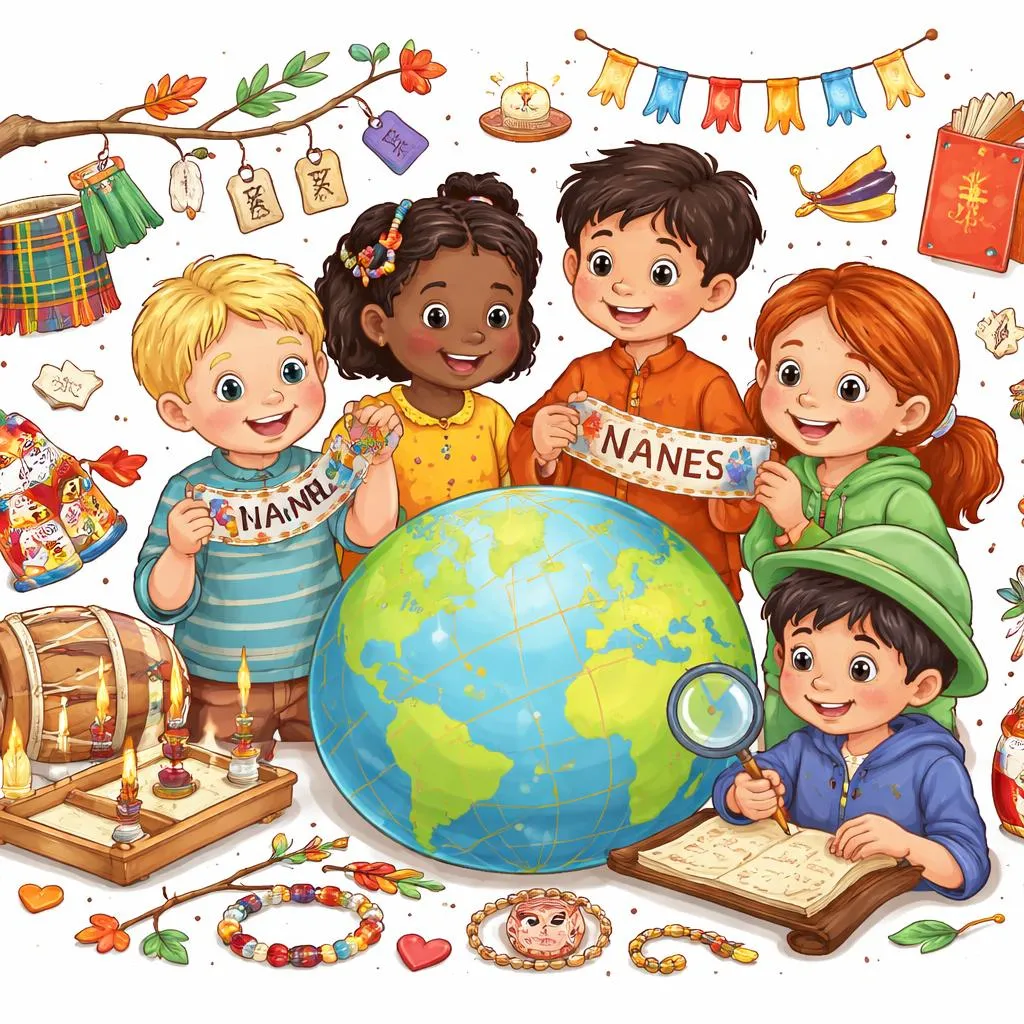

What is name traditions?
Hello, friends. Today, we are going to learn about something very special. We are going to learn about name traditions. A name is the word people call you. It is your very first gift. But did you know that how people choose names is different all over the world. These different ways are called name traditions.
Name traditions are like family recipes for picking a name. Every culture has its own recipe. Some families choose names from a grandparent. Some choose names from a beautiful story. Some choose names based on the day a baby is born. Learning about these traditions helps us understand our friends and the big, wonderful world we share. Let's explore some of these amazing traditions together.
Meaning and explanation
So, what do we mean by name traditions? It is the special way a family or a culture decides what to name a new baby. A tradition is something people have done for a long time, passed down from parents to children. Name traditions connect a new baby to their family, their history, and their culture.
A name is not just a sound. It often has a meaning. In many traditions, a name is a wish or a blessing. It might mean "strong," "peaceful," "wise," or "brave." Parents hope the child will grow to be like the meaning of their name. Name traditions are like a secret code of love and hope from the very first day. They tell a story about who you are and where you come from.
Categories or lists
Let's look at different name traditions from some places around the world. This is like taking a quick trip to learn how friends in other countries get their names.
Tradition 1: Honoring Family (Common in many places like Spain, Korea, the Middle East). In this tradition, babies are named after their family members. A boy might be named after his grandfather. A girl might be named after her aunt. This shows respect and keeps family names alive. In some Spanish-speaking countries, a child might have two last names, one from the father and one from the mother. In Korea, many people in the same family share a special "generation name" in one part of their full name.
Tradition 2: Names from Nature and Values (Common in many cultures, like in Japan and Nigeria). Here, names are chosen from beautiful parts of the world or important ideas. A Japanese name like "Haruka" can mean "distant," or "Sakura" means "cherry blossom." A Nigerian name like "Chiamaka" (Igbo) can mean "God is beautiful," and "Oluwatobi" (Yoruba) can mean "God is great." These names connect the child to the beauty and beliefs of their culture.
Tradition 3: Religious and Saint Names (Common in Christian, Muslim, Jewish, and Hindu traditions). Many families choose names from their holy books or from important religious figures. A Christian child might be named "Mary," "David," or "Gabriel." A Muslim child might be named "Mohammed," "Aisha," or "Fatima." A Jewish child might be named "Sarah," "Jacob," or "Rachel." A Hindu child might be named from stories like "Krishna" or "Sita." This tradition connects the child to their faith and its stories.
Tradition 4: Names Based on Time and Place. Some names come from when or where a baby was born. In Ghana, a baby boy born on a Friday might be called "Kofi." A girl born on Saturday might be called "Ama." In some Vietnamese traditions, the middle name can show if the child is a boy or a girl. Sometimes, a place name is used, like "Brooklyn" or "Jordan," to remember a special location.
Daily life examples
You can see and share name traditions in your own life. Here are two simple ways.
In Your Own Classroom: Your class is a perfect place to explore. Have a "Name Story" day. Each child can share how they got their name. Someone might be named after a grandma. Someone might have a name that means "light" in another language. Someone might be named after a favorite book character. Listening to these stories helps everyone learn about different family traditions and feel connected.
When You Meet a New Friend: If you make a friend with a name that is new to you, you can ask kindly, "That's a beautiful name. Does it have a special meaning?" You might learn that your friend "Maya" has a name that means "illusion" in Sanskrit or "water" in Hebrew. You might learn that your friend "Liam" is the Irish form of "William," which means "strong protector." Asking politely shows you are interested in their story.
Printable flashcards
Printable materials can make learning about name traditions very fun. You can create a "Name Origins" matching game.
Make cards that have two sides. On one side, draw a simple flag or landmark of a country. On the other side, write a common name from that tradition and its meaning. For example, a card with the Japanese flag on one side. The other side says: "Name: Sakura. Meaning: Cherry Blossom." Another card with Nigeria: "Name: Ade. Meaning: Crown." Kids can guess the meaning or match names to their country of origin.
You can also make a "My Name Poster" template for kids to fill out. The poster has spaces for: "My Name:", "What It Means:", "Why My Family Chose It:", "How to Say It in Another Language:", and a big space to draw a picture that represents their name. This activity encourages kids to talk to their families and be proud of their own name story.
Another idea is a "World Name Bingo" game. Create bingo cards with squares containing names from different traditions (e.g., Giovanni, Sofia, Aarav, Chihiro, Kwame). The caller reads out the meaning. "I am looking for a name that means 'God is gracious'." Players see if they have "John" or "Juan" on their card. This links the name directly to its traditional meaning.
Learning activities or games
Let's play some games all about name traditions. First, play the "Name Interview" game. Pair up students. They have to interview each other to learn the story of their partner's name. They can ask questions like: "Who chose your name?" "Were you named after someone?" "Does your name have a special meaning?" Then, each person introduces their partner to the class, sharing the name story they learned. This builds speaking skills and community.
Try the "Create a Name" activity. Explain that in some traditions, names are wishes. Give each child a scenario. "You are naming a baby born on a sunny spring morning." "You are naming a new explorer about to sail across the sea." Ask them to invent a name and explain its meaning. "I would name the baby 'Sunny Dawn' because she brings light." "I would name the explorer 'Brave-Heart Oceanrider'." This creative activity helps them understand the thought behind name traditions.
Finally, have a "Global Greetings" circle. Teach kids how to say "What is your name?" and "My name is..." in a few different languages. "¿Cómo te llamas?" in Spanish. "Comment t'appelles-tu?" in French. "Anata no namae wa nan desu ka?" in Japanese. Then, go around the circle letting everyone introduce themselves using a different language's phrase. This connects the tradition of names directly to the language we use to share them, celebrating global friendship.