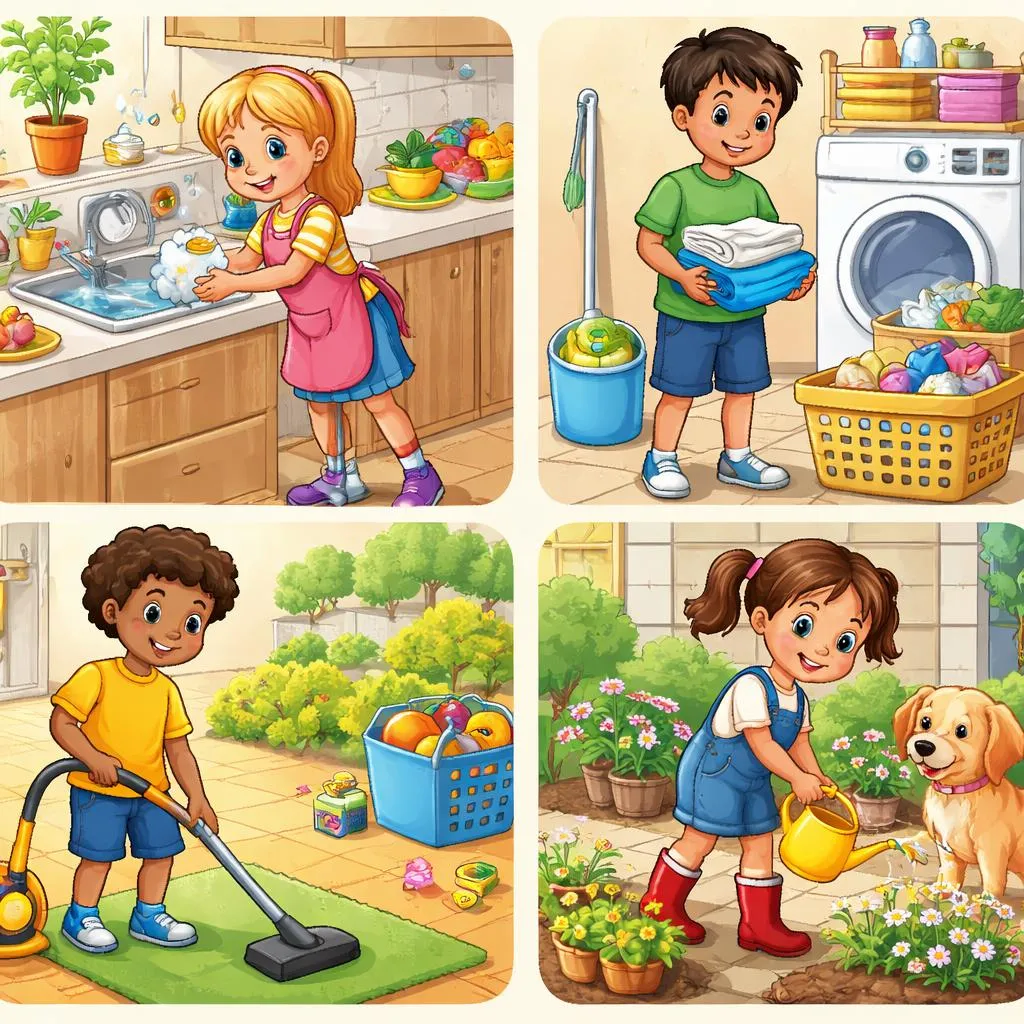

What is a chore?
Hello, helpful friends. Today, we are going to talk about something very important. We are going to talk about chores. A chore is a small job you do to help at home or at school. It is a regular task that needs to be done. Chores are not just work. They are a way to help your family and take care of your space.
Chores can be simple and quick. They are things like putting toys away or setting the table. Doing chores helps you learn responsibility. Responsibility means being trusted to do something important. It shows you are a helpful part of your family team. Everyone in a family can have chores. Even grown-ups have chores. They are a normal part of life.
Learning to do chores teaches you skills you will use forever. You learn how to clean, organize, and take care of things. Best of all, doing a good job on a chore makes you feel proud and capable. Let us learn more about these helpful tasks.
Meaning and explanation
So, what does a chore really mean? A chore is a routine duty. The word "routine" means it happens often, like every day or every week. It is a job that contributes to the household. The purpose of a chore is to keep your living space nice, clean, and organized.
Chores teach us about contribution. When you do a chore, you are contributing. This means you are adding your effort to help the whole family. You are not just helping yourself. You are helping your parents, your brothers, your sisters, and even your pets. Your help makes life easier and more pleasant for everyone.
Chores also teach planning and completion. You learn to see a task from start to finish. First, you see a messy floor. Then, you decide to sweep it. You get the broom. You sweep all the dirt into a pile. You get the dustpan. You put the dirt in the trash. Finally, you put the broom away. You completed the chore. This process teaches you to follow steps and finish what you start.
Categories or lists
Chores can be sorted into fun categories. Here are some common types of chores, perfect for kids to learn.
Self-Care Chores: These are chores that take care of you and your own things. They are the first step in being responsible. Examples are making your bed, putting your dirty clothes in the hamper, putting your clean clothes away in drawers, and putting your toys back on the shelf after playing. Keeping your backpack tidy is also a self-care chore.
Family-Help Chores: These chores help the whole family and the shared spaces in your home. Examples are setting the table for dinner, clearing your plate after eating, wiping the kitchen table, feeding a family pet, watering houseplants, and sorting socks from the clean laundry. Helping to put groceries away is a great family-help chore.
Seasonal or Special Chores: These chores do not happen every day. They happen sometimes. Examples are helping to rake leaves in the fall, shoveling a little bit of snow with a small shovel, helping to wash the car with a sponge, or planting seeds in a garden during spring. These chores connect you to the world outside your home.
Daily life examples
You can find chores in your daily routine. Here are two simple scenes. In the morning, your chore time starts right after you wake up. Your first chore is to make your bed. Pull up the sheets and blanket. Fluff your pillow. A made bed makes your room look neat. Next, you get dressed. Your chore is to put your pajamas under your pillow or in a drawer. Then, you go to the bathroom. Your chore is to hang up your towel neatly after you dry your hands. These small actions start the day in an organized way.
After school, you have more chore opportunities. You come home and take off your shoes. Your chore is to put them neatly by the door, not in the middle of the floor. You have a snack. Your chore is to put your plate and cup in the sink or dishwasher. Later, before dinner, a family chore might be to set the table. You put out the plates, forks, knives, and napkins for everyone. This directly helps the family get ready for the meal together.
Before bedtime, you have your final chores. Your main chore is to tidy your play area. Put all the blocks in the block bin. Put the books back on the shelf. Put the stuffed animals on the bed. Then, you pick out your clothes for tomorrow and put them on your chair. This is a planning chore. Finally, you brush your teeth. Putting the toothbrush and toothpaste back in the cup is a tiny but important chore. Doing these things makes the next morning much smoother.
Printable flashcards
Printable chore cards are a fantastic tool. They turn chores into a clear and fun game. You can print cards with pictures and words.
Make cards for different daily chores. One card can show a picture of a bed being made. The word on the card says "Make Your Bed." Another card shows a toy box. The word says "Put Toys Away." Another shows a plate and fork. It says "Set the Table." Another shows a dog with a food bowl. It says "Feed the Pet."
You can use these cards in a "Chore Chart" on the wall. Each day, you pick the cards for your chores and clip them to your chart. When you finish a chore, you move that card to a "Done!" pocket. This gives you a visual checklist. It is very satisfying to move each card to the finished spot.
You can also use the cards for a "Chore Lottery" game. Put all the chore cards in a basket. In the morning, you pick two cards without looking. Those are your surprise chores for the day. Maybe you will pick "Water the Plants" and "Wipe the Table." This adds an element of fun and chance to being helpful.
Learning activities or games
Let's play some chore games. First, play "Beat the Clock" tidying. Set a timer for five minutes. Your chore is to tidy the living room floor. How many toys can you put away before the timer rings. Can you do it in four minutes? This game makes cleaning up fast and exciting. You are racing against time.
Another great game is "Chore Charades." Write different chores on small papers. Fold them and put them in a bowl. One player picks a paper and acts out the chore without speaking. Can the others guess "sweeping the floor" or "folding towels"? This gets everyone laughing and thinking about how chores look.
Finally, try the "Helper's Story Chain." Sit in a circle with your family. Start a story about a helpful character. "Once there was a robot whose chore was to take out the recycling." The next person adds a sentence. "One day, the recycling bin was very full of cardboard boxes." Keep going around the circle, each person adding a sentence about the chore adventure. This creative game connects chores to imagination and storytelling.