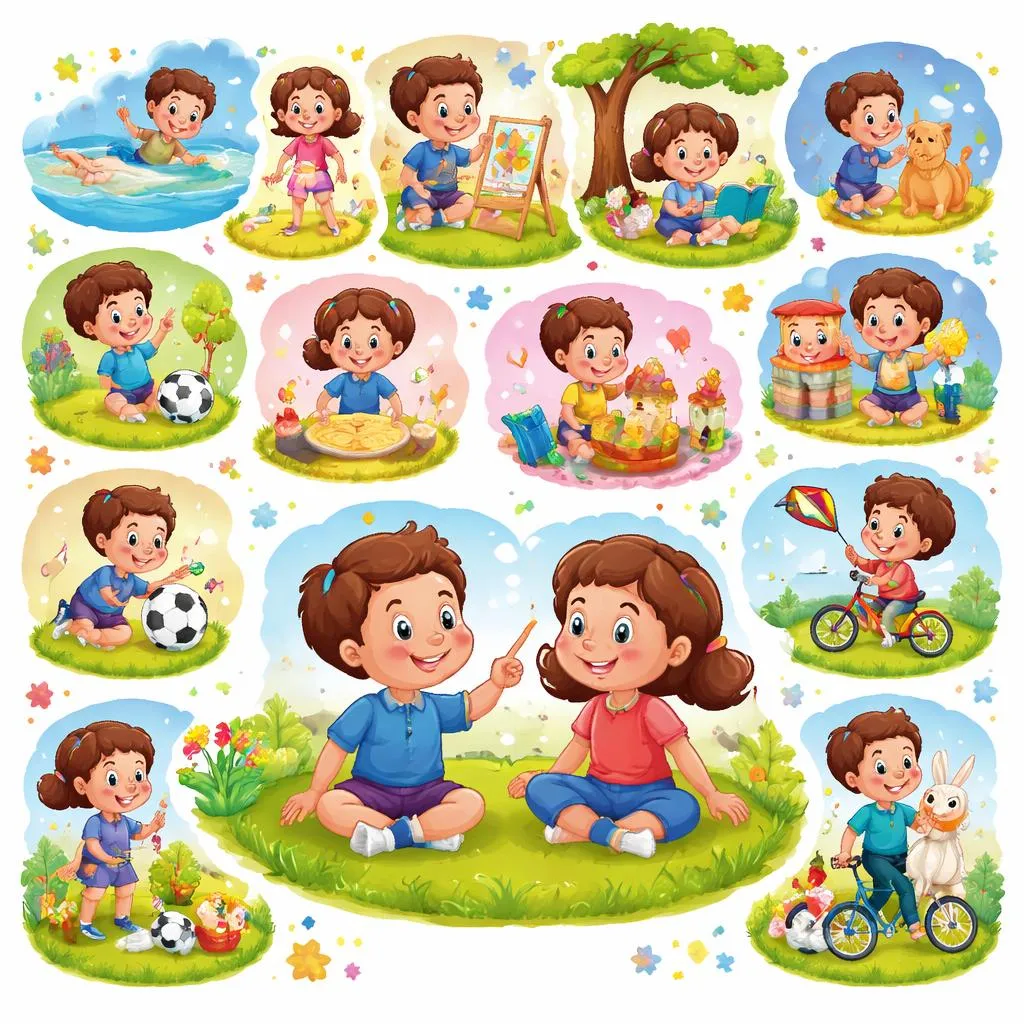

Present continuous tense tells us what is happening right now. It uses am, is, or are with a verb that ends in -ing. Words like eating, sleeping, playing, running, and jumping are all present continuous verbs. For a six-year-old, present continuous helps them talk about actions in progress at this very moment. Learning the 70 most common present continuous verbs for a 6-year-old gives children the tools to describe what they and others are doing right now. These words make their language immediate and lively.
Meaning of Present Continuous Present continuous tense has several important uses. It focuses on actions that are happening at the moment of speaking or around now.
Actions happening right now are the main use of present continuous. These are things in progress at this exact moment.
I am eating lunch right now.
She is sleeping in her bed.
They are playing outside.
The baby is crying.
Actions happening around now but not necessarily at this exact second. These are temporary activities.
I am reading a really good book these days.
She is learning to ride her bike.
We are building a fort in the living room.
He is staying at Grandma's house this week.
Future plans that are already arranged. We often use present continuous for planned events.
I am going to the doctor tomorrow.
We are having a party on Saturday.
She is coming over after school.
They are visiting the zoo next week.
Temporary situations that are different from usual.
I am living with my aunt for the summer.
He is walking to school this week because his bike is broken.
We are eating dinner early today.
For a six-year-old, present continuous is the tense they use to talk about what is happening in the moment. "Look! It is raining!" "Mommy is cooking dinner."
When we talk about the 70 most common present continuous verbs for a 6-year-old, we mean the -ing forms of the verbs children use most often to describe actions in progress.
Conjugation of Present Continuous Present continuous is formed with the helping verb be (am, is, are) and the main verb with -ing added.
For I we use am + verb-ing.
I am playing .
I am eating .
I am sleeping .
For he, she, it we use is + verb-ing.
He is running .
She is jumping .
It is raining .
For you, we, they we use are + verb-ing.
You are singing .
We are dancing .
They are swimming .
Spelling rules for adding -ing are important for children to learn.
For most verbs, just add -ing.
play → playing
eat → eating
sleep → sleeping
For verbs ending in silent e, drop the e and add -ing.
dance → dancing
bake → baking
ride → riding
For short verbs ending in consonant-vowel-consonant, double the last letter and add -ing.
run → running
swim → swimming
hop → hopping
sit → sitting
For verbs ending in ie, change ie to y and add -ing.
die → dying
lie → lying
tie → tying
For a six-year-old, the most important thing is learning the pattern of am/is/are + -ing. They will learn the spelling rules gradually through practice.
Present Tense Examples Here are examples of present continuous verbs in action. These are the kinds of sentences six-year-olds use every day.
Actions happening right now:
I am building a tower with my blocks.
You are jumping on the trampoline.
He is drawing a picture of a dinosaur.
She is singing her favorite song.
It is snowing outside.
We are waiting for the bus.
They are running in the park.
Questions about what is happening now:
What are you doing ?
Where is she going ?
Why is the baby crying ?
Are you listening to me?
Is he coming with us?
Negative sentences about what is not happening:
I am not eating candy right now.
She is not sleeping .
They are not playing outside because it's raining.
We are not watching TV at the moment.
Future plans using present continuous:
I am going to the park tomorrow.
We are having pizza for dinner tonight.
She is coming to my birthday party.
They are visiting Grandma next week.
Questions with Present Continuous Asking questions in present continuous helps children find out what is happening and make plans.
Yes/No questions put the helping verb (am, is, are) at the beginning.
Am I doing this right?
Are you listening to me?
Is he coming to the party?
Is she sleeping ?
Is it raining outside?
Are we going to the store?
Are they playing in the yard?
Wh- questions start with a question word followed by am, is, or are.
What are you doing ?
Where is she going ?
When are we eating ?
Why is he crying ?
Who are you waiting for?
How are they getting here?
Negative questions express surprise or check information.
Isn't it raining ?
Aren't you coming ?
Why aren't they playing ?
Here are some question examples children ask every day:
"What are you making ?"
"Where is Daddy going ?"
"Why is the dog barking ?"
" Are we leaving now?"
" Is she feeling better?"
Other Uses of Present Continuous Present continuous has several other important uses in English. Learning these helps children understand more complex language.
Temporary situations that are happening around now but not permanently.
"I am living with my cousin this summer."
"He is staying at a hotel this week."
"We are using the small classroom while the other one is being painted."
Repeated actions with always to express annoyance or surprise.
"You are always losing your shoes!"
"She is always singing in the bathroom."
"He is always helping others."
Changing and developing situations.
"The weather is getting warmer."
"Your hair is growing so long!"
"The baby is learning to walk."
To emphasize that something is in progress even if not at the exact moment.
"I am reading a really interesting book."
"She is studying for her test."
"They are building a new house down the street."
For a six-year-old, the most important use is talking about what is happening right now. The other uses will come with time and exposure.
Categories or Lists: The 70 Most Common Present Continuous Verbs Here is a practical list of the 70 most common present continuous verbs for a 6-year-old. These are the -ing forms children use most often in their daily conversations.
Everyday Actions (20 words)
eating
drinking
sleeping
waking up
getting dressed
brushing teeth
washing hands
taking a bath
going to school
coming home
sitting
standing
lying down
walking
running
jumping
hopping
skipping
crawling
climbing
Play Activities (15 words) 21. playing 22. building 23. drawing 24. painting 25. coloring 26. cutting 27. gluing 28. folding 29. stacking 30. knocking down 31. pushing 32. pulling 33. throwing 34. catching 35. kicking
Fun and Games (10 words) 36. swinging 37. sliding 38. spinning 39. dancing 40. singing 41. laughing 42. smiling 43. crying 44. shouting 45. whispering
Learning Activities (8 words) 46. reading 47. writing 48. counting 49. spelling 50. listening 51. watching 52. looking 53. learning
Helping and Chores (7 words) 54. helping 55. cleaning 56. picking up 57. putting away 58. setting the table 59. making the bed 60. watering the plants
Weather and Nature (5 words) 61. raining 62. snowing 63. shining 64. blowing 65. growing
Feelings and States (5 words) 66. feeling 67. needing 68. wanting 69. hoping 70. waiting
Daily Life Examples with Present Continuous The best way to teach present continuous is to use it naturally in everyday conversations. Children learn these verbs best when they hear them in context.
Morning routine: "Look, you are waking up! I am making breakfast. Daddy is showering. Your sister is still sleeping. We are getting ready for school."
At breakfast: "What are you eating ? I am having cereal. The milk is pouring into your bowl. Your brother is drinking his juice. We are sitting at the table."
At school: "The teacher is reading a story. We are listening carefully. My friend is drawing a picture. The boys are playing outside. The bell is ringing ."
At the park: "Look! You are swinging so high! I am pushing you. The dog is running after a ball. Children are laughing on the slide. The sun is shining ."
At home: "I am cooking dinner. You are setting the table. Daddy is coming home soon. The cat is sleeping on the couch. We are waiting for Grandma."
At bedtime: "You are brushing your teeth. I am reading a story. Your teddy bear is sitting next to you. The moon is shining outside. We are having such a nice time."
Printable Flashcards for Present Continuous Flashcards are a wonderful tool for learning present continuous verbs. You can make them together, which makes the learning even more meaningful.
To make present continuous flashcards, you will need index cards or thick paper, markers, crayons, and maybe some old magazines for pictures. On one side of the card, write the present continuous verb phrase. On the other side, draw a simple picture that shows the action.
For example:
"eating" with a picture of someone eating
"running" with a picture of someone running
"sleeping" with a picture of someone sleeping
"singing" with a picture of someone singing
"raining" with a picture of rain and clouds
Here are some fun ways to use your flashcards:
Act it out: Pick a card and act out the action without speaking. Your child guesses what you are doing . "You are eating !" "You are sleeping !" Then switch roles.
Sentence building: Pick a card and use it in a complete sentence. "I am eating an apple." "She is running fast." "They are playing outside."
What's happening now?: Look around the room and use the cards to describe what people are doing. "Mommy is cooking . Daddy is reading . The cat is sleeping ."
Matching game: Make pairs of cards with the same action or match the base verb with its -ing form.
Story cards: Pick several cards and use them to tell a story about what is happening. "The girl is walking in the park. She is looking at the flowers. The sun is shining ."
Learning Activities or Games Games make learning present continuous fun and memorable. Here are some games you can play with your child to practice these important verbs.
The What Are You Doing? Game: Take turns doing an action and asking, "What am I doing ?" Your child guesses, "You are jumping !" Then switch roles. This is simple and effective.
The Simon Says Game: Play Simon Says using present continuous. "Simon says, act like you are swimming ." "Simon says, pretend you are eating pizza." "Now pretend you are sleeping ." (No Simon Says, so don't do it!)
The Picture Hunt Game: Look at pictures in books or magazines and ask, "What is this person doing ?" Your child answers, "He is reading ." "She is cooking ." "They are playing ."
The Mirror Game: Stand in front of a mirror with your child and do actions while describing them. "I am waving . You are smiling . We are making funny faces."
The Telephone Game with Actions: Whisper an action to your child, like "I am hopping ." Your child acts it out for the next person or a stuffed animal. The last person guesses what the action was.
The Story Time Present Continuous Hunt: When you read stories together, have your child raise their hand every time they hear present continuous. "The bear is walking through the forest. He is looking for honey. The bees are flying around the hive." This builds listening skills.
The What's Happening Outside? Game: Look out the window together and describe what you see using present continuous. "A car is driving by. A bird is flying . The wind is blowing . A person is walking their dog."
The Future Plans Game: Talk about what you are doing later using present continuous for future plans. "What are you doing after school?" "I am going to the park." "What are we having for dinner?" "We are eating pizza."
By using these examples, flashcards, and games, you are helping your child master the 70 most common present continuous verbs for a 6-year-old in a natural and enjoyable way. These -ing words will become a lively part of their language. They will use them to describe what is happening right now, to make plans, and to share their world with others. Every conversation gives them more practice. Your child will gain confidence as they learn to use am, is, and are correctly with action words. The more they hear and use present continuous, the more naturally these words will flow in their everyday speech. Soon they will be telling you all about what they are doing , what you are doing , and what everyone around them is doing , and you will hear their language coming alive with action.