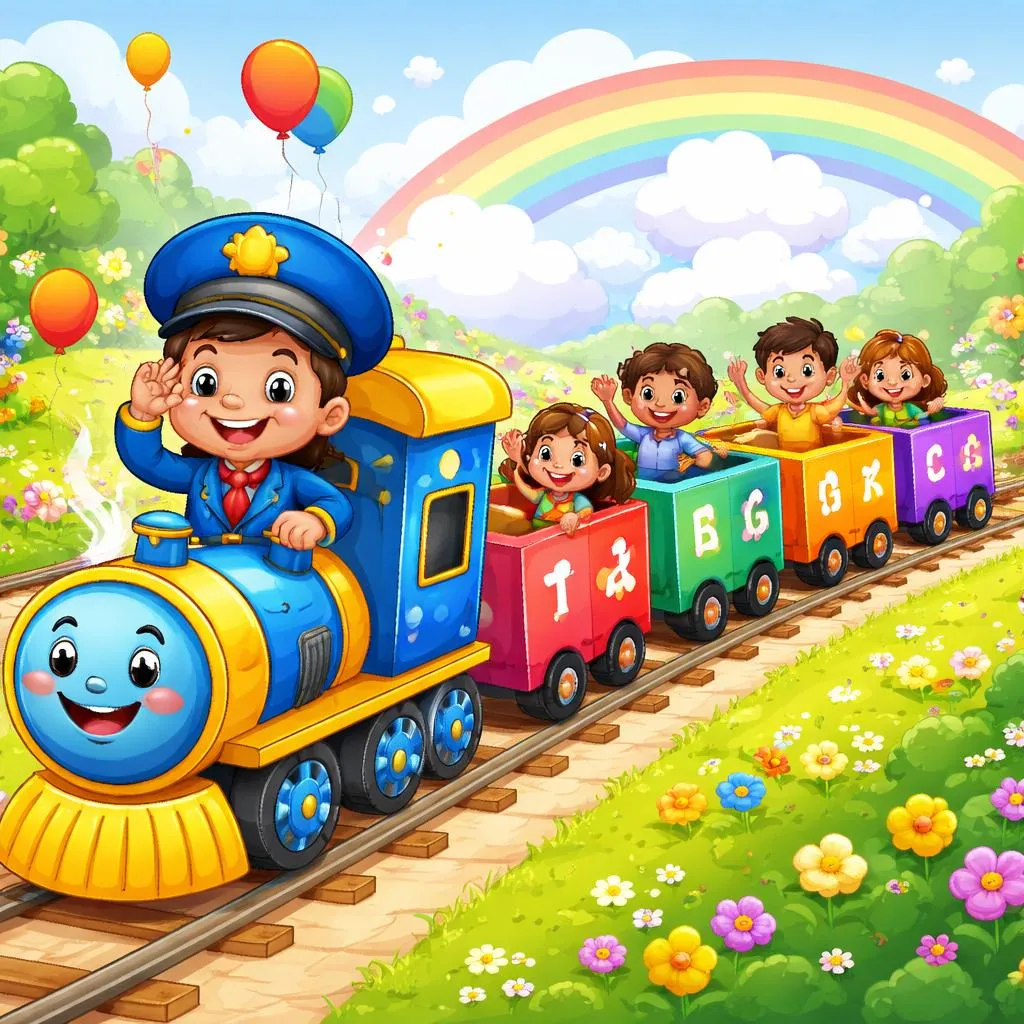

Hello, word conductor! Do you know about a train? A train has many cars. They are connected by strong couplings. The couplings hold the cars together. Your sentences have couplings too! These word couplings are called conjunctions. A conjunction is a word that connects other words, phrases, or sentences. It joins ideas together. Today, we will connect eighty wonderful word cars. Our guide is Cory the Conjunction Conductor. Cory loves to drive the word train! He will show us conjunctions at home, the playground, school, and on the railroad. Let's get the train rolling!
What Is a Conjunction? A conjunction is your word coupling. It is a connecting word. It joins two or more words, groups of words, or whole sentences. It makes your ideas flow together smoothly. At home, you say "I like apples and bananas." The word "and" is a conjunction. It couples the words "apples" and "bananas". At the playground, you say "I want to play, but it is raining." The word "but" connects two ideas. At school, you say "I listen because I want to learn." In nature, Cory says "The sun is warm, so the flowers grow." "Cory uses his eighty must-master conjunctions to build long trains of thought." Learning these conjunctions helps you build better, more interesting sentences.
Why Do We Need Word Couplings? Conjunctions are your connection power! They help your ears listen. You can follow how ideas are related. You hear reasons, contrasts, and additions. They help your mouth speak. You can explain your thoughts clearly. "I am tired, so I will rest." They help your eyes read. Conjunctions are the glue that holds stories and explanations together. They help your hand write. You can write compound and complex sentences that show relationships between ideas. Using word couplings makes you a sophisticated thinker and communicator.
What Types of Couplings Do We Have? We have three main types of conjunction couplings. Each one connects in a different way.
Coordinating Conjunctions (F.A.N.B.O.Y.S.): These join equal parts. For, And, Nor, But, Or, Yet, So. Subordinating Conjunctions: These join a main idea to a less important one. They show a relationship like cause, time, or condition. Because, if, when, although, since, before, after, while, until. Correlative Conjunctions: These work in pairs. Either/or, neither/nor, both/and, not only/but also.
We will learn conjunctions from all these groups in our list of eighty.
How Can You Spot a Word Coupling? Spotting a conjunction is a fun train-spotting game. Use these simple clues.
First, look for the F.A.N.B.O.Y.S. words. They are very common couplings.
Second, look for words that often start a dependent clause (a clause that can't stand alone). Words like because, if, when, although.
Third, see if the word is joining two words, two phrases, or two sentences. If it is, it's probably a conjunction.
Look at Cory's train. "I like cookies, and I like milk. I will eat them because I am hungry." The word "and" joins two sentences. The word "because" joins a main idea ("I will eat them") to a reason ("I am hungry"). You found two conjunctions!
How Do We Use Our Word Couplings? Using conjunctions is about knowing which coupling to use for the job. For coordinating conjunctions joining two sentences, use a comma before the conjunction. Pattern: Sentence + Comma + FANBOYS + Sentence. "I like dogs, and my friend likes cats."
For subordinating conjunctions, you can put the clause first or second. If the dependent clause is first, use a comma after it. "Because it is cold, I wear a coat." If it is second, usually no comma is needed. "I wear a coat because it is cold."
For correlative conjunctions, make sure you use both parts correctly. "Either you come with me, or you stay here."
Cory shows us. "I am seven years old, and I go to school. Because I am smart, I learn quickly. I like both reading and writing."
Let's Fix Some Coupling Mistakes. Sometimes our train cars get uncoupled. Let's fix that.
A common mistake is a comma splice. This is using a comma alone to join two sentences. "I like pizza, it is tasty" is wrong. Use a conjunction: "I like pizza, and it is tasty" or "I like pizza because it is tasty."
Another is using the wrong conjunction. "I was tired, and I went to bed" is okay, but "I was tired, so I went to bed" shows cause and effect better.
Also, with correlative conjunctions, the parts that follow each half must be parallel. "I like both to swim and running" is awkward. "I like both swimming and running" is better.
Can You Be a Master Conductor? You are a great conductor! Let's play the "Connect the Cars" game. I will give you two ideas. You connect them with a conjunction. Ideas: "It is sunny. We will go to the park." You say: "It is sunny, so we will go to the park." Ideas: "I like cats. I am allergic to them." You say: "I like cats, but I am allergic to them." Great! Here is a harder challenge. Take the sentence "I finished my homework". Add a subordinate clause that starts with "after" and one that starts with "because".
Your Coupling Kit of 80 Must-Master Conjunctions. Ready to see the full kit? Here are eighty wonderful conjunctions. Cory the Conductor uses them all. They are grouped by their main type. Each group has examples from our four scenes.
Coordinating Conjunctions (F.A.N.B.O.Y.S. and more) - 20. For, and, nor, but, or, yet, so, and then, and so, but also, or else, yet still, so then, and yet, but then, or so, for example, and therefore, but however, or otherwise. Examples: Home: I am full, for I ate a big lunch. I have a mom and a dad. I have no sister, nor do I have a brother. I am small, but I am strong. Would you like juice or milk? I am young, yet I am responsible. I was thirsty, so I drank water. Playground: Let's play tag, and then we can swing. I fell down, but I am okay. We can slide or climb. It started to rain, yet we played on. The bell rang, so then we went inside. School: I raised my hand, for I knew the answer. I write with a pencil and an eraser. I did not talk, nor did I shout. I tried, but I made a mistake. Is the answer A or B? It was hard, yet I finished. I studied, so I did well. Nature: The flower needs sun and water. It is not an animal, nor is it a rock. The branch is thin, but it is strong. Is it a rock or a pinecone? The path is long, yet the walk is nice. The cloud was dark, so it rained.
Subordinating Conjunctions - 40. After, although, as, as if, as long as, as much as, as soon as, as though, because, before, even if, even though, how, if, in case, in order that, now that, once, only if, provided that, since, so that, than, that, though, till, unless, until, when, whenever, where, wherever, whether, while, why, as, after, before, if, since. Examples (a few from each scene): Home: I brush my teeth after I eat. I help although I am small. I cried because I fell. Eat your dinner before you have dessert. I will share if you ask nicely. I have grown since I was a baby. I go to bed when it is dark. I will wait until you come. I can play while dinner cooks. Playground: We can play after you finish. I will try even if it is hard. We stopped because it started to rain. Line up before you go down the slide. You can play if you are careful. We have been friends since kindergarten. I laugh when I am happy. Wait here until I get back. I can swing while you slide. School: I felt proud after I finished. I listened although it was noisy. I raised my hand because I knew. Practice your spelling before the test. You will learn if you listen. I have known this since last year. Put your hand up when you know. Read the book until page five. I will work quietly while you read. Nature: The sun rises after the night. The flower grew although it was dry. The bird sang because it was morning. Look both ways before you cross. A seed will grow if you water it. Many years have passed since the tree was a seed. Flowers bloom when spring comes. I will wait until the butterfly lands. The stars shine while we sleep.
Correlative Conjunctions - 20. Both/and, either/or, neither/nor, not only/but also, whether/or, just as/so, as/as, as many/as, no sooner/than, rather/than, such/that, scarcely/when, what with/and, the/the, more/than, less/than, so/that, as/if, as/though, as/so. Examples (focus on the first few pairs): Home: I love both my mom and my dad. You can have either an apple or a pear. I have neither a brother nor a sister. I am not only smart but also kind. Playground: I can either swing or slide. Neither my friend nor I could reach. We not only played tag but also built a fort. School: I am good at both reading and math. The answer is either right or wrong. Neither the teacher nor the student knew. Nature: I see both trees and flowers. The sound came from either a bird or a squirrel. Neither the sun nor the moon was out.
Making Your Ideas Flow Together. You did it! You are now a conjunction expert. You know a conjunction is a word coupling that connects words, phrases, or sentences. You know the three main types: coordinating, subordinating, and correlative. You can spot them and use them to build longer, better sentences. Cory the Conjunction Conductor is proud of your train-driving skills. Now your ideas can flow together in clear and interesting ways. Your writing and speaking will be more connected and powerful.
Here is what you can learn from our train adventure. You will know what a conjunction is. You will understand the different types and their jobs. You can identify conjunctions in sentences. You can use conjunctions correctly to join ideas. You have a coupling kit of eighty must-master conjunctions.
Now, let's do some life practice! Your mission is today. Be a word conductor. Listen for the words "and" and "but" when people talk. Then, use two different conjunctions to tell someone about your day. Say: "I played outside, and then I had a snack. I wanted to play more, but it was time for dinner." You just coupled your ideas! Keep connecting with your word couplings every day. Have fun, little conductor!