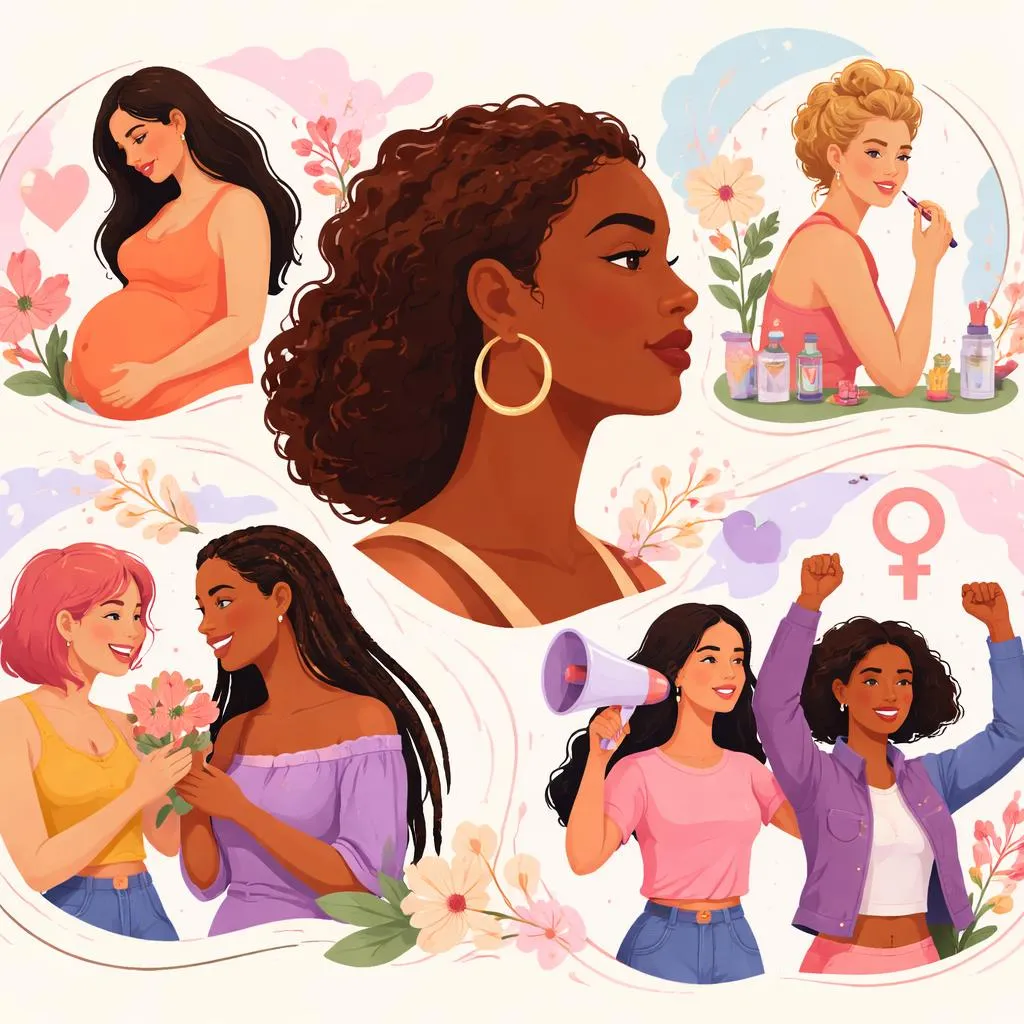

Hello, word explorer! Have you ever seen these words? A book says "a female lion." A dress is called "feminine." Someone talks about "femininity." A person believes in "feminism." They all start with "fem-". They seem connected. But they are not the same! They are a "Word Idea Team". Each member has a different job. Your mission is to learn their special meanings. Let's see a quick example.
You might say: "That is a female kitten." This talks about its sex, like girl or boy. But you could also say: "The kitten's grace is feminine." This talks about a graceful quality. Which idea is right? Both can be! You need the right team member. Let's start our word adventure!
Adventure! Decoding the Word Idea Team
Welcome to the idea playground! Our four word ideas are here. They share a root about women and girls. But their jobs are different. Meet Female. It is a factual label. Meet Feminine. It describes a style or trait. Meet Femininity. It is the name for those traits. Meet Feminism. It is a belief or movement. Let's find their big differences.
Dimension One: The Fact vs. Trait Show – What Are You Describing?
Some words state a simple fact. Others describe a cultural style or idea. This is a key difference.
Female: The Fact Label. This word states a biological fact. It answers: Is this person or animal a girl or a woman? It is about sex. It is neutral and scientific. Look at "school" and "animal" examples.
Animal example: "The female eagle is larger than the male." This is a fact about nature. It describes sex.
School example: "She is a female student in my class." This states a simple fact. It is like "boy" or "girl".
Feminine: The Trait Describer. This word describes qualities, styles, or things. These are often linked to women and girls in a culture. It is about perception, not biology. It is an adjective.
Home example: "Some people think pink is a feminine color." This describes a color's common association. It is a cultural idea.
Playground example: "Her dancing has a very feminine grace." This describes the style of her movement. It is about a quality.
Femininity and Feminism: The Idea Nouns. These are big concepts. Femininity is the abstract noun. It names the whole idea of having feminine traits. Feminism is a different abstract noun. It names the belief in equality for women.
Dimension Two: The Role Reveal – Are You a Label, a Describer, or a Big Idea?
Every word has a role. Is it a label for a category? Is it a describing word? Or is it the name of a whole concept?
Female: The Category Noun or Adjective. This word can be two things. As an adjective, it describes a noun's category. As a noun, it names a female person or animal.
As an adjective (label): "She is a female pilot." Here, "female" describes the category of the pilot. As a noun (name): "The lioness is the female of the species." Here, "female" is the name for the girl/woman animal.
Feminine: The Quality Adjective. This word is always an adjective. It describes nouns by giving them a quality. It answers "what kind?"
School example: "He has a feminine sensitivity to his friends' feelings." It describes his caring quality. "Feminine" tells us "what kind" of sensitivity.
Home example: "The room had a feminine design." It describes the style of the design.
Femininity: The Concept Noun. This word is always an abstract noun. It is not a person or thing you can touch. It is the idea, the state, or the collection of feminine traits.
Playground example: "She expressed her femininity through strong, graceful gymnastics." Here, "femininity" is the concept she showed.
Feminism: The Belief Noun. This word is also an abstract noun. It names the belief in social, political, and economic equality for women. It is about a idea and a movement.
School example: "We learned about feminism in history class." This means we learned about the equality movement.
Dimension Three: The Team-Up – Neutral, Descriptive, or Belief-Based?
These words belong in different kinds of conversations. Some are for simple facts. Some are for describing styles. One is for talking about beliefs.
Female: The Neutral Partner. This word teams up with neutral, factual language. It works in science, reports, and simple descriptions. Its partners are often other factual nouns.
Animal example: "The female wolf hunts for the pack." This is a neutral, factual statement. School example: "The female athletes trained hard." This is a simple fact.
Feminine: The Descriptive Partner. This word teams up with nouns about style, appearance, and behavior. It often pairs with words like "style", "energy", "voice", "clothing".
Home example: "She prefers feminine styles like dresses and skirts." It describes a clothing preference. Playground example: "His kindness is a feminine strength." It describes a type of strength.
Femininity: The Concept Partner. This word teams up with verbs like "express", "show", "embrace", "define". It talks about the idea as a whole. It is often used with "her", "his", "their".
Feminism: The Belief Partner. This word teams up with verbs like "believe in", "support", "study", "discuss". It is about ideas and actions related to equality.
School example: "Many people support feminism around the world." This talks about supporting the belief.
Our Discovery Map: The Word Idea Guide
So, what did we find? Our idea map is clear. Do you need to state a simple, biological fact about a girl, woman, or female animal? Use the factual word female. Do you want to describe a quality, style, or thing often associated with women? Use the descriptive adjective feminine. Do you want to talk about the whole idea or collection of feminine traits? Use the concept noun femininity. Do you want to talk about the belief in equality for women and girls? Use the belief noun feminism. Remember their teams: female is for simple facts. Feminine is for describing styles. Femininity is the big idea of those styles. Feminism is the big idea of equality.
Challenge! Become a Word Idea Master
-
Best Word Choice: Read the scene. Pick the best word. (Natural/Animal Scene) In a beehive, there is one special bee that lays all the eggs. This bee is of the egg-laying sex. a) The queen bee is the feminine leader. b) The queen bee is the female leader. Which one states the biological fact about the bee's role in reproduction? (Answer: b)
-
Two-Word Sentence Showdown: (School Project Scene) Imagine a school project about famous people. First, use "female" as an adjective to state a fact about a scientist. Example: "Marie Curie was a famous female scientist." Now, use "feminism" to talk about a belief she might have supported. Example: "Her work helped the cause of feminism."
-
Sharp Eyes! Find the Glitch: Look at this sentence. One word is not quite right for the meaning. Can you fix it? (Home/Play Scene) "My brother's femininity is shown when he plays gently with our kitten." What's wrong? "Femininity" is the abstract concept. While boys can have gentle traits, the sentence seems to label his gentle play directly as the whole concept of femininity. Using the adjective to describe the quality might be smoother. Fixed sentence: "My brother shows a feminine gentleness when he plays with our kitten." Or, "My brother's gentle play has a feminine quality."
Your Takeaway and Mission! Make Your Ideas Clear
Excellent work, idea explorer! You learned the special meanings of each word. You can now choose the right word for the right idea. Your thinking and speaking will be more precise.
What you can learn from this article:
You now see that female, feminine, femininity, and feminism are a team. But they express different ideas. You learned to use "female" for biological facts about girls and women. You use "feminine" to describe styles or qualities. You use "femininity" to name the whole concept of those qualities. You use "feminism" to talk about the belief in equality for women. You know that "female" is neutral. "Feminine" is descriptive. The other two are big idea nouns.
Live Practice Application:
Try this today! Watch animals or people. State a fact: "That is a female squirrel." Describe a style: "Her new backpack has a feminine design." Think about big ideas: "Femininity can mean strength and kindness." "Feminism means girls and boys should have equal chances." When you read or write, think: Is it a fact? Use female. Is it a style? Use feminine. Is it the big idea of style? Use femininity. Is it the big idea of equality? Use feminism. Choosing the right word makes your ideas shine. You are now a master of this word idea team. Well done