
Meaning
Hello, word detectives. Today, we are going to investigate two groups of pronouns that look like twins. They are reflexive pronouns and intensive pronouns. They look exactly the same. Myself, yourself, himself, herself, itself, ourselves, yourselves, themselves. But they have different jobs in a sentence. It is like having two friends with the same name, but one is a cook and one is a painter. We need to learn their jobs.
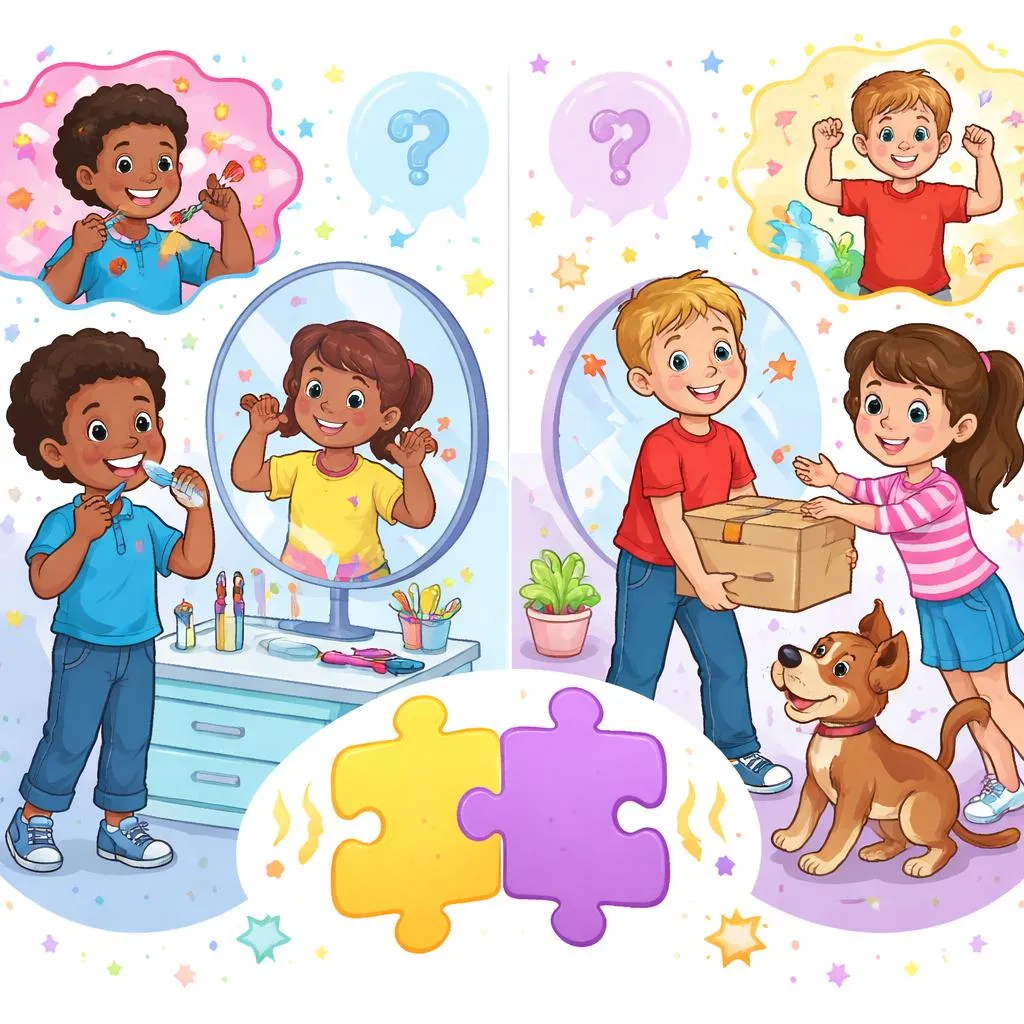
A reflexive pronoun is like a mirror. It reflects the action of the verb back to the subject. It shows that the subject is doing the action to itself. "I cut myself." Here, "myself" reflects the cutting action back to "I." An intensive pronoun is like a spotlight. It emphasizes, or puts a big highlight, on the noun it follows. It is not needed for the sentence's basic meaning. "I myself made this cake." The spotlight is on "I." Let's learn to spot the mirror and the spotlight.
Conjugation
The words themselves do not change. The list is the same for both reflexive pronouns and intensive pronouns. But you must match them to the subject. Here is the important matching list.
For one person or thing, we use: -self. I ➔ myself
You ➔ yourself (or yourselves for plural 'you')
He ➔ himself
She ➔ herself
It ➔ itself
For more than one, we use: -selves. We ➔ ourselves
You ➔ yourselves
They ➔ themselves
Whether you use the word as a mirror (reflexive) or a spotlight (intensive), you must pick the right word from this list to match the person you are talking about.
Present tense
Let's look at reflexive pronouns and intensive pronouns in the present tense, for actions and states now.
A reflexive pronoun is necessary. The sentence needs it to make sense. I am teaching myself to draw. You should believe in yourself. He is talking to himself. She bought herself a gift. The cat cleans itself. We are preparing ourselves. Please, help yourselves. They are enjoying themselves. In each, the action comes back to the subject.
An intensive pronoun is extra. It adds emphasis. The sentence is fine without it. I myself do not like spinach. (I do not like spinach.) You yourself said it was true. The teacher herself will call you. The toy itself is broken. We ourselves saw the accident. Did you build this yourselves? They themselves are to blame. The intensive pronoun is the spotlight word.
Past tense
We also use these pronouns to talk about the past. The pronouns stay the same, but the main verb changes to show past time.
Reflexive pronouns in the past: I hurt myself yesterday. You saw yourself in the mirror. He taught himself to swim. She made herself a sandwich. The door closed by itself. We found ourselves lost. Did you kids behave yourselves? They introduced themselves.
Intensive pronouns in the past: I myself baked the cookies. You yourself told me the story. The principal himself gave the award. She herself fixed the computer. The answer itself was wrong. We ourselves cleaned the whole room. You yourselves won the game. The players themselves chose the captain. Even in the past, the intensive pronoun shines a light on the subject.
Future tense
We can use these pronouns to talk about future plans and actions.
Reflexive pronouns in the future: I will buy myself a new book. You are going to teach yourself. He will build himself a fort. She is going to treat herself. The machine will turn itself off. We will ask ourselves why. Will you guys help yourselves? They are going to enjoy themselves.
Intensive pronouns in the future: I myself will be there. You yourself will see. The mayor himself will open the festival. She herself is going to lead the team. The idea itself is great. We ourselves will take care of it. Will you yourselves be ready? They themselves have promised to come. The spotlight pronoun adds strong emphasis to future plans.
Questions
We can ask questions using both types of pronouns, but the feeling is different.
Questions with reflexive pronouns often check if someone did something alone or for their own benefit. Did you make that yourself? Can he tie his shoes by himself? Why is she talking to herself? Should we go by ourselves? Did they paint the room themselves? The reflexive pronoun is part of the action.
Questions with intensive pronouns are less common, but they can be used for strong emphasis or surprise. You yourself ate the whole pie? The president himself is coming here? We ourselves have to solve this? The intensive pronoun in a question expresses disbelief or highlights importance.
Other uses
The most important thing is knowing the difference. A reflexive pronoun is needed. Without it, the sentence is wrong or unclear. "I cut" is incomplete. Cut what. "I cut myself" is clear. An intensive pronoun is an extra bonus word. You can remove it and the sentence is still correct. "I made the cake" is fine. "I myself made the cake" is stronger.
Intensive pronouns usually come right after the noun or pronoun they emphasize. Sometimes they come at the end of the sentence for a different effect. "I made the cake myself." This still emphasizes that I did it alone. The position can change, but the job as a spotlight stays the same.
Learning tips
A great tip is the "removal test." Read the sentence. Try to remove the -self/-selves word. If the sentence still makes perfect sense, the word is an intensive pronoun (spotlight). If the sentence becomes wrong or confusing, it is a reflexive pronoun (mirror). "She saw herself." Remove "herself." "She saw." Saw what. Confusing. Reflexive. "She herself saw it." Remove "herself." "She saw it." Still makes sense. Intensive.
Act it out. For a reflexive action, pretend to look in a mirror and say "I see myself." For an intensive statement, point to your chest proudly and say "I myself did it!" The physical gesture helps remember the difference between reflecting and emphasizing.
Make a two-column chart. Label one side "Mirror (Reflexive)" and draw a mirror. Label the other "Spotlight (Intensive)" and draw a spotlight. Write example sentences in each column. This visual separation helps a lot.
Educational games
Let's play "Mirror or Spotlight." Prepare a set of sentence cards. Some use the pronoun as a mirror, some as a spotlight. "The cat washed itself." (Mirror). "The queen herself waved." (Spotlight). Read a sentence aloud. Kids must hold up a picture of a mirror or a spotlight (or just say the word) to show which type it is. This quick game builds instant recognition.
Try the "Build a Sentence" challenge. Give kids two sets of word cards. Set A has sentence starters: "I taught...", "The hero...", "We made...". Set B has the -self/-selves pronouns. They must build two sentences with the same starter, one using the pronoun as a mirror, one as a spotlight. "I taught myself to juggle." (Mirror). "I myself taught the class." (Spotlight). This creative exercise solidifies the different roles.
Create a "Pronoun Theater" activity. Write short, simple scenarios on cards. One player is the narrator and reads the scenario. "Tell everyone you built the model rocket alone, with great pride." Another player must act it out and say a line using an intensive pronoun. "I myself built this rocket!" Then, "Tell everyone you accidentally gave yourself a paper cut." The player acts it out: "Ouch, I cut myself!" This combines drama, speaking, and grammar in a memorable, fun way.