
Meaning
Hello, grammar explorers. Today, we are unlocking a very useful and common part of English. We are learning about verbs in the present simple tense. Let's break that down. Verbs are action words. They tell us what someone or something does. Words like run, eat, sleep, and play are all verbs.
The present simple tense is a way we use verbs. We use it to talk about habits. Things we do again and again. I brush my teeth every morning. We use it to talk about facts. Things that are always true. The sun rises in the east. We use it to talk about things we like or do not like. I love ice cream. She does not like spinach. This tense is all about routines, truths, and regular things.
Conjugation
The word "conjugation" means changing the verb to match the subject. The subject is who is doing the action. For most verbs in the present simple, it is very easy. We use the base form of the verb. I walk. You walk. We walk. They walk.
But there is one important rule. When the subject is he, she, or it, we usually add an 's' to the verb. This is for the third person singular. He walks. She eats. It sleeps. The cat purrs. My dad works. This 's' rule is the key to using verbs in the present simple tense correctly.
Some verbs are special. The verb "to be" is different. I am happy. You are tall. He is funny. The verb "to have" changes too. I have a ball. She has a doll. We will practice these.
Present tense
The present simple tense is the main way we talk about the present for habits and facts. Let's look at it in action.
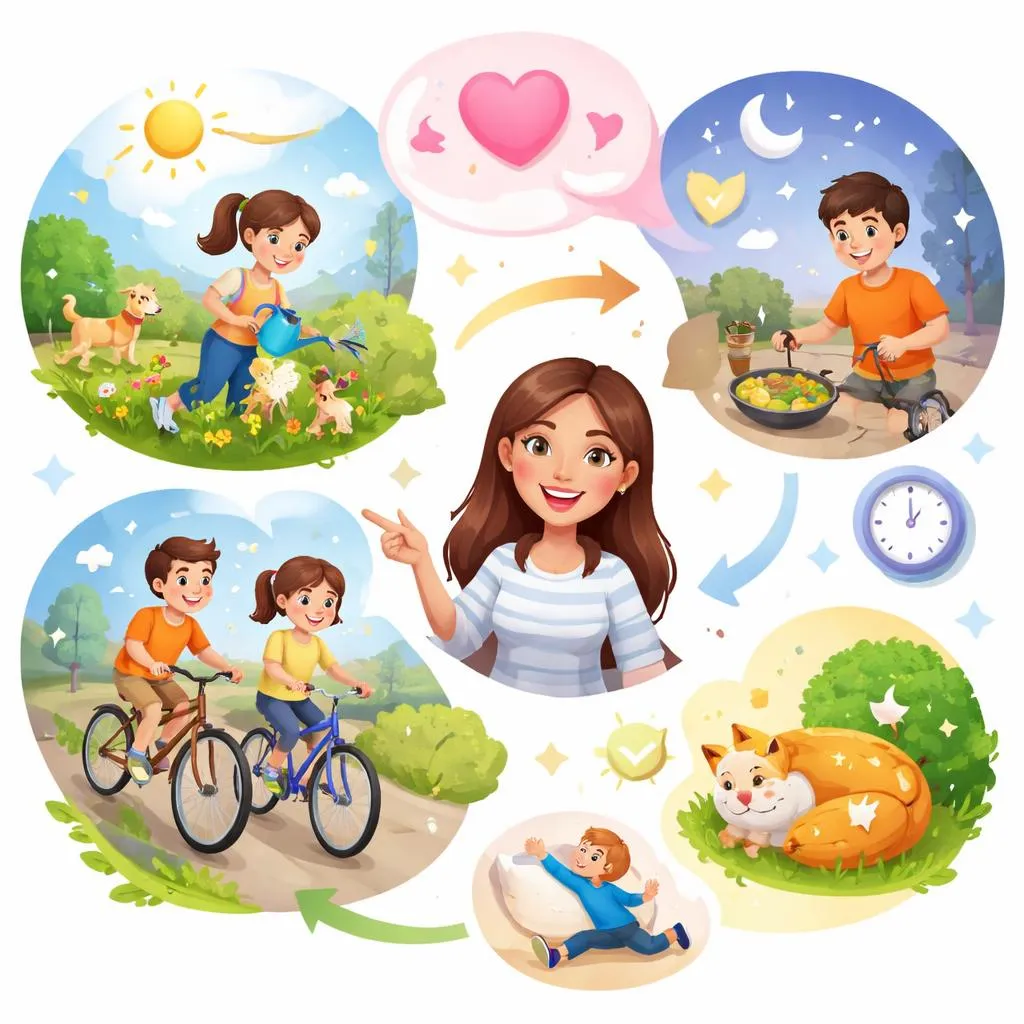
We use it for daily routines. I wake up at seven o'clock. You go to school. He eats breakfast. She reads a book. We do our homework. They play in the park. These are things that happen regularly, not just right this second.
We use it for things that are always true. Water boils at one hundred degrees. Birds fly. Two plus two equals four. Parents love their children. These are facts about the world.
We also use it for things we like or things we can do. I like chocolate. You enjoy swimming. He knows the answer. She understands the game. We want a puppy. These describe states and feelings that are generally true.
Past tense
The present simple tense itself does not talk about the past. But we can use it to tell a story that happened in the past, to make it sound exciting and like it is happening now. This is called the "historic present." We might say, "Yesterday, I am walking to school, and I see a huge dog!" This is for telling stories in a fun way.
Normally, to talk about the past, we use a different tense, like the simple past. I walked to school yesterday. She ate an apple. They played a game. The present simple tense is not used for finished past actions. It is for habits that continue into the now. I walk to school every day. This means I did it yesterday, I do it today, and I will probably do it tomorrow.
Future tense
The present simple tense is not the main way to talk about the future. We usually use "will" or "going to" for that. I will go to the zoo tomorrow. She is going to visit her grandma.
However, we use the present simple tense for the future when we talk about schedules and timetables that are fixed. The train leaves at six pm. School starts in September. The movie begins at seven. My plane arrives on Friday. We use it because the schedule is a set fact, like a rule. It is not a personal plan.
Questions
To ask questions in the present simple tense, we often use the helper verbs "do" and "does." We use "do" for I, you, we, they. We use "does" for he, she, it. After "do" or "does," we use the base form of the main verb.
Do you like pizza. Does he play soccer. Do they live here. Does the cat sleep a lot. Where do you go to school. What does she eat for breakfast. How do they get home.
For the verb "to be," it is easier. We just put the verb at the front. Am I late. Are you happy. Is he your brother. Are we ready. Where is the book. How are they.
Other uses
The present simple tense has some other fun uses. We use it for giving instructions or directions. First, you mix the flour and eggs. Then, you bake it for twenty minutes. You turn left at the traffic lights. This is because instructions are like general rules or steps to follow.
We use it in sports commentary to make the action feel immediate and exciting. He passes the ball. She shoots. She scores. The announcer uses the present simple to describe the fast action as it happens.
We also use it in stories from books. "The little bear walks into the woods. He sees a bee." Storybooks often use the present simple to make the story feel alive and happening right in front of you as you read.
Learning tips
A great way to learn verbs in the present simple tense is to talk about your own life. Make a "My Day" poster. Draw pictures of your routine. Write one sentence for each picture using the tense. I wake up. I eat breakfast. I go to school. I play with friends. I read a book. I go to sleep. This connects the grammar to your own world.
Sing a "Daily Routine" song. Use the tune of "This is the Way We Wash Our Clothes." "This is the way I brush my teeth, brush my teeth, brush my teeth. This is the way I brush my teeth so early in the morning." Change the actions. Sing about getting dressed, eating lunch, riding the bus. Music makes the pattern stick in your head.
Practice the 's' rule with a silly game. Every time you see a single person or thing (like your mom, the clock, a dog), point and say "He runs!" or "She cooks!" or "It ticks!" Do it fast. This gets your brain used to adding that 's' for he, she, and it.
Educational games
Let's play "Simon Says" with verbs in the present simple tense. The leader says, "Simon says, 'You jump.'" Everyone jumps. "Simon says, 'He claps.'" Everyone pretends to be a 'he' and claps. "You spin." If someone spins without hearing "Simon says," they are out. This game gets you moving and using the verb forms in commands.
Play "Find Someone Who..." Create a simple worksheet with present simple habits. "Find someone who... has a pet dog... likes broccoli... plays the piano... reads every night." Kids must walk around the classroom and ask questions. "Do you have a pet dog?" "Do you like broccoli?" They write the name of the classmate who says "Yes, I do." This is a classic and fun speaking activity.
Try the "Fact or Habit?" sorting game. Write many sentences on cards. Some are facts. "The moon orbits Earth." Some are habits. "I drink milk with dinner." Some are wrong. "I am eating an apple right now" (that's present continuous, not simple). In teams, kids must sort the cards into the "Fact," "Habit," or "Oops, Wrong Tense!" piles. This game really tests their understanding of when to use the present simple tense.