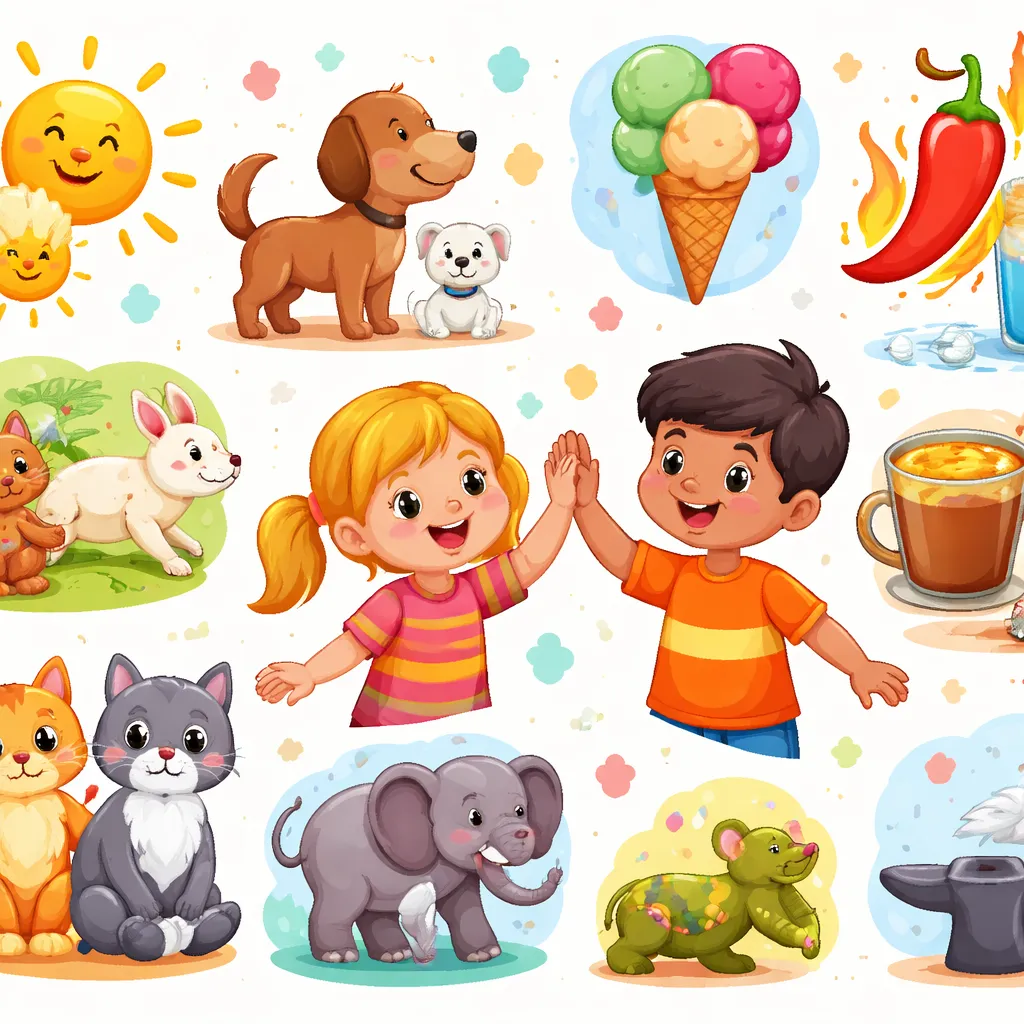

Words are like people. Some words are best friends. They have almost the same meaning. These are synonyms. Some words are total opposites. They have opposite meanings. These are antonyms. Knowing these "Word Friends" and "Word Opposites" makes you a word expert. Let's explore this exciting world.
What Are 'Word Friends' and 'Word Opposites'?
Synonyms are different words that share a similar meaning. They are like friends who like the same things. Antonyms are words with opposite meanings. They are like rivals in a game. At home, you feel 'happy'. A synonym is 'joyful'. An antonym is 'sad'. At the playground, you 'run'. A synonym is 'sprint'. An antonym is 'walk'. In school, a test can be 'easy'. A synonym is 'simple'. An antonym is 'hard'. In nature, the day is 'bright'. A synonym is 'sunny'. An antonym is 'dark'. These relationships make language rich.
Why Are These Word Relationships So Valuable?
Knowing synonyms and antonyms builds your word power. It helps your ears, your voice, your reading eyes, and your writing hand.
First, it helps your listening. You hear a character say, "I'm terrified!" You know a synonym is 'scared'. You understand the strong feeling. A teacher might say, "This is optional, not mandatory." You hear the antonyms. You know it's a choice. You catch the exact meaning in conversations and stories.
Next, it makes your speaking vivid and precise. You can describe things better. Instead of always saying "good", you can say "excellent" or "fantastic". You can explain differences clearly. "The soup isn't hot; it's cold." Your words become more colorful and expressive. People enjoy listening to you.
Then, it gives you a reading superpower. You read a description: "The colossal, gigantic tree." You see two synonyms. You understand the author is emphasizing huge size. You read: "It was a success, not a failure." The antonyms make the contrast clear. This helps you understand the author's message quickly and deeply.
Finally, it makes your writing engaging and sophisticated. Your stories won't be repetitive. Instead of "The big, big house," you can write "The enormous, massive house." Your essays will show contrast. "Some plants need sun, while others prefer shade." Your writing becomes dynamic and interesting to read.
Meet the Word Friends and Opposites
Let's give each group a fun nickname and explore them.
First, the Word Friends: Synonyms. These words are buddies with similar meanings. They help you avoid repetition. Look at these examples. At home: 'Begin' and 'start' are synonyms. "Let's begin our project." or "Let's start our project." At the playground: 'Fast' and 'quick' are synonyms. "She is a fast runner." or "She is a quick runner." In school: 'Correct' and 'right' are synonyms. "Your answer is correct." or "Your answer is right." In nature: 'Silent' and 'quiet' are synonyms. "The forest was silent." or "The forest was quiet."
Now, the Word Opposites: Antonyms. These words are total contrasts. They show differences. Look at these examples. At home: 'Day' and 'night' are antonyms. At the playground: 'Win' and 'lose' are antonyms. In school: 'Question' and 'answer' are antonyms. In nature: 'Young' and 'old' are antonyms. A tree can be young or old.
Remember, synonyms are not always exactly the same. 'Big' and 'huge' are synonyms, but 'huge' is stronger. Antonyms are often used to show a clear difference or choice.
Your Detective Tool: How to Spot Them
Finding synonyms and antonyms is a fun game. For synonyms, ask: "Can I replace this word with another that means almost the same?" If yes, you've found a synonym. For antonyms, ask: "What is the opposite idea of this word?" The sentence might have clues like 'but', 'however', or 'not'. The patterns are: Similar Meaning = Synonyms. Opposite Meaning = Antonyms. A thesaurus is a great tool to find them.
How to Use Your Word Friends and Opposites
Using them well makes your language sparkle. Use synonyms to make your writing less boring. Use antonyms to show contrast and make your point stronger. The formula is simple: To add variety, use synonyms. To show difference, use antonyms. For example, instead of: "The weather was good. We had a good time." Try: "The weather was perfect. We had a wonderful time." (Synonyms). Or, "The first plan failed, but the second one succeeded." (Antonyms).
Oops! Let's Fix Common Mistakes
Everyone makes word choice mistakes. Let's fix common ones. One mistake is using a synonym that doesn't quite fit. A child might write: "I ate a fast meal." 'Fast' is a synonym for 'quick', but we usually say "a quick meal". The correct word is 'quick'.
Another mistake is forcing antonyms where they aren't needed. Do not write: "I love and hate pizza." unless you truly have both feelings. Use antonyms to show real contrast, not just to use big words.
A third mistake is thinking all synonyms are interchangeable. They are not. 'House' and 'home' are similar, but 'home' has a warmer feeling. Choose the word that fits the feeling you want.
Are You Ready for a Word Relationship Challenge?
Test your skills. Think of three synonyms for the word 'small'. Now, think of three antonyms for the word 'happy'. Look at a sentence from a book. Find one word and think of its synonym and antonym. Finally, write a short paragraph about your favorite season. Use at least two pairs of synonyms and one pair of antonyms. Make your writing shine!
You Are Now a Master of Word Relationships
You have learned all about synonyms and antonyms. You know synonyms are Word Friends with similar meanings. You know antonyms are Word Opposites. You have tools to find and use them. You can make your speaking and writing more powerful. You can even avoid common word choice errors. Your vocabulary is now stronger and more flexible.
You can learn many things from this article. You now know that synonyms are words with similar meanings, and antonyms are words with opposite meanings. You understand that using synonyms can make your writing more varied and interesting, while using antonyms can help you show contrast and clarify ideas. You learned how to identify these words and use them effectively in your own speaking and writing. You also know to be careful to choose the exact right word, as not all synonyms are perfect replacements.
Now, try using your new knowledge in real life. Here are two fun ideas. First, play the "Synonym Switch" game. When you're talking with family, try to replace a common word with a synonym. For example, instead of saying "I'm tired," say "I'm exhausted." Second, be a "Word Detective" in a magazine article. Find one sentence and list all the synonyms and antonyms you can think of for the key words. Share your list. Have fun playing with words!