
A young girl watches from the reeds. Her baby brother floats in a basket on the river. She must stay quiet. She must stay brave. Everything depends on her. Children's Bible story about Miriam introduces us to one of the Bible's first heroines. She grows from a watchful sister into a leader and prophet who helps guide God's people.
Miriam's name means bitter, but her life brought sweetness to Israel. Let us walk beside her through the bulrushes, across the Red Sea, and into the wilderness.
<h2>What is the story?</h2> Children's Bible story about Miriam begins in Egypt. God's people, the Israelites, live as slaves. The Egyptian king Pharaoh fears them. He gives a terrible order. Every baby boy born to the Hebrews must be thrown into the Nile River.A baby boy is born to a Levite family. His mother hides him for three months. When she can hide him no longer, she takes a basket made of papyrus reeds. She coats it with tar and pitch to make it waterproof. She places the baby inside and puts the basket among the reeds along the riverbank.
The baby's older sister stands watch at a distance. Her name is Miriam. She wants to see what will happen to her little brother.
Pharaoh's daughter comes down to the river to bathe. Her servants walk along the riverside. She sees the basket among the reeds and sends a servant to get it. When she opens it, she sees the baby. He is crying. She feels sorry for him. This is one of the Hebrew babies, she says.
Miriam steps forward with courage. She approaches the princess and asks, Shall I go and call a nursing woman from the Hebrew women to nurse the baby for you?
Pharaoh's daughter says yes. Miriam runs and brings her own mother. The princess tells her, Take this baby and nurse him for me. I will pay you.
Miriam's mother takes her baby home, safe because of Pharaoh's own order. When the child grows older, she brings him to the princess. The princess names him Moses, saying, I drew him out of the water.
Miriam grows up. Years later, Moses leads God's people out of Egypt. Pharaoh's army chases them to the Red Sea. God parts the waters. Israel crosses on dry ground. When the army follows, the waters crash down and destroy them.
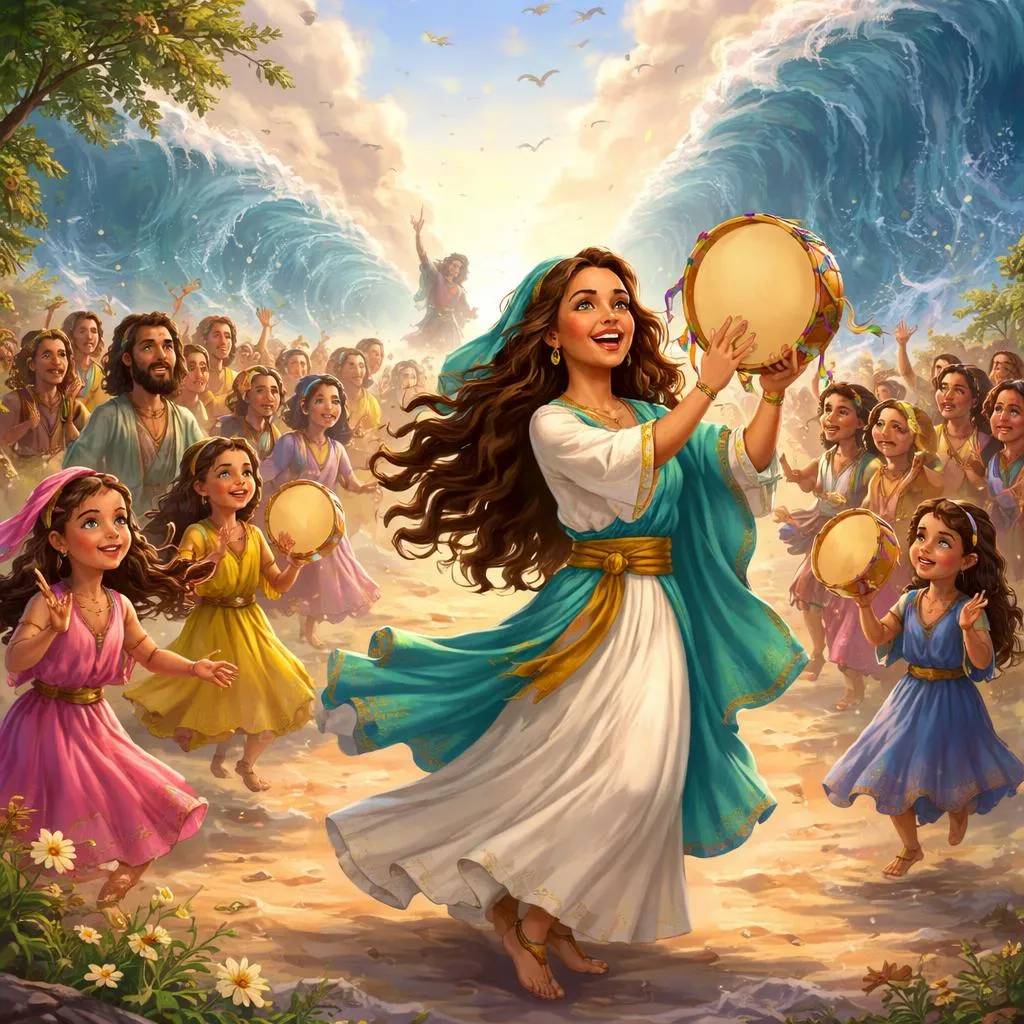
Then Miriam the prophetess takes a tambourine in her hand. All the women follow her with tambourines and dancing. Miriam sings to them, Sing to the Lord, for he has triumphed gloriously. The horse and his rider he has thrown into the sea.
<h2>The message of the story</h2> Children's Bible story about Miriam carries powerful messages about courage and celebration. Young Miriam showed bravery beyond her years. She watched her baby brother from the reeds. She spoke to a princess. She saved her entire family without anyone telling her what to do.God uses children. Miriam was probably between five and ten years old when she watched Moses. Yet she played a crucial role in God's plan. Children learn that they matter too. God can use them right now, not just when they grow up.
Miriam also shows the importance of women in God's story. She is called a prophetess, one who speaks for God. She leads worship after the Red Sea crossing. Her song is one of the oldest poems in the Bible.
The story also teaches about God's care. A baby in a basket seemed helpless. But God placed a sister nearby, a princess at the river, a mother ready to nurse. God works through ordinary people to protect and provide.
We can ask our children, When have you felt brave like Miriam? How did you help someone even though you were young?
<h2>Vocabulary learning</h2> Children's Bible story about Miriam introduces important words that help children understand this ancient tale.Bulrushes are tall reeds that grow along riverbanks. Miriam's mother used them to make the basket.
Tar and pitch are sticky substances that make things waterproof. They kept water out of Moses' basket.
Princess means the daughter of a king or Pharaoh. Pharaoh's daughter found Moses and saved him.
Prophetess means a woman who speaks for God. Miriam was a prophetess who led worship.
Tambourine is a musical instrument like a small drum with metal discs. Miriam played tambourine and danced.
Exodus means a mass departure of people. The Exodus from Egypt is the central event of the Old Testament.
After reading, we can use these words naturally. When you see reeds by water, you might say, Those look like bulrushes, like where baby Moses was hidden. When you hear music, you might say, Let's dance and sing like Miriam.
<h2>Phonics points</h2> The names in children's Bible story about Miriam give us lovely phonics practice.Miriam has three syllables. Mir-i-am. The M at the beginning requires closing the lips. Mmm-miriam. The R in the middle requires curling the tongue. The I is short like in it. Mir-i-am.
Moses has two syllables. Mo-ses. The M again at the beginning. The O is long like in go. The S at the end of the second syllable hisses. Mo-ses. This name appears throughout the Bible.
Pharaoh has three syllables but feels like two. Pha-raoh. The PH makes an F sound. Fff-pharaoh. The R in the middle curls. The AOH at the end says long O. Fair-o.
Egypt has two syllables. E-gypt. The E is short like in egg. The GY makes a J sound. E-jipt. This name teaches that letters can make unexpected sounds.
We can play with these sounds by finding other words with the same patterns. Miriam and mirror both start with Mir. Moses and motor both start with Mo. Pharaoh and phone both start with Ph making F.
<h2>Grammar patterns</h2> Children's Bible story about Miriam uses language patterns that help children understand how sentences work.We see action verbs that move the story. Miriam watched. She waited. She spoke. She ran. Each verb shows something happening and reveals Miriam's character.
Questions appear at key moments. Shall I go and call a nursing woman? Miriam's question changes everything. It shows her wisdom and courage.
The story uses dialogue to show relationships. Pharaoh's daughter says, Take this baby and nurse him. Miriam's mother hears these words and knows her son is safe.
We see time markers that help follow the sequence. When the baby could be hidden no longer. When he grew older. Years later. These phrases connect events across time.
After reading, we can notice these patterns. The story said Miriam watched from a distance. Why do you think she didn't go closer? What would have happened if she had?
<h2>Learning activities</h2> Children's Bible story about Miriam inspires creative activities that help children connect with her experience.Make a floating basket like Moses used. Use a small box or bowl. Cover it with foil or wax paper to make it waterproof. Place a small doll inside and float it in the bathtub. Talk about how Miriam's mother trusted God with her baby.
Create tambourines for dancing. Use paper plates stapled together with dried beans inside. Decorate them with streamers. Play music and dance like Miriam after the Red Sea crossing.
Practice being a watchful sister like Miriam. Set up a safe watching post in your home. Have your child watch over a younger sibling at play. Talk about how Miriam kept Moses safe by watching carefully.
Draw the river scene with baby Moses in his basket, Miriam watching from the reeds, and the princess finding him. Include all the details from the story.
<h2>Printable materials</h2> Many wonderful printable materials exist for children's Bible story about Miriam.Look for coloring pages showing Miriam watching by the river, Miriam speaking to the princess, and Miriam dancing with a tambourine. Children can color while you talk about each brave moment.
Find printable paper dolls of Miriam as a girl and as a woman. Dress her in Bible times clothing. Act out scenes from her life.
Some websites offer printable sequencing cards for Moses' rescue. Put them in order. Mother hides baby. Miriam watches. Princess finds basket. Miriam speaks. Mother nurses Moses. This builds story comprehension.
You might also find printable verse cards with Miriam's song. Sing to the Lord for he is highly exalted. Display these where your child can see them.
<h2>Educational games</h2> Games based on Miriam's story help children internalize these lessons through play.Play a game of I Spy using details from the story. I spy something made of reeds. I spy someone wearing a crown. I spy something that floats. Children guess the basket, princess, or basket again.
Create a river bank hiding game. Hide a small baby doll somewhere in a room. One person watches from a distance while others search. The watcher gives hints but does not touch the baby, just like Miriam watched but did not interfere.
Play a call and response game with Miriam's song. You sing Sing to the Lord. Your child echoes. For he has triumphed gloriously. Echo. The horse and his rider. Echo. He has thrown into the sea. Echo. This builds memory and joy.
For younger children, play a simple matching game matching Miriam to her tambourine, Moses to his basket, and the princess to her crown.
These games show that Miriam's story offers wonderful opportunities for learning through play. Children absorb her courage while having fun together.
<h2>Miriam's later life</h2> Children's Bible story about Miriam does not end with the Red Sea. She continues as a leader through the wilderness years. But like all Bible heroes, she makes mistakes too.In the wilderness, Miriam and Aaron speak against Moses. They say, Has the Lord spoken only through Moses? Has he not also spoken through us? They question Moses' special relationship with God.
God hears this. He calls Moses, Aaron, and Miriam to the tent of meeting. He appears in a pillar of cloud. He reminds them that Moses is faithful in all God's house. He speaks to Moses face to face, not in riddles.
When the cloud lifts, Miriam has leprosy. Her skin turns white as snow. Aaron begs Moses to intercede. Moses cries out, Please God, heal her!
God answers that she must be shut outside the camp for seven days. Then she can return. The whole camp waits for her. They do not move on until Miriam comes back.
This part of the story teaches that even leaders make mistakes. Miriam forgot her place. She became proud. But God disciplined her and then restored her. The people waited. She remained part of God's family.
<h2>The message of Miriam's whole life</h2> Miriam's story shows a full life. She starts as a brave child. She becomes a worship leader. She stumbles in pride. She receives discipline and restoration. She finishes her journey with God's people.Children need to see that Bible heroes were real people. Miriam was not perfect. She made mistakes. But God still used her. God still loved her. God still included her in the story.
Miriam died in the wilderness during the forty years of wandering. The people buried her there. She never entered the promised land. But her song lived on. Her courage inspired generations. Her tambourine echoed through history.
When we share this children's Bible story about Miriam with our own children, we give them a heroine to admire. A girl who saved her brother. A woman who led worship. A leader who stumbled and got back up. A life fully lived for God.
So find a children's Bible with Miriam's story. Settle in together. Watch with her from the reeds. Dance with her by the sea. Walk with her through the wilderness. Let her courage and her song inspire the young hearts in your home.