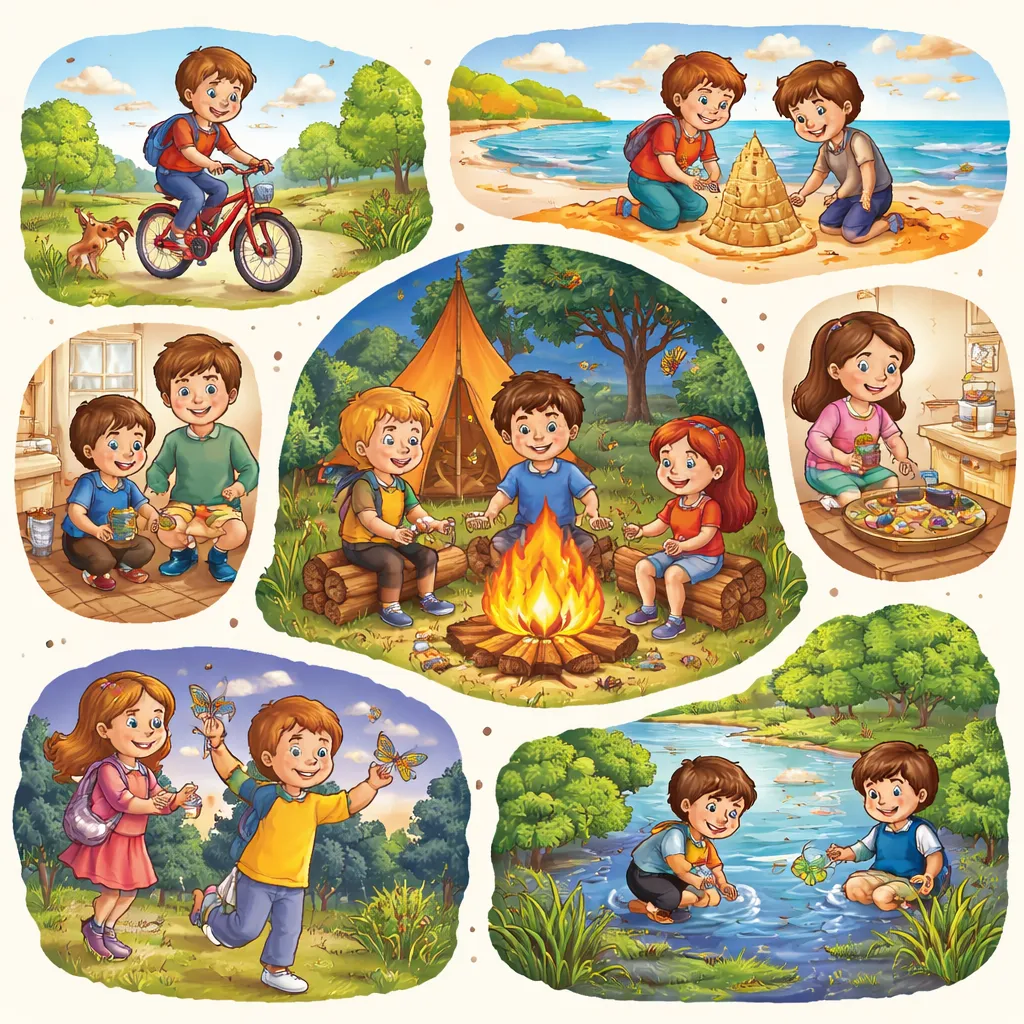

Close your eyes. Think way back. Think of something you did every summer, every weekend, or every day when you were little. How do you tell that story in a special way? You can use 'would'. 'Would' is your "Storyteller's Time Machine." It helps you share warm, repeated memories from the past. It makes your stories come alive. Let's learn this magical way of talking about the past.
What Is the 'Storyteller's Time Machine'?
'Would' is a special word. We use it to talk about repeated actions in the past. It describes habits that happened again and again. It paints a picture of "back then." We often use it to share nostalgic or personal memories. At home, your grandma might say, "When I was young, I would bake with my mother every Sunday." It was a regular, happy event. At the playground: "We would play tag for hours until the streetlights came on." It happened many times. In school: "My teacher would read us a story every Friday afternoon." It was a lovely tradition. In nature: "Every spring, the birds would return to the same tree." It was a predictable, repeated event. The 'would' time machine takes you back to these routines.
Why Is This Time Machine So Valuable?
Using 'would' for past habits makes you a captivating storyteller. It helps your ears, your voice, your reading eyes, and your writing hand.
First, it helps your listening. You listen to an elder share a memory. "In the evenings, we would all listen to the radio." You hear the warmth and routine. You catch the feeling of a time long ago. In audiobooks, it sets the scene. "The old train would chug slowly up the hill." You are transported. You learn to appreciate stories from the past.
Next, it makes your speaking vivid and nostalgic. You can share your own childhood memories beautifully. "On Saturdays, I would help my dad wash the car." This sounds more story-like than "I helped." You can create a mood. Your family stories become more engaging. People love to listen when you paint pictures with 'would'.
Then, it gives you a reading superpower. You read a novel set in the past. "Each morning, she would feed the chickens." You instantly understand this was her daily chore. This helps you sink into the world of the story. You understand characters' routines and lives deeply. Your reading becomes an immersive experience.
Finally, it makes your writing descriptive and literary. Your personal narratives and historical stories improve. Instead of "I visited my grandma," you can write "Every summer, I would visit my grandma." It shows a tradition. Your writing gains rhythm and a sense of time. You sound like a true writer.
How the Storyteller's Time Machine Works
The structure for 'would' is simple and consistent. It is the same for all subjects (I, you, he, she, it, we, they). The formula is: Subject + would + base form of the verb.
Look at these examples from our four scenes. At home: "My brother would always hide my toys." At the playground: "The kids would cheer after every goal." In school: "Our class would sing a song before lunch." In nature: "The frog would croak loudly every night."
We often use it with time expressions that show repetition: 'always', 'every day', 'every summer', 'often', 'never'.
Important Rule: The 'Would' Time Machine is for repeated actions only. It is not for describing past states (how things were). For states, we use 'used to' or the simple past. For example, you can say, "I would play there" (repeated action) but not "I would be happy" for a past state of being. For a state, say "I used to be happy" or "I was happy."
Your Detective Tool: How to Spot It
Finding this use of 'would' is a clue hunt. Look for the word 'would' followed by a base verb (like 'play', 'go', 'eat'). Then, look at the context. Is it talking about the past? Is it describing something that happened many times? The pattern is: [Subject] + would + [base verb]. Also, listen for time words like 'every day' or 'always'. These are big clues.
How to Use Your Time Machine Correctly
Using 'would' is about choosing the right memory. Think of an action you did repeatedly in the past. It should be a finished period of time. Then, use the formula. Start your sentence with a time frame if you like. "When I was six..." or "Every winter...". Then, say what you would do. The formula is: Past Time Reference + Subject + would + base verb. For example: "When I was little, I would pretend to be a superhero." Remember, it's for actions, not states.
Oops! Let's Fix Common Mistakes
Everyone makes mistakes. Let's fix the most common one. The biggest mistake is using 'would' for a past state. A child might say, "When I was five, I would have a red bike." This is wrong because 'have' here is a state (possession), not a repeated action. The correct way is: "When I was five, I had a red bike." Use 'would' for actions you did with the bike: "I would ride my red bike every day."
Another mistake is using it for a single past event. Do not say, "Yesterday, I would go to the park." For a single event, use the simple past: "Yesterday, I went to the park." Use 'would' for habits: "When I was younger, I would go to that park every week."
A third mistake is forgetting that 'would' needs a clear past context. You can't just say "I would play." You need to set the time. "When I lived in my old house, I would play in the garden."
Are You Ready for a Storytelling Challenge?
Test your skills. Think of a holiday tradition from your childhood. Describe it using 'would'. Now, think of a game you always played with a friend. Use 'would' to describe it. Imagine you are writing a story about a child 100 years ago. Write two sentences about their daily life using 'would'. Finally, write a short paragraph about "A Perfect Day in My Past." Use 'would' at least three times to describe your routines. Be a time-traveling storyteller!
You Are Now a Time Machine Operator
You have learned about using 'would' for past habits. You know it is the Storyteller's Time Machine for repeated actions. You understand the simple formula and the important rule about actions vs. states. You have clues to spot it. You can use it to tell warm, engaging stories. You can even fix common errors. You can now share memories in a beautiful, narrative way.
You can learn many things from this article. You now know that 'would' can be used to talk about repeated actions or habits in the past, often to share nostalgic memories. You understand the sentence structure: subject + would + base verb. You learned that 'would' is used for actions, not for past states (like "I was happy"), and that it often comes with time expressions like 'every day' or 'always'. You saw how this usage makes your storytelling more vivid and engaging. You also know how to avoid common mistakes, like using 'would' for a single past event.
Now, try using your new knowledge in real life. Here are two fun ideas. First, play the "Back in My Day" interview. Ask a parent, grandparent, or older sibling about their childhood. Listen for sentences with 'would'. Ask them, "What would you do every Saturday?" Write down their story. Second, be a "Memory Keeper." In your journal, write about a past routine you had (like a summer camp or an old hobby). Use 'would' at least twice to describe what you always did. Share your memory. Have fun traveling back in time!