
Meaning
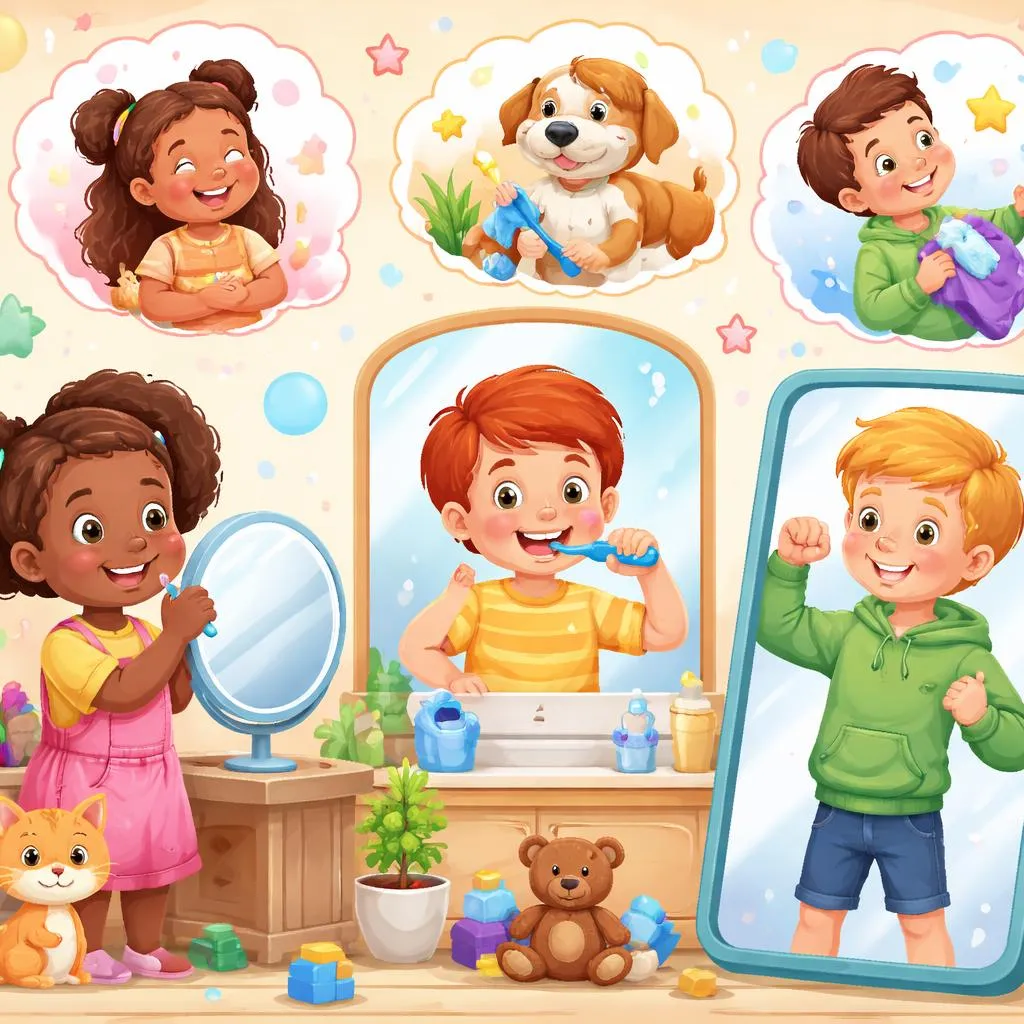
Hello, word explorers. Today we are going to learn about a special kind of word. It is called a reflective pronoun. The word "reflective" is like a mirror. A mirror reflects your image back to you. A reflective pronoun does something similar in a sentence. It reflects the action of the verb back to the subject.
Let me show you. Look at the sentence, "I see a cat." I am doing the seeing, and the cat is being seen. Now, look in a mirror. "I see myself." Who is doing the seeing. I am. Who is being seen. I am. The word "myself" reflects the action of seeing back to me. It is a reflective pronoun. It shows that the subject is doing the action to itself. It is like a word-mirror.
Conjugation
Reflective pronouns must match the subject. This means you need to pick the right one. Here is the list you need to know.
For one person or thing, we use: -self. I use myself. You use yourself. He uses himself. She uses herself. It uses itself.
For more than one person or thing, we use: -selves. We use ourselves. You use yourselves. They use themselves.
You must match them carefully. You cannot say "I saw himself." You must say "I saw myself" or "He saw himself." The reflective pronoun is a perfect mirror of the subject.
Present tense
We use reflective pronouns in the present tense to talk about actions we do to ourselves right now or as habits.
I am teaching myself to draw. You should believe in yourself. He is talking to himself. She bought herself a new book. The cat cleans itself. We need to prepare ourselves. Please, help yourselves to some fruit. They are enjoying themselves.
In all these sentences, the action comes back to the person who is doing it. I teach me. He talks to him. The cat cleans it. The reflective pronoun makes that clear. It is necessary for the sentence to be correct.
Past tense
We also use reflective pronouns to talk about actions we did to ourselves in the past. The pronoun stays the same, but the main verb changes.
I cut myself yesterday. You saw yourself in the photo. He taught himself to swim last summer. She made herself a sandwich. The door locked by itself. We found ourselves lost in the mall. Did you kids behave yourselves? They introduced themselves to the new neighbor.
Even though the action (cut, taught, made) happened in the past, the reflective pronoun (myself, himself, herself) still perfectly mirrors the subject who performed that past action on themselves.
Future tense
We can use reflective pronouns to talk about things we will do for ourselves in the future. We use "will" or "going to" with the reflective pronoun.
I will buy myself a new toy. You are going to teach yourself how to bake. He will build himself a model plane. She is going to treat herself to ice cream. The computer will restart itself. We will ask ourselves an important question. Will you guys be able to entertain yourselves? They are going to enjoy themselves at the fair.
The reflective pronoun still points back to the subject, even when we are talking about their future plans.
Questions
We can ask questions using reflective pronouns. These questions often check if someone did something alone or for their own benefit.
Did you make that cake yourself? This means, did you do it alone, without help. Can he tie his shoes by himself? Why is she talking to herself? Should we go by ourselves? Did they paint the room themselves? How do I see myself in five years?
A very common and useful question is, "Did you do it yourself?" The reflective pronoun in the question emphasizes the subject's own role in the action.
Other uses
Reflective pronouns are very important for clear sentences. Without them, some sentences are wrong or confusing. "I cut" is not a complete idea. Cut what. "I cut myself" is clear. "She taught" is unclear. "She taught herself" is clear.
We also use them after words like "by" to mean "alone." I went to the park by myself. He solved the puzzle by himself. They traveled by themselves. This is a common way to say someone did something without company or help.
Remember, a reflective pronoun is needed for the sentence to be correct. It is not an extra word. It is the mirror that completes the action.
Learning tips
A great way to learn reflective pronouns is to use the mirror idea. Actually look in a mirror and say sentences. "I see myself." "You see yourself." This physical connection helps a lot.
Make a matching chart. Write the subject pronouns in one column: I, you, he, she, it, we, you, they. In the next column, write their reflective partners: myself, yourself, himself, herself, itself, ourselves, yourselves, themselves. Look at this chart every day.
Play the "I Can Do It Myself" game. Name things you can do without help, using a reflective pronoun. "I can get dressed by myself. I can wash my hands by myself. I can make my bed by myself." This builds confidence and grammar skills.
Educational games
Let's play "Reflective Pronoun Charades." Write down sentences that use reflective pronouns on cards. "I am teaching myself to juggle." "She is looking at herself in the mirror." Players pick a card and act it out. The others must guess the full sentence. "You are teaching yourself to juggle!" This connects the grammar to action.
Try the "By Myself" sorting game. Gather pictures from magazines. Some show someone doing something alone. Some show someone getting help. Kids sort the pictures into two piles: "By Myself/Himself/Herself" and "With Help." For each "By Myself" picture, they say a sentence. "He is reading by himself." This reinforces the concept.
Create a "Super Self" award. Give each child a mission to do one new thing by themselves and report back. "I taught myself to draw a dog!" "I made my own sandwich by myself!" They get a certificate or sticker. This positive reinforcement makes using reflective pronouns a real and proud part of their day. It shows that these words are all about their own abilities and independence.