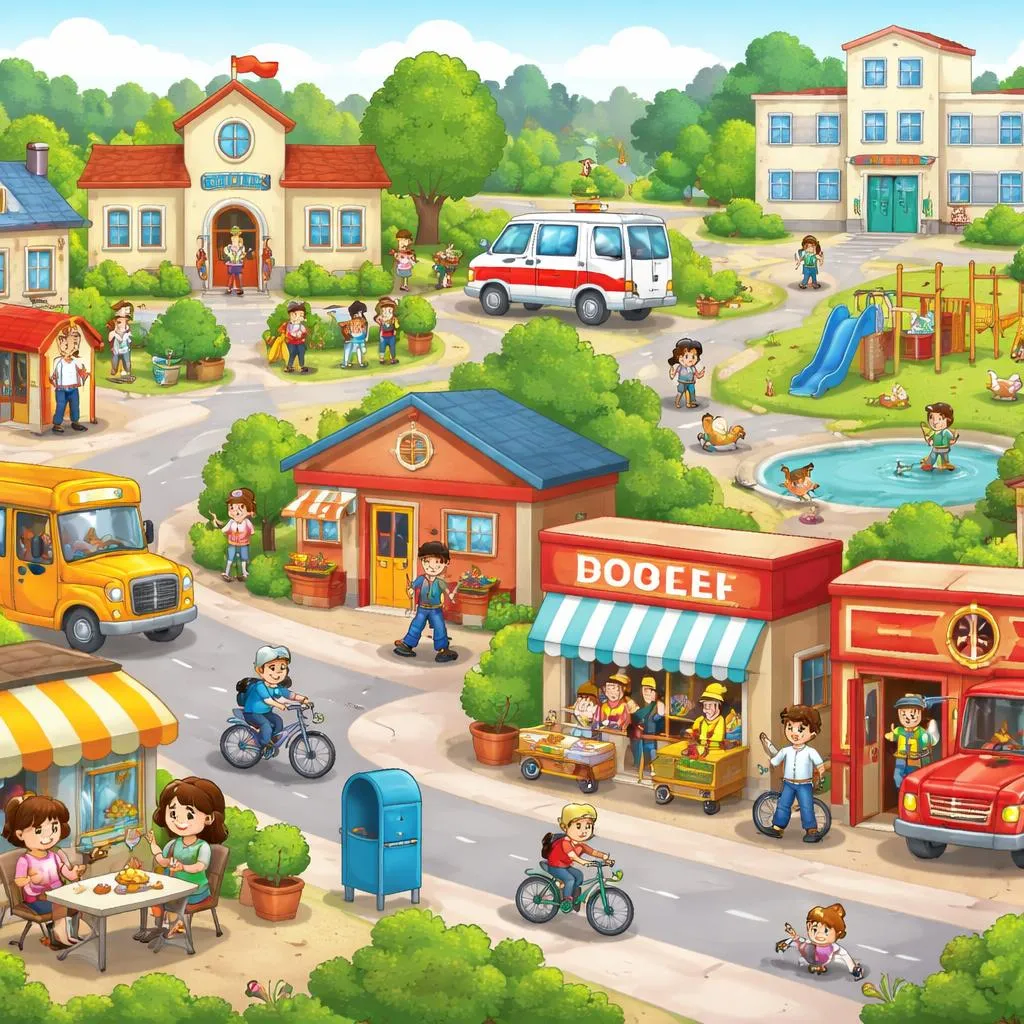

Welcome, young explorers! Today, we are going on a fascinating journey. We will answer the question, "what is in a town". A town is a community where people live, work, and play. It is filled with different buildings and places, each with a special name and purpose. Learning these names helps us describe our world in English. Let's start our discovery tour and learn about the places that make up a town.
What is "What is in a town"? The question "what is in a town" invites us to list and learn about the common features of a community. This includes all the buildings, services, and public spaces we find in most towns. Think of it as making an inventory or a map with words. Learning this vocabulary is a practical way to connect English to everyday life. It helps children talk about where they go, what they see, and understand how a community functions. It is the first step in giving directions and telling stories about daily adventures.
Meaning and Explanation Understanding what is in a town is about seeing how a community works together. Each place has a role. A hospital helps sick people. A library lends books. A supermarket sells food. A park gives space to play.
This knowledge also teaches us about categorization. We can group places by what they do: places for help, places for shopping, places for fun. Furthermore, it introduces prepositions of place. We learn to say the bank is next to the post office, or the school is between the park and the fire station. This vocabulary builds a mental map and the language to describe it.
Categories or Lists We can organize the places in a town into clear, kid-friendly categories.
Essential Services: These are crucial for safety and health. They include: Hospital (or Clinic), Police Station, Fire Station, Post Office. Education & Culture: Places for learning and enjoyment. Examples: School, Library, Museum, Cinema. Shops & Businesses: Where we buy things. Key places: Supermarket, Bakery, Bookshop, Toy Store, Restaurant, Cafe, Bank. Recreation & Transport: For fun and travel. Think of: Park, Playground, Swimming Pool, Sports Field, Train Station, Bus Stop. Living Spaces: Where people live: Houses, Apartment Buildings.
Daily Life Examples We use these words every day! You might say, "I am going to the park with my friend." Or, "Mom is at the supermarket."
If you need a book, you go to the library or a bookshop. To send a card, you visit the post office. When you are sick, you go to the hospital or clinic.
You can give simple directions: "My house is next to the school. The bus stop is in front of the bank." Using the vocabulary in real sentences makes it stick.
Printable Flashcards Flashcards are a great tool. Create a set with a picture of a place on one side.
For the Fire Station, show a picture of the building with a fire truck. On the back, write: "FIRE STATION. Firefighters work here. They help put out fires."
For the Library, show a picture of bookshelves. The back states: "LIBRARY. A quiet place to read and borrow books."
You can also make "Town Map" cards. Have a basic street grid and separate cards for each building. Children place them to create their own town, saying, "I am putting the hospital here."
Learning Activities or Games Let's make learning active and fun with these games.
-
"Build Your Town" Model: Use blocks, cardboard, or drawings to create a 3D town. Label each building as you create it. Discuss, "Where should we put the park? It should be near houses." This combines creativity with vocabulary.
-
"I Spy, Town Edition": Look at a detailed picture of a town scene. Say, "I spy with my little eye something that starts with 'B' where you buy bread." Others guess: "The Bakery!" This practices phonics and vocabulary.
-
"Where Am I Going?" Charades: One child acts out an activity (like reading a book, buying groceries, putting out a fire). Others guess the place. "You are going to the library!" or "You are at the fire station!"
-
Town Map Drawing: Give learners a blank map with roads and a river. Provide a list of places to draw and label in their town. "Draw a school here. Draw a bridge over the river." This reinforces word recognition and spatial awareness.
Asking "what is in a town" opens up a world of language. It's more than a list; it's about understanding how communities work and finding the words to talk about them. Encourage children to be word detectives on car rides or walks, spotting and naming places they see. Each new word is a piece of their English map, helping them navigate and describe their world with confidence. Keep exploring and naming the places around you