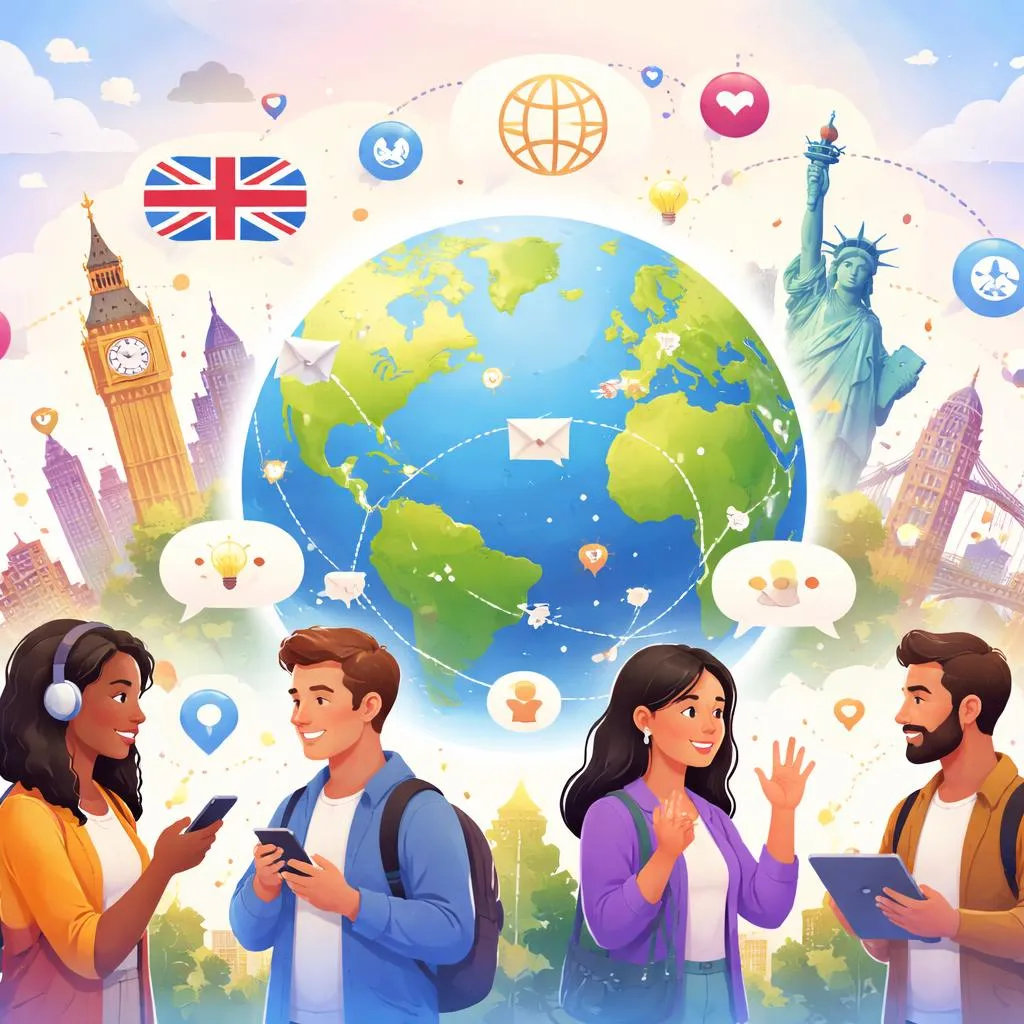

What is english language?
Hello, young language explorers. Today, we are going to talk about a very special and important way of communicating. We are going to learn about the English language. What is a language. A language is a system of words and rules that people use to talk, write, and share ideas with each other. The English language is one of the most spoken languages in the whole world.
Think of the English language as a giant, magical key. This key can open doors to new friends, exciting stories, fascinating knowledge, and fun games from many different countries. People use the English language to talk to each other in business, in science, on the internet, and when they travel. Learning about the English language helps you connect with a big, wide world. It is a wonderful adventure for your brain and your heart.
Meaning and explanation
So, what does the English language really mean. It is more than just a bunch of words. It is a living, growing system for sharing thoughts and feelings. Every language has its own rules, sounds, and special words. The English language has rules for putting words together to make sentences. It has a big collection of sounds that make up its words. And it has a huge, huge collection of words from many other languages.
The English language is also a bridge. It helps people from different countries and cultures understand each other. A scientist in Japan can share a discovery with a scientist in Brazil using the English language. Two friends playing an online game from different continents can chat in English. It is a tool for global friendship and learning. When you learn the English language, you are not just learning grammar, you are learning how to be a citizen of the world.
Categories or lists
We can think about the English language in different parts. Let's look at some of the main pieces that make it work.
The Big Parts of English: Vocabulary: This is the collection of all the words. Words for things (cat, house), actions (run, think), and descriptions (happy, blue). The English language has a very large vocabulary because it borrowed words from many other languages.
Grammar: These are the rules for building sentences. Grammar tells us the order of words. "The cat sat on the mat" is correct. "Sat cat the mat on the" is not. Grammar includes rules for tenses (past, present, future) and for making words plural (cat -> cats).
Pronunciation: This is how we say the words. The way you use your mouth, tongue, and voice to make the sounds of English. Some sounds, like "th," can be tricky for new learners.
Spelling: This is how we write the words. English spelling can be surprising. Words like "knight" have silent letters. Learning spelling is an important part of reading and writing in the English language.
Different Flavors of English: Just like ice cream comes in different flavors, the English language comes in different varieties. British English: Spoken in the United Kingdom. Words like "lorry" for truck and "lift" for elevator.
American English: Spoken in the United States. Words like "truck" and "elevator."
Australian English: Spoken in Australia. They might say "g'day" for hello.
Other Varieties: Canada, India, South Africa, and many other countries have their own special ways of using the English language, with local words and accents.
Daily life examples
You use and see the English language all around you every single day. Let's look at three simple places.
At Home Watching TV or Playing a Video Game: Turn on your favorite cartoon. The characters are probably speaking the English language. Listen to the words they use. Play a video game. The instructions, menus, and dialogue are often in English. "Press START." "You found a treasure!" "Game Over." Your fun time is also a chance to hear the English language in action.
At the Supermarket or on a Walk: Look at the signs and labels. The words on a cereal box, a juice carton, or a street sign are in the English language. "STOP." "MILK." "SALE." When you help your parent read a shopping list, you are reading the English language. The world is full of written English waiting for you to read it.
At School with Your Teacher and Friends: This is one of the most important places. Your teacher uses the English language to teach you math, science, and stories. You use it to ask a question. "Can I go to the bathroom?" You use it to talk to your friends at lunch. "Do you want to play tag?" School is your main practice zone for listening, speaking, reading, and writing in the English language.
Printable flashcards
Printable flashcards are a fantastic tool for learning parts of the English language. You can create "Word Family" cards.
Make cards for rhyming word families. One card has the letters "-at" at the bottom. Separate cards have letters: c, b, m, r, s. Kids can place the "c" card in front of "-at" to make "cat." Then change it to "b" to make "bat." This teaches phonics and spelling patterns in a hands-on way.
Another great printable is a "Parts of Speech" sorting mat. Create a mat with three sections: Noun (Person/Place/Thing), Verb (Action), Adjective (Describing Word). Then, provide a pile of word cards: "dog," "run," "happy," "school," "jump," "blue." Kids sort the words onto the correct section of the mat. This makes learning grammar visual and tactile.
You can also make "Everyday Object" vocabulary cards. Take photos of items around your house or classroom: a chair, a window, a book, a pencil. Print the photos on cards. On the back, write the word. Kids can use these to play memory games, go on scavenger hunts, or practice simple sentences. "This is a chair."
Learning activities or games
Let's play "I Spy" with a grammar twist. This classic game is perfect for the English language. "I spy with my little eye, something that is... blue and an adjective!" or "I spy something that can... run (a verb)!" This encourages kids to think about the function of words in their environment, not just the object itself.
Try the "Story Dice" game. Create dice with pictures on each side (or use printable cube templates). One die has characters (a pirate, an astronaut, a dog). Another has settings (a castle, space, a park). Another has objects (a key, a cake, a map). Kids roll the dice and must create a short, spoken story in the English language using the three elements. "The pirate found a key in the castle." This builds vocabulary and sentence skills creatively.
Create a "Classroom News Show." Set up a pretend TV studio. Each day or week, a different child or pair is the "news anchor." Their job is to write (or dictate) two short sentences about class news in the English language. "We painted pictures today." "Our plant is growing." Then, they present it to the class on "TV." This activity combines writing, speaking, and confidence-building, all while using the English language for a real purpose. It shows that language is for sharing important information with others.