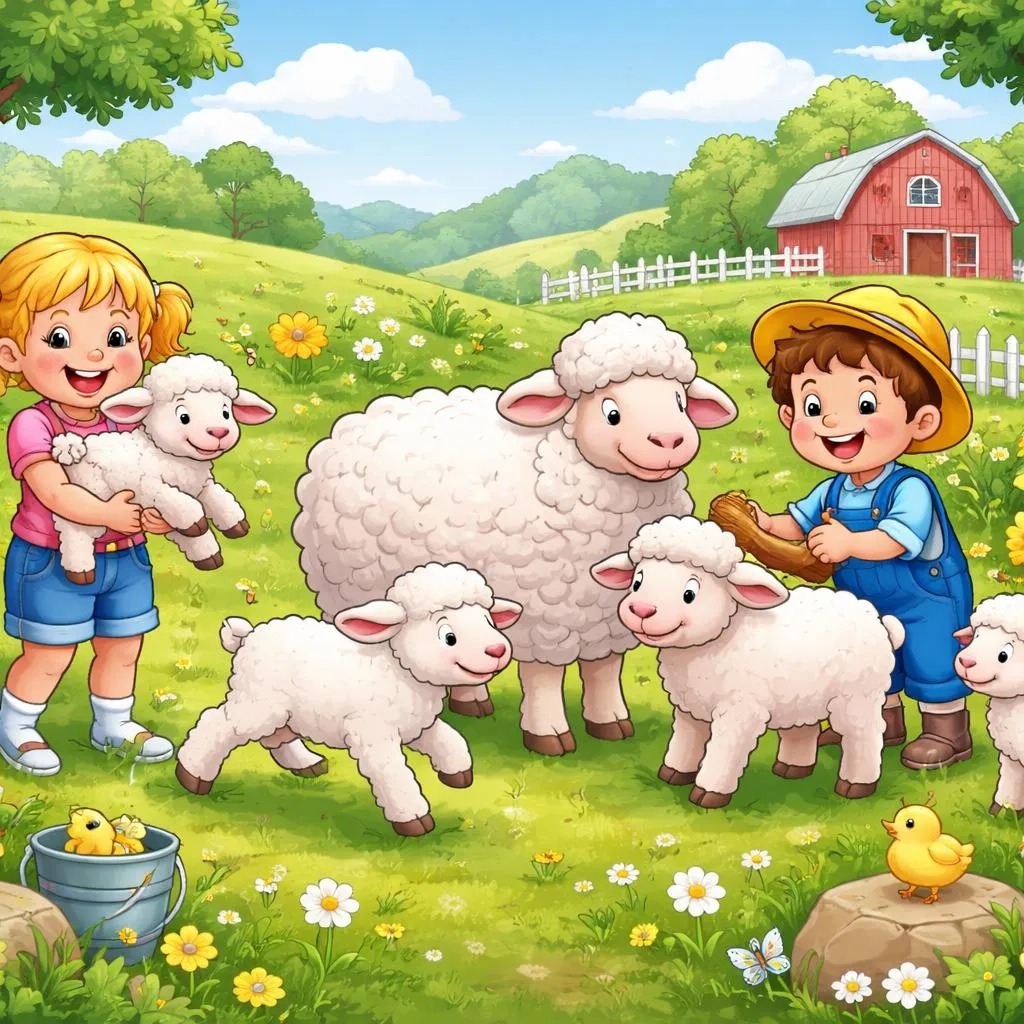

Hello, word farmer! Have you ever seen a fluffy, white animal in a field? It says "baa!" Now, imagine a tiny, wobbly one following its mother. What do you call them? You might call both a "sheep." But English has a special secret. It has two words for this. Today we explore a word pair. We explore sheep and lamb. They are like parent and child. They are in the same family. But they have different names! Knowing the difference is a superpower. Your farm stories will be soft and clear. Let us start our word pasture adventure!
Be a Language Watcher now. Our first clue is at home. You read a nursery rhyme. It says, "Mary had a little lamb." Then, you see a picture of a whole field. The caption says, "A flock of sheep." They are the same kind of animal. But are they the same word? Let us test with two sentences.
"The woolly sheep grazed on the hill." This describes a grown animal. "The little lamb followed its mother everywhere." This describes a baby.
They seem to be in the same family. And they are! One is the adult. One is the child. Your watching mission starts. Let us wander into their word field.
Adventure! Wander Into the Word Field
Feel the Word's Softness!
Feel the word sheep. It is a steady, gentle word. It feels calm and mature. It is like a soft blanket. The word lamb is a tender, sweet word. It feels incredibly cute and young. It is like a fluffy cloud. Sheep is for the flock. Lamb is for the new life. One is a peaceful field. The other is a playful hop. Let us see this at school.
In a science lesson, you learn: "A sheep is farmed for its wool." This is a fact about the animal. In music class, you sing a song about a lamb. It feels sweet and innocent. Saying "Mary had a little sheep" changes the feeling. The softness of the words is different. One is general. One is specifically young.
Compare Their Age and Meaning!
Think about a big, cozy sweater and a small, soft bib. The word sheep is the big sweater. It is the general word for the animal. It can be any age. The word lamb is the small bib. It is only the baby stage. A lamb is a young sheep. But the word lamb has another meaning. It can also mean the meat from a young sheep. The word sheep does not mean meat. The age and usage are key. Let us test this on the playground.
You play a jumping game. You say, "I can jump over the fence, like a sheep!" This is a general animal action. Your friend pretends to be a baby. She says, "I am a lost lamb, looking for my mom." This is a specific baby role. The word lamb gives a clear age clue. The playground shows the difference in life stage.
Meet Their Best Word Friends!
Words have favorite companions. The word sheep likes group and wool words. It teams up with 'flock', 'black', 'wool', and 'count'. You count sheep to sleep. You see a black sheep. The word lamb likes baby and gentle words. It teams up with 'little', 'spring', 'chop', and 'sacrificial'. You hear about spring lambs. You eat a lamb chop. Their companions are very different. Let us go back to school.
In a geography class, you learn about sheep farming in New Zealand. This is about the industry. In a literature class, you read about the "Lamb of God." This is a symbolic reference. You would not say "Sheep of God." The word friends lock in the specific meaning.
Our Little Discovery!
We explored the word pasture together. We made a soft discovery. The words sheep and lamb are a family. But they are not the same. The word sheep is the general word. It is for the whole animal species. It is for adults. The word lamb is a special word. It is only for a baby sheep. Also, lamb is the word for the meat. Sheep is the living animal. Lamb is the young one or the food. One is the parent. The other is the child.
Challenge! Become a Flock Word Expert
"Best Choice" Challenge!
Let us visit a spring farm. Read each scene. Pick the champion word. Scene one: A farmer looks at hundreds of animals. He says, "I have one thousand ______ on my land." Is it Sheep or Lambs? The champion is Sheep! He is talking about the whole flock, all ages. Scene two: You see a baby animal taking its first steps. It is only a few days old. You say, "Look at the newborn ______!" Is it sheep or lamb? The champion is lamb! It is specifically a baby. Great choice!
"My Sentence Show"!
Now, create your own sentences. Here is a fun scene: Imagine a green, rolling hill in spring. Use the word sheep in one sentence. Use the word lamb in another. Try it! Here is an example. Sentence one: "The sheep were sheared for their wool." Sentence two: "The lamb drank milk from its mother." See the difference? The first talks about the adult animals and their product. The second focuses on a baby's action.
"Eagle Eyes" Search!
Can you find the word that needs help? Read this sentence: "For dinner, we are having roasted sheep with mint sauce." Hmm. This is a common error. The meat from a young sheep is called lamb. The word sheep refers to the live animal. The correct word is: "For dinner, we are having roasted lamb with mint sauce." This is the proper term for the meal. You have a sharp eye!
What a lovely journey in the word field! You started as a curious visitor. Now you are a word shepherd. You know the secret of sheep and lamb. You can feel their different softness. You see their age and meanings. You know their best word friends. This is a real language superpower.
You can learn amazing things from this article. You now know that a 'sheep' is the general word for the woolly animal, adult or child. You understand that a 'lamb' is specifically a baby sheep. You also learned that 'lamb' is the word we use for the meat from a young sheep. You can explain that a farmer has a flock of sheep, which includes both adults and lambs. Your vocabulary for the farm is now more precise.
How can you use this today? It is easy and fun. Next time you see a picture of a farm, look closely. Point and say, "That's a grown sheep" and "That's a little lamb." Listen to songs or nursery rhymes. Notice when they use the word lamb for something young and innocent. Help set the table for dinner. If you have lamb, you can say, "We are having lamb." You are using your new knowledge every day.
Keep your shepherd's eyes open. Language helps us care for meaning, just like tending a flock. You are learning to do that with words. Great work, word farmer. Your English journey is growing warmer and more detailed with every new word pair you understand!