
Start! Find a Pair of 'Figure Twin' Words
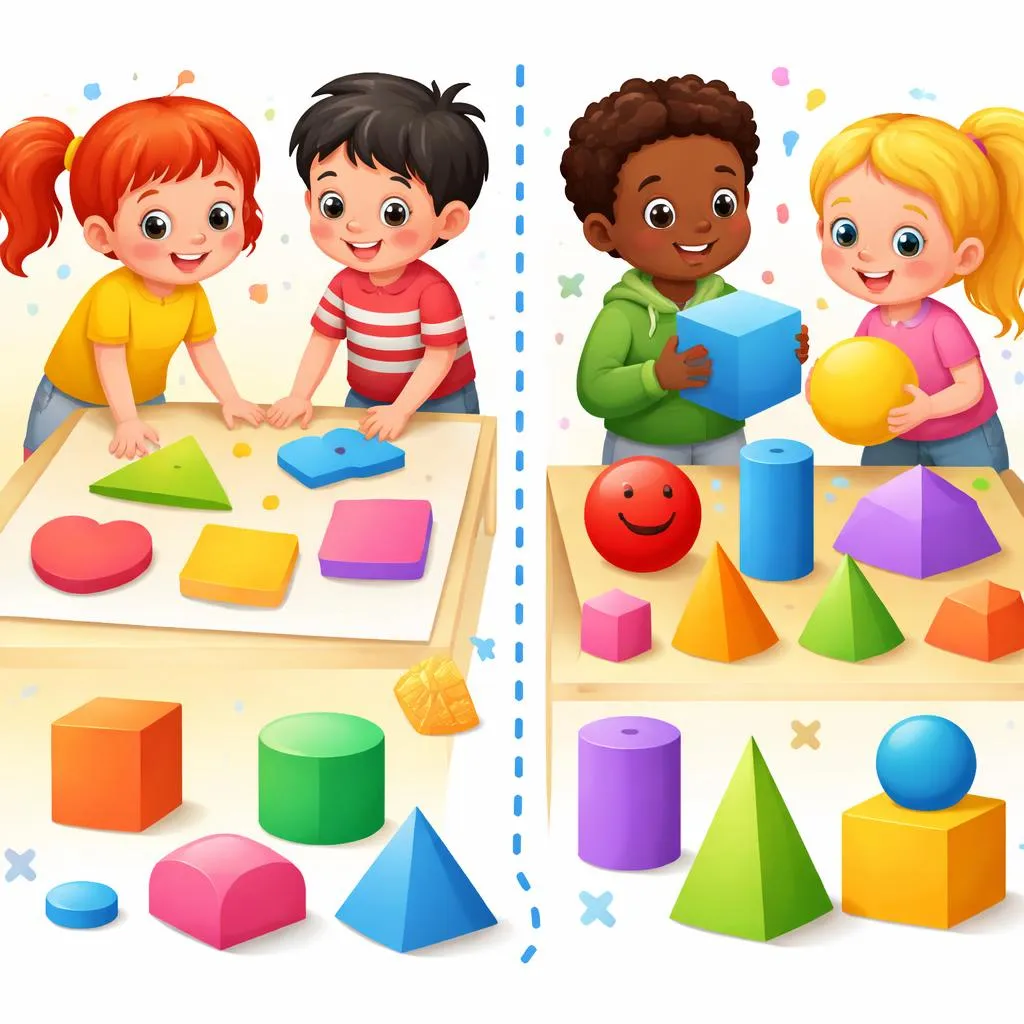
Hello, word explorer! Have you ever drawn a picture? You start with a circle or a square. Those are shapes! Now, think about a clay pot. It has a three-dimensional form. They are both about how things look. Are they the same? This is a fun word puzzle. Today we explore a word pair. We explore shape and form. They are like a drawing and a sculpture. One is flat. One is fat. Knowing the difference is a superpower. Your talk about art and math will be clear and smart. Let us start our word creation!
Be a Language Observer now. Our first clue is at home. You look at a picture book. You point to a triangle. You say, "That is a shape." Your dad points to a vase. He says, "The form of this vase is elegant." They are both about appearance. But are they the same? Let us test with two sentences.
"A triangle is a simple shape with three sides." This is about a flat, two-dimensional outline. "The sculptor worked the clay into the form of a cat." This is about a three-dimensional, solid figure.
They both describe how something is configured. But one feels flat and simple. One feels solid and full. Your observation mission starts. Let us build our way into their word world.
Adventure! Build Into the Word World
Feel the Word's Flat and Full Nature!
Feel the word shape. It is a flat, simple word. It feels like a drawing on paper. It is about outline and boundary. The word form is a full, solid word. It feels like a statue you can walk around. It is about volume and structure. Shape is the shadow. Form is the object casting the shadow. One is the silhouette. The other is the body. Let us see this at school.
In a math class, you learn about geometric shapes like squares and circles. This is about flat, measurable outlines. In an art class, you learn about the form of a sculpture. This is about its three-dimensional presence. Saying "the geometric form of a square" is less common. The dimension of the words is different. One is 2D. The other is 3D.
Compare Their Simplicity and Complexity!
Think about a paper cut-out and a stuffed animal. The word shape is the paper cut-out. It is simple, defined by its edges. The word form is the stuffed animal. It is complex, with depth and substance. Their complexity is a clue. A shape is often a basic, recognizable outline. A form suggests a more complete, often more artistic, realization. Let us test this on the playground.
You draw a star in the sand with a stick. You say, "I drew a star shape." Your friend builds a sandcastle with towers. He says, "Look at the form of my castle." The word shape describes the flat drawing. The word form describes the three-dimensional structure. The playground shows the difference.
Meet Their Best Word Friends!
Words have favorite figure partners. The word shape likes simple and geometric words. It teams up with 'take', 'in good', 'different', 'basic', 'cut out', and 'of things'. Take shape. She is in good shape. The word form likes structural and official words. It teams up with 'take', 'application', 'art', 'in the', 'bad', and 'of government'. Fill out an application form. The idea took form. Their partners are different. Let us go back to school.
In a physical education class, you get in good shape. This is about physical condition. In an office, you fill out a form to join a club. This is about a document with a structure. You would not fill out a "shape" to join a club. The word friends set the context.
Our Little Discovery!
We built in the word workshop. We made a clear discovery. The words shape and form are different. The word shape usually refers to the two-dimensional outline or external boundary of something. It is flat and simple. The word form usually refers to the three-dimensional structure or the visible configuration of something. It has depth and volume. Shape is the flat drawing. Form is the solid object. One is about outline. The other is about the whole body.
Challenge! Become a Figure Word Expert
"Best Choice" Challenge!
Let us look at a nature scene. A leaf falls from a tree. You look at its flat outline against the sky. You are observing the leaf's shape. Is it Shape or Form? The champion is Shape! The outline of the leaf is its two-dimensional shape. Now, imagine holding a pinecone in your hand. You feel its three-dimensional, spiky body. You are feeling the pinecone's form. Is it shape or form? The champion is form! The pinecone is a solid object with depth. Excellent!
"My Sentence Show"!
Now, create your own sentences. Here is a fun scene: Imagine the outline of a heart on a card. Use the word shape in one sentence. Now imagine a beautifully carved wooden bird you can hold. Use the word form in another. Try it! Here is an example. Sentence one: "The card had a red heart shape on the front." Sentence two: "The artist carved the wood into the form of a flying bird." See the difference? The first is about a flat symbol. The second is about a three-dimensional artwork.
"Eagle Eyes" Search!
Can you find the word that needs help? Read this sentence: "The cloud had a funny form that looked like a rabbit, so we pointed at its outline in the sky." Hmm. This is a mix. A cloud in the sky is a two-dimensional image from our view. We see its outline, or its shape. A better sentence is: "The cloud had a funny shape that looked like a rabbit, so we pointed at its outline in the sky." You fixed it!
What a creative building session in the word workshop! You started as a curious drawer. Now you are a word sculptor. You know the secret of shape and form. You can feel their different flat and full natures. You see their simplicity and complexity. You know their best word friends. This is a real language superpower.
You can learn amazing things from this article. You now know that a 'shape' is the two-dimensional outline of something, like a circle or a star. You understand that a 'form' is the three-dimensional structure of something, like a statue or a box. You can explain that shape is flat and form is solid. You learned that we talk about being "in shape" and filling out a "form".
How can you use this today? It is easy and fun. Look at a picture in a book. Name the shapes you see. Pick up a toy. Feel its form. In art class, draw shapes. Then build a form with clay. Look at a tree. Its leaf has a shape. The whole tree has a form. Draw two pictures. Draw flat shapes. Draw a 3D form. You are using your new skill every day.
Keep your explorer eyes and hands ready. The world is full of flat shapes and solid forms. You are learning the words to describe them all. Great work, word expert. Your English journey is taking on a more precise and creative form with every new word pair you discover!