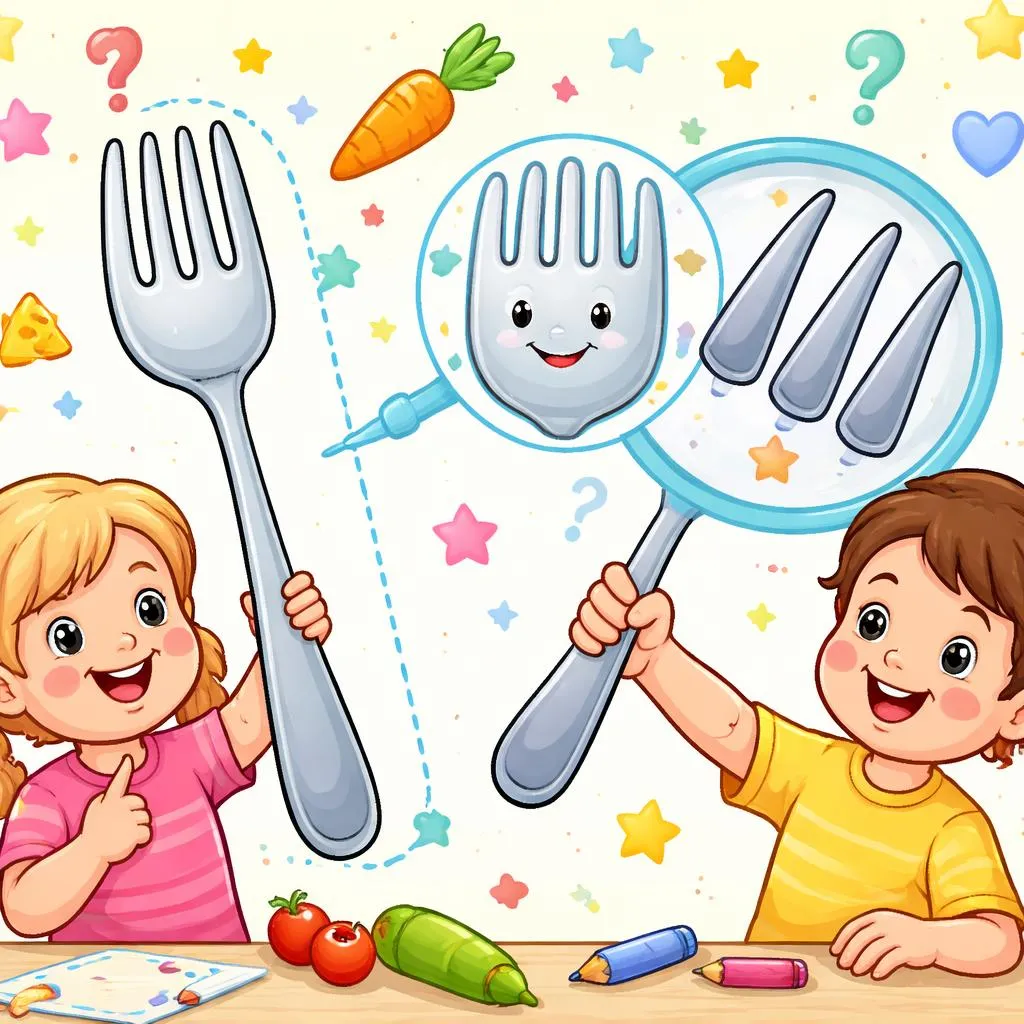

Start! Find a Pair of 'Pointy Twin' Words
Hello, word helper! Do you help set the table for dinner? You put out knives, spoons, and forks. Look closely at a fork. What are its pointy ends called? They are prongs! They are both about pointy things. Are they the same? This is a fun table-setting puzzle. Today we explore a word pair. We explore fork and prong. They are like a whole hand and the fingers. One is the whole thing. One is a part of it. Knowing the difference is a superpower. Your talk about tools and meals will be clear and smart. Let us start our word lesson!
Be a Language Observer now. Our first clue is at home. Your mom says, "Please set the table with a fork for each person." You look at your fork. It has four sharp prongs. They are connected. But are the words the same? Let us test with two sentences.
"Use a fork to eat your pasta." This is about the whole eating utensil you hold. "One prong of the fork was bent." This is about just one of the pointy parts.
They are both about pointy objects. But one is the complete tool. One is a piece of that tool. Your observation mission starts. Let us dig into their word world.
Adventure! Dig Into the Word World
Feel the Word's Whole and Part Vibe!
Feel the word fork. It is a whole, complete word. It feels like a tool, a utensil, or a piece of cutlery. You can hold it and use it. The word prong is a part, a piece word. It feels like a tip, a spike, or a tine. It is a feature of something bigger. Fork is the whole bicycle. Prong is one wheel. One is the object. The other is a piece. Let us see this at school.
In the lunchroom, you eat with a plastic fork. This is the whole utensil. In a science class, you look at a plug. It has two metal prongs. These are the parts that go into the wall. Saying "the plug has two forks" is wrong. The relationship of the words is different. One is a stand-alone item. The other is a component.
Compare Their Relationship: The Object vs. Its Parts!
Think about a comb and its teeth. The word fork is the whole comb. The word prong is one tooth of the comb. Their relationship is the key. A fork is an object that has prongs. You cannot have a fork without prongs. But you can have a prong that is not on a fork. A garden rake has prongs too. Let us test this on the playground.
You are drawing in the sand. You use a stick with three points to make lines. You call it a little rake or a fork. Each pointy end is a prong. The word fork names the whole tool. The word prong names each point. The playground shows the difference.
Meet Their Best Word Friends!
Words have favorite pointy partners. The word fork likes utensil and road words. It teams up with 'salad', 'tuning', 'pitch', 'in the road', 'kitchen', and 'electrical'. A tuning fork. A fork in the road. The word prong likes part and point words. It teams up with 'three-', 'two-', 'metal', 'sharp', 'broken', and 'each'. A three-prong plug. Each prong was sharp. Their partners are different. Let us go back to school.
In a geography lesson, you see a fork in a river. This is where it splits. In a shop class, you learn about a prong setting for a jewel. This is a metal claw that holds a gem. You would not say a "fork setting." The word friends lock in the meaning.
Our Little Discovery!
We explored the world of pointy things. We made a clear discovery. The words fork and prong are different. A fork is a whole utensil or tool with a handle and several pointy parts at the end. A prong is one of those pointy parts. A fork has prongs. A prong is part of a fork. One is the object. The other is a piece of the object. This is the main difference.
Challenge! Become a Pointy Word Expert
"Best Choice" Challenge!
Let us look at a nature scene. A deer has antlers. Each antler has several pointy branches. One of these pointy branches is like a prong. Is it Fork or Prong? The champion is Prong! This describes a single point on the antler. Now, imagine a bird's foot. Some birds have feet with long, thin toes for perching. The whole foot is not really a fork, but one toe could be like a single prong. For the challenge, if we imagine a tool, a fork is the whole thing. But in nature, a deer's antler is often said to have prongs. Excellent!
"My Sentence Show"!
Now, create your own sentences. Here is a fun scene: Imagine you are eating pie. You need a utensil to pick it up. Use the word fork in one sentence. Now, look at that utensil. Describe one of its sharp points. Use the word prong in another. Try it! Here is an example. Sentence one: "I need a fork to eat this delicious apple pie." Sentence two: "I pressed one prong of the fork into the crust." See the difference? The first is about the whole utensil. The second is about just one of its points.
"Eagle Eyes" Search!
Can you find the word that needs help? Read this sentence: "Be careful with that old rake; one of its forks is loose and could snap off." Hmm. This is a mix. A rake has prongs, not forks. The loose part is a single prong. A better sentence is: "Be careful with that old rake; one of its prongs is loose and could snap off." You fixed it!
What a great digging session in the word world! You started as a curious observer. Now you are a word expert. You know the secret of fork and prong. You can feel their different whole and part vibes. You see that a fork is the tool and a prong is its point. You know their best word friends. This is a real language superpower.
You can learn amazing things from this article. You now know that a 'fork' is a whole utensil with a handle and several pointed ends, used for eating or digging. You understand that a 'prong' is one of those pointed ends on a fork, rake, or plug. You can explain that a fork has prongs, and a prong is part of a fork. You learned terms like 'fork in the road' and 'three-prong plug'.
How can you use this today? It is easy and fun. Look at your dinner fork. Count its prongs. Most have four. Look at an electrical plug. It has two or three prongs. In the garden, a rake has many prongs. Help set the table. Ask for the forks. Draw two pictures. Draw a whole fork. Draw a close-up of one prong. You are using your new skill every day.
Keep your explorer eyes open. The world is full of forks and the prongs that make them useful. You are learning the words to describe them all. Great work, word expert. Your English journey is getting more precise and pointed with every new word pair you discover!