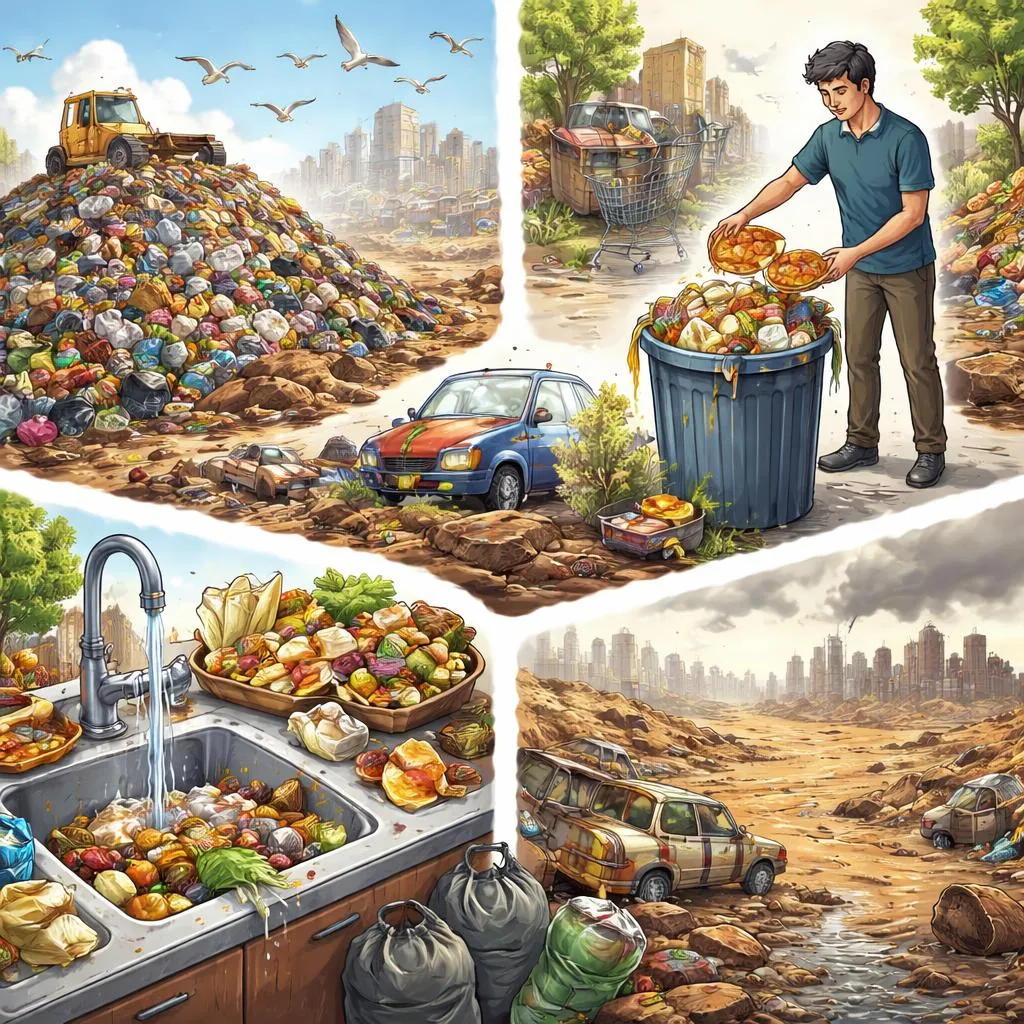

You waste water when you leave the tap on. A wasteful person uses more than they need. The words “waste, wasteful, wasting, wasteland” all come from one family. Each word talks about using too much or having nothing. But each one has a different job in a sentence. Learning this family helps children value resources and avoid excess. Let us explore these four words together.
What Does “Same Word, Different Forms” Mean? One core idea can grow into many word shapes. The meaning stays the same at the heart. But the word changes its ending or combines for a new role. For example, “waste” is a verb or a noun. “Wasteful” is an adjective. “Wasting” is a noun or a verb form. “Wasteland” is a noun. Knowing these four forms helps a child talk about conservation and emptiness.
Personal Pronouns Change Their Form Pronouns change from “he” to “him” or “his”. Our word family changes by adding suffixes and compounds. Think of “waste” as the core action of using without need. “Wasteful” turns that quality into a description of behavior. “Wasting” turns the action into an activity. “Wasteland” combines waste with land to name a barren place. Each form answers a simple question. What action or leftover? Waste. What describes overuse? Wasteful. What is the activity of overuse? Wasting. What is a barren land? Wasteland.
From Verb to Noun to Adjective to Adverb – One Family, Many Words This family has a verb, nouns, and an adjective. Let us start with the verb “waste”. Verb: Do not waste food. Eat what you take. “Waste” means to use something carelessly without need.
“Waste” can also be a noun. Noun: The factory produces toxic waste. “Waste” means leftover material that is not useful.
Next is the adjective “wasteful”. Adjective: Leaving the lights on all night is wasteful. “Wasteful” means using more than necessary.
Then “wasting” as a noun. Noun: Wasting electricity harms the environment. “Wasting” can also be a verb form. Verb (ongoing): She is wasting time on video games.
Finally the noun “wasteland”. Noun: The desert was a dry wasteland. “Wasteland” means a barren area where nothing grows.
One Root, Many Roles – How Words Grow from Actions to Qualities The Latin word “vastus” meant empty or desolate. From this root, we built a family about loss and emptiness. “Waste” kept the main verb and noun meanings. Adding -ful made “wasteful” (full of waste). Adding -ing made “wasting” (the activity). Combining “waste” with “land” made “wasteland” (empty land). Children can see the same pattern in other families. For example, “trash, trashy, trashing, trashland (rare)”. Learning the -ful suffix for negative traits helps kids describe bad habits.
Same Meaning, Different Jobs – Is It a Verb or a Noun? Look at each word’s job carefully. “Waste” can be a verb or a noun. Verb example: Waste not, want not. Noun example: The landfill is full of waste.
“Wasteful” is an adjective. Example: A wasteful person throws away leftovers.
“Wasting” is a noun or a verb form. Noun example: Wasting paper kills trees. Verb example: He is wasting his talent.
“Wasteland” is a noun. Example: The abandoned factory area became a wasteland. Each form has a clear job.
Adjectives and Adverbs – When Do We Add -ly? We can make an adverb from “wasteful”. Add -ly to get “wastefully”. Example: She spends money wastefully. We can also make “wastingly” from “wasting,” but it is rare. For young learners, focus on the verb and the adjective “wasteful.” A simple reminder: “Waste is the action or trash. Wasteful is a bad habit. Wasteland is a sad, empty place.”
Watch Out for Tricky Spelling Changes (Double Letters, y to i, and More) “Waste” has no double letters. It ends with a silent e. Add -ful to make “wasteful”. Waste + ful = wasteful (keep the e? Yes, wasteful keeps the e from waste.) Add -ing to make “wasting”. Waste → wasting (drop the e, add ing). Add “land” to make “wasteland”. Waste + land = wasteland (keep the e? Yes, wasteland keeps the e.) A common mistake is writing “waste” as “waist” (which is part of your body). Say “Waste is trash. Waist is your middle.” Another mistake is “wasteful” spelled “wastefull” (double l). Say “Wasteful has one l. Waste + ful.” Another mistake is “wasting” spelled “wasteing” (with e). Say “Wasting drops the e.” Another mistake is “wasteland” spelled “waste land” as two words. “Wasteland” as one word is correct.
Let’s Practice – Can You Choose the Right Form? Try these sentences with your child. Read each one aloud. Pick the correct word from the family.
Please do not ______ food. Take only what you will eat. Answer: waste (verb)
The chemical ______ polluted the river. Answer: waste (noun)
Leaving the water running while brushing is ______. Answer: wasteful (adjective)
______ time on things that do not matter means less time for what does. Answer: wasting (noun)
The drought turned the farmland into a ______. Answer: wasteland (noun)
She is ______ her energy on worry instead of action. Answer: wasting (verb form)
A ______ person uses three paper towels when one will do. Answer: wasteful (adjective)
The ______ of resources hurts our planet. Answer: wasting (noun)
The empty lot looked like a ______ after the fire. Answer: wasteland (noun)
Do not ______ your allowance on cheap toys that break. Answer: waste (verb)
After the practice, ask your child one question. Is this word an action of overuse, leftover trash, a bad habit, an ongoing overuse, or an empty place? That simple question teaches grammar through conservation.
Tips for Parents – Help Your Child Learn Word Families in a Fun Way Use a dripping faucet to teach “waste”. Say “A dripping faucet can waste a lot of water.”
Use a full trash can to teach “waste as noun”. Say “This bag of waste needs to go outside.”
Use a light left on to teach “wasteful”. Say “Leaving the TV on all night is wasteful.”
Use a lazy afternoon to teach “wasting”. Say “Wasting time on too much TV is not good for your brain.”
Use a dry desert to teach “wasteland”. Say “The moon’s surface is a cold wasteland.”
Play “fill in the blank” during car rides. Say “Do not ______ electricity. Turn off the lights.” (waste) Say “The ______ from the factory smelled bad.” (waste) Say “A ______ person buys more than they need.” (wasteful) Say “______ food means throwing away what could feed someone.” (wasting) Say “The abandoned mine area is a ______.” (wasteland)
Read a story about a character who learns to be less wasteful. Ask “What does the character waste at the beginning?” Ask “How does the wasteland become fertile again?”
Turn a drawing activity into a word lesson. Draw a person pouring water on the ground. Label “waste water”. Draw a trash pile. Label “waste”. Draw a person with many empty bottles. Label “wasteful”. Draw a clock melting. Label “wasting time”. Draw a desert with a dead tree. Label “wasteland”.
When your child makes a mistake, stay calm. If they say “Do not wasteland water,” say “Almost. Do not waste water. Wasteland is a place.” If they say “He is waste,” for a person who wastes, say “Close. He is wasteful. Waste is the action or trash. Wasteful is the adjective.”
Write the four words on sticky notes. Put them on the recycling bin or the light switch. Each time you save energy or resources, point to “waste”.
Remember that waste is a choice. Use these words to build gratitude. “When you waste less, you have more to share.” “A wasteland can become a garden with care.” Soon your child will avoid waste. They will not be wasteful. They will stop wasting precious things. And they will help turn a wasteland into a wonderland. That is the conservation power of learning one small word family together.