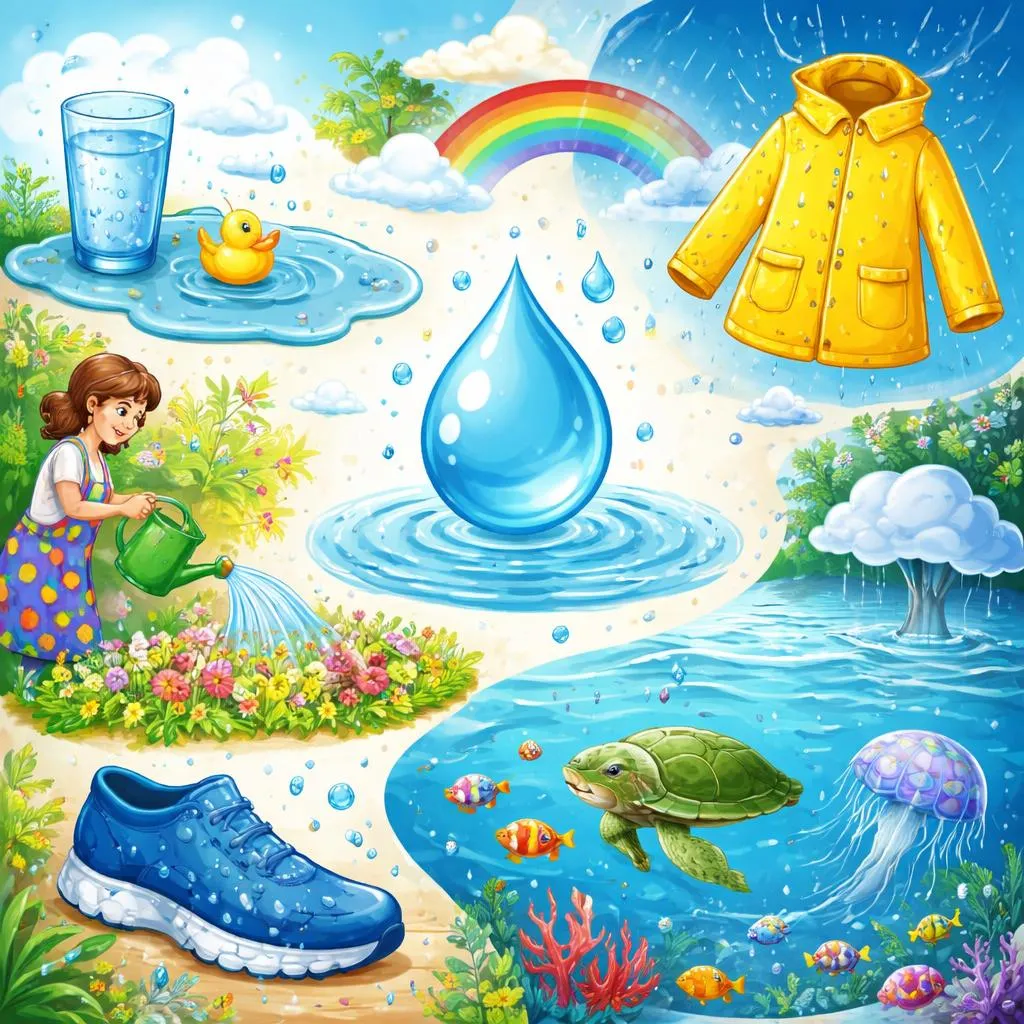

Water is clear and necessary for life. A watery soup has too much liquid. The words “water, watery, watering, waterproof, underwater” all come from one family. Each word talks about the liquid or things related to it. But each one has a different job in a sentence. Learning this family helps children describe liquids and protection. Let us explore these five words together.
What Does “Same Word, Different Forms” Mean? One core idea can grow into many word shapes. The meaning stays the same at the heart. But the word changes its ending or combines for a new role. For example, “water” is a noun or a verb. “Watery” is an adjective. “Watering” is a noun or a verb form. “Waterproof” is an adjective. “Underwater” is an adjective or an adverb. Knowing these five forms helps a child talk about water and wetness.
Personal Pronouns Change Their Form Pronouns change from “he” to “him” or “his”. Our word family changes by adding suffixes and compounds. Think of “water” as the core liquid. “Watery” turns that liquid into a description. “Watering” turns the liquid into an action. “Waterproof” combines water with proof to mean protected from water. “Underwater” combines under with water to mean below the surface. Each form answers a simple question. What liquid? Water. What is thin or wet? Watery. What is the action of giving water? Watering. What resists water? Waterproof. What is below the surface? Underwater.
From Verb to Noun to Adjective to Adverb – One Family, Many Words This family has a noun, a verb, adjectives, and an adverb. Let us start with the noun “water”. Noun: Drink plenty of water every day. “Water” means the clear liquid that falls as rain.
“Water” can also be a verb. Verb: Please water the plants while I am away. Here “water” means to give water to something.
Next is the adjective “watery”. Adjective: The watery soup had no flavor. “Watery” means containing too much water or thin.
Then “watering” as a noun. Noun: Watering the garden takes ten minutes. “Watering” can also be a verb form. Verb (ongoing): She is watering the flowers.
Then the adjective “waterproof”. Adjective: A waterproof jacket keeps you dry in the rain. “Waterproof” means not letting water pass through.
Finally the word “underwater”. Adjective: The submarine is an underwater vessel. “Underwater” can also be an adverb. Adverb: The fish swam underwater.
One Root, Many Roles – How Words Grow from Actions to Qualities The Old English word “w?ter” meant water. From this root, we built a family about the liquid and its properties. “Water” kept the main noun and verb meanings. Adding -y made “watery” (like water). Adding -ing made “watering” (the action). Combining “water” with “proof” made “waterproof” (resistant to water). Combining “under” with “water” made “underwater” (below the surface). Children can see the same pattern in other families. For example, “rain, rainy, raining, rainproof, underrain (no)”. Learning compounds helps kids describe materials and locations.
Same Meaning, Different Jobs – Is It a Verb or a Noun? Look at each word’s job carefully. “Water” can be a noun or a verb. Noun example: The water in the lake is cold. Verb example: Water the lawn twice a week.
“Watery” is an adjective. Example: The watery eyes showed she was sad.
“Watering” is a noun or a verb form. Noun example: Watering daily helps seeds grow. Verb example: The farmer is watering the crops.
“Waterproof” is an adjective. Example: A waterproof watch can be worn while swimming.
“Underwater” is an adjective or an adverb. Adjective example: Underwater caves are beautiful. Adverb example: The turtle swam underwater. Each form has a clear job.
Adjectives and Adverbs – When Do We Add -ly? We can make an adverb from “watery”. Add -ly to get “waterily” (rare). We can also make “underwaterly” but it is not used. For young learners, focus on “water” as a noun and “waterproof” as a useful adjective. A simple reminder: “Water is the liquid. Watery means thin or wet. Watering is giving water. Waterproof means dry inside. Underwater means below the surface.”
Watch Out for Tricky Spelling Changes (Double Letters, y to i, and More) “Water” has no double letters. Add -y to make “watery”. Water + y = watery (keep the e? No, drop the e? Water has e at the end? Water has e? W-A-T-E-R. Yes, it has an e. Watery: W-A-T-E-R-Y. Keep the e. No drop. So water + y = watery. Keep the e.) Add -ing to make “watering”. Water → watering (keep the e? Yes, keep the e. Water + ing = watering. Keep the e.) Combine with “proof” to make “waterproof”. Water + proof = waterproof (keep the e). Combine with “under” to make “underwater”. Under + water = underwater (keep the e). A common mistake is writing “water” as “watter” (double t). Say “Water has one t. W-A-T-E-R.” Another mistake is “watery” spelled “watery” (correct) but some write “watery” (same). Good. Another mistake is “watering” spelled “waterring” (double r). Say “Watering has one r.” Another mistake is “waterproof” spelled “water proof” as two words. “Waterproof” as one word is correct. Another mistake is “underwater” spelled “under water” as two words. “Underwater” as one word is correct.
Let’s Practice – Can You Choose the Right Form? Try these sentences with your child. Read each one aloud. Pick the correct word from the family.
______ is essential for all living things. Answer: water (noun)
The ______ soup had no flavor because it was too thin. Answer: watery (adjective)
______ the garden in the morning reduces evaporation. Answer: watering (noun)
This jacket is ______, so you can wear it in the rain. Answer: waterproof (adjective)
The fish live in an ______ cave. Answer: underwater (adjective)
Please ______ the dog’s bowl before leaving. Answer: water (verb)
Her eyes became ______ when she watched the sad movie. Answer: watery (adjective)
The gardener is ______ the new seeds. Answer: watering (verb form)
Make sure your phone case is ______ before taking it on a boat. Answer: waterproof (adjective)
The diver swam ______ for ten minutes. Answer: underwater (adverb)
After the practice, ask your child one question. Is this word the liquid, a thin description, a giving-water action, a resistant description, or a below-surface place? That simple question teaches grammar through science and nature.
Tips for Parents – Help Your Child Learn Word Families in a Fun Way Use a glass to teach “water”. Say “Drink a glass of water after playing.”
Use a bland soup to teach “watery”. Say “This soup tastes watery. It needs more salt.”
Use a hose to teach “watering”. Say “Watering the plants helps them grow.”
Use a raincoat to teach “waterproof”. Say “A waterproof hat keeps your hair dry.”
Use a pool to teach “underwater”. Say “Look at your feet underwater in the bathtub.”
Play “fill in the blank” during car rides. Say “______ freezes at 32 degrees Fahrenheit.” (water) Say “The juice was too . I added more powder.” (watery) Say “ flowers in the evening is best.” (watering) Say “This tent is ______. It will not leak.” (waterproof) Say “The submarine went ______.” (underwater)
Read a story about a diver, a pool, or a garden. Ask “How does the character use water?” Ask “What is waterproof in the story?”
Turn a drawing activity into a word lesson. Draw a drop of water. Label “water”. Draw a bowl with a splash. Label “watery soup”. Draw a person with a watering can. Label “watering plants”. Draw a raincoat. Label “waterproof”. Draw a fish below the water line. Label “underwater”.
When your child makes a mistake, stay calm. If they say “The water is watering,” say “Yes. The water is watering the plants. Or you are watering.” If they say “This is water,” for a waterproof thing, say “Waterproof means water does not go through. Water is the liquid.”
Write the five words on sticky notes. Put them on the kitchen sink or a raincoat hook. Each time you use water, point to “water”.
Remember that water is precious. Use these words to build conservation habits. “Do not leave the water running. That is wasteful.” “Waterproof gear lasts longer.” Soon your child will drink water happily. They will describe a watery oatmeal. They will enjoy watering the garden. They will wear a waterproof coat. And they will love watching fish underwater. That is the liquid power of learning one small word family together.