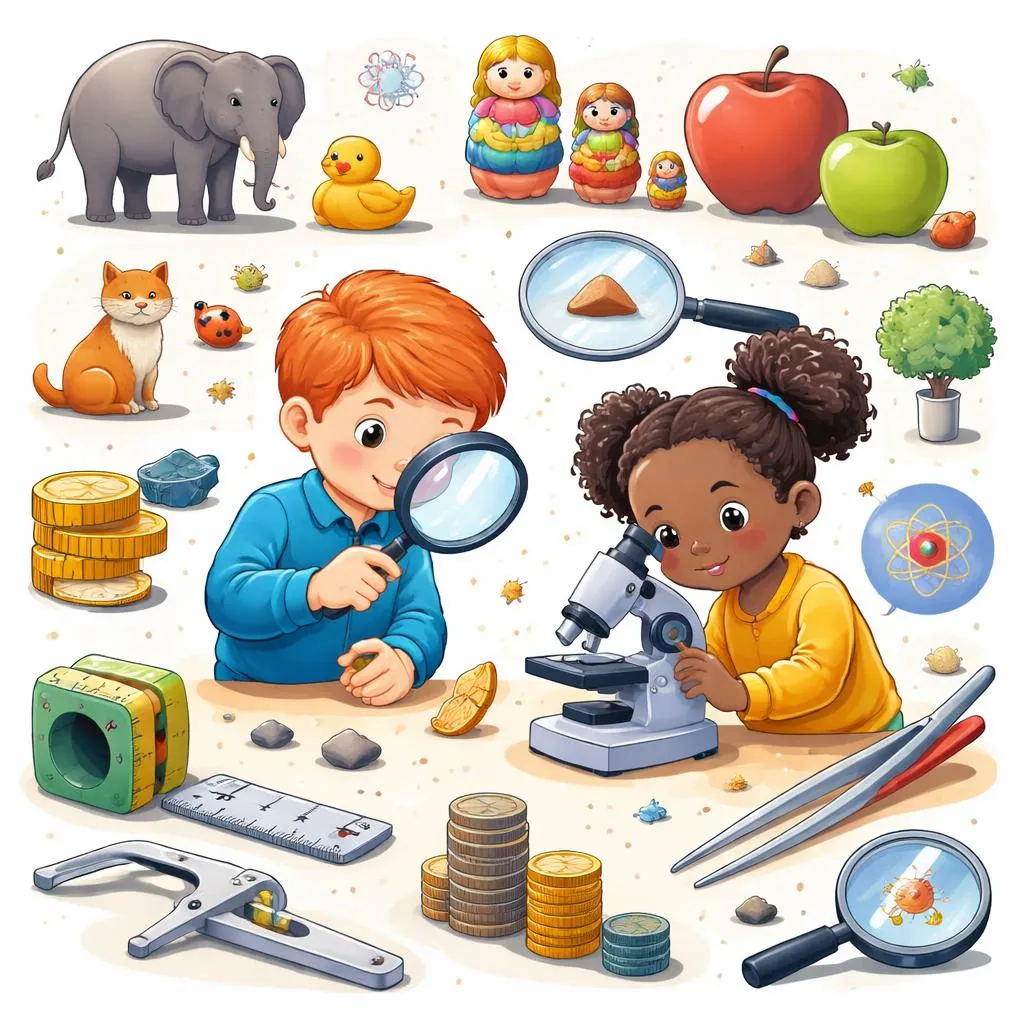

tiny seed is small. A marble is smaller than a ball. The words “small, smaller, smallest, smallness” all come from one family. Each word talks about little size. But each one has a different job in a sentence. Learning this family helps children compare objects and describe dimensions. Let us explore these four words together.
What Does “Same Word, Different Forms” Mean? One core idea can grow into many word shapes. The meaning stays the same at the heart. But the word changes its ending for a new role. For example, “small” is an adjective. “Smaller” is a comparative adjective. “Smallest” is a superlative adjective. “Smallness” is a noun. Knowing these four forms helps a child compare sizes accurately.
Personal Pronouns Change Their Form Pronouns change from “he” to “him” or “his”. Our word family changes by adding suffixes, not by changing person. Think of “small” as the quality of little size. “Smaller” compares two things. “Smallest” compares three or more. “Smallness” names the quality as a thing. Each form answers a simple question. What quality? Small. What is the comparison between two? Smaller. What is the comparison among many? Smallest. What is the state of being small? Smallness.
From Verb to Noun to Adjective to Adverb – One Family, Many Words This family has adjectives and a noun. Let us start with the adjective “small”. Adjective: This small box holds my jewelry. “Small” means little in size, amount, or importance.
Next is the comparative adjective “smaller”. Adjective: My hand is smaller than my father’s hand. “Smaller” means more small than something else.
Then the superlative adjective “smallest”. Adjective: This ant is the smallest insect I have seen. “Smallest” means the most small compared to all others.
Finally the noun “smallness”. Noun: The smallness of the kitten made everyone say “aww.” “Smallness” names the quality of being small. This family has no verb or adverb form. That is fine. Many size families work this way.
One Root, Many Roles – How Words Grow from Actions to Qualities The Old English word “sm?l” meant narrow or thin. From this root, we built a size family. “Small” kept the main adjective meaning. Adding -er made “smaller” (more small). Adding -est made “smallest” (most small). Adding -ness made “smallness” (the state). Children can see the same pattern in other adjectives. For example, “tall, taller, tallest, tallness”. Also “big, bigger, biggest, bigness”. Learning patterns helps kids compare objects easily.
Same Meaning, Different Jobs – Is It a Verb or a Noun? Look at each word’s job carefully. “Small” is an adjective. Example: A small bird sat on the fence.
“Smaller” is an adjective. Example: This piece is smaller than that one.
“Smallest” is an adjective. Example: That is the smallest cupcake on the plate.
“Smallness” is a noun. Example: The smallness of the room made it cozy. Each form has one clear job. That makes this family very easy to learn. No confusing double roles here.
Adjectives and Adverbs – When Do We Add -ly? We can make an adverb from “small”. Add -ly to get “smallly”. Small + ly = smallly. But “smallly” is extremely rare. We usually say “in a small way” instead. For young learners, focus on the adjectives. Teach comparisons first. A simple reminder: “Small describes one thing. Smaller compares two. Smallest compares three or more.”
Watch Out for Tricky Spelling Changes (Double Letters, y to i, and More) “Small” has a double l at the end. That is the only tricky part. Add -er to make “smaller”. Small + er = smaller (keep the double l). Add -est to make “smallest”. Small + est = smallest (keep the double l). Add -ness to make “smallness”. Small + ness = smallness (keep the double l). A common mistake is writing “smal” with one l. Say “Small has two l’s, like tall and ball.” Another mistake is “smaller” spelled “smaller” (that is correct). But some write “smaler”. Say “Keep the double l for all forms.” Another mistake is “smallness” spelled “smallness” (correct) but written “smallnes”. Say “Smallness has two s’s at the end.”
Let’s Practice – Can You Choose the Right Form? Try these sentences with your child. Read each one aloud. Pick the correct word from the family.
A ______ mouse hid behind the refrigerator. Answer: small (adjective)
This crayon is ______ than that one. Answer: smaller (adjective)
That is the ______ piece of pie on the table. Answer: smallest (adjective)
The ______ of the seeds made them hard to plant. Answer: smallness (noun)
We live in a ______ town with one traffic light. Answer: small (adjective)
My sister’s room is ______ than mine. Answer: smaller (adjective)
Who has the ______ feet in your family? Answer: smallest (adjective)
The ______ of the details mattered in the drawing. Answer: smallness (noun)
A ______ mistake can cause a big problem. Answer: small (adjective)
This bag is ______ than the blue one. Answer: smaller (adjective)
After the practice, ask your child one question. Is this word a simple description, a comparison of two, a comparison of many, or a quality name? That simple question teaches grammar through comparing sizes.
Tips for Parents – Help Your Child Learn Word Families in a Fun Way Use a set of nesting cups to teach all forms. Hold up the smallest cup. Say “This cup is small.” Hold up a medium cup. Say “This cup is bigger.” Then say “This medium cup is smaller than the big one.” Hold up the tiniest cup. Say “This is the smallest of all.”
Use fruit at snack time. Pick a blueberry. Say “This is small.” Pick a grape. Say “This grape is smaller than the blueberry? Actually compare correctly.” Say “The grape is small. The blueberry is smaller.” Pick a raisin. Say “The raisin is the smallest.”
Play “fill in the blank” during car rides. Say “A ______ car fits in a tiny parking spot.” (small) Say “My shoe is ______ than your shoe.” (smaller) Say “That ant is the ______ bug I see.” (smallest) Say “The ______ of the cracker made it easy to eat.” (smallness)
Read a story about tiny animals or miniatures. Ask “Which animal is smallest in the story?” Ask “What does the author say about smallness?”
Turn a drawing activity into a word lesson. Draw three circles: one small, one smaller, one smallest. Label them “small, smaller, smallest”. Draw a magnifying glass looking at a tiny dot. Label “smallness”.
When your child makes a mistake, stay calm. If they say “This is more small,” say “Yes, or you can say smaller. More small works, but smaller is shorter and more common.” If they say “The small of the doll is nice,” say “Almost. The smallness of the doll is nice. Small is the adjective. Smallness is the noun.”
Write the four words on sticky notes. Put them on a wall near a height chart or a set of measuring cups. Each time you measure something, point to the correct word.
Remember that comparing sizes is a daily skill. Use these words in the kitchen, the garden, and the toy box. Soon your child will describe a small pebble. They will say which toy is smaller. They will find the smallest sock in the drawer. And they will appreciate the smallness of a ladybug. That is the power of learning one small word family together.