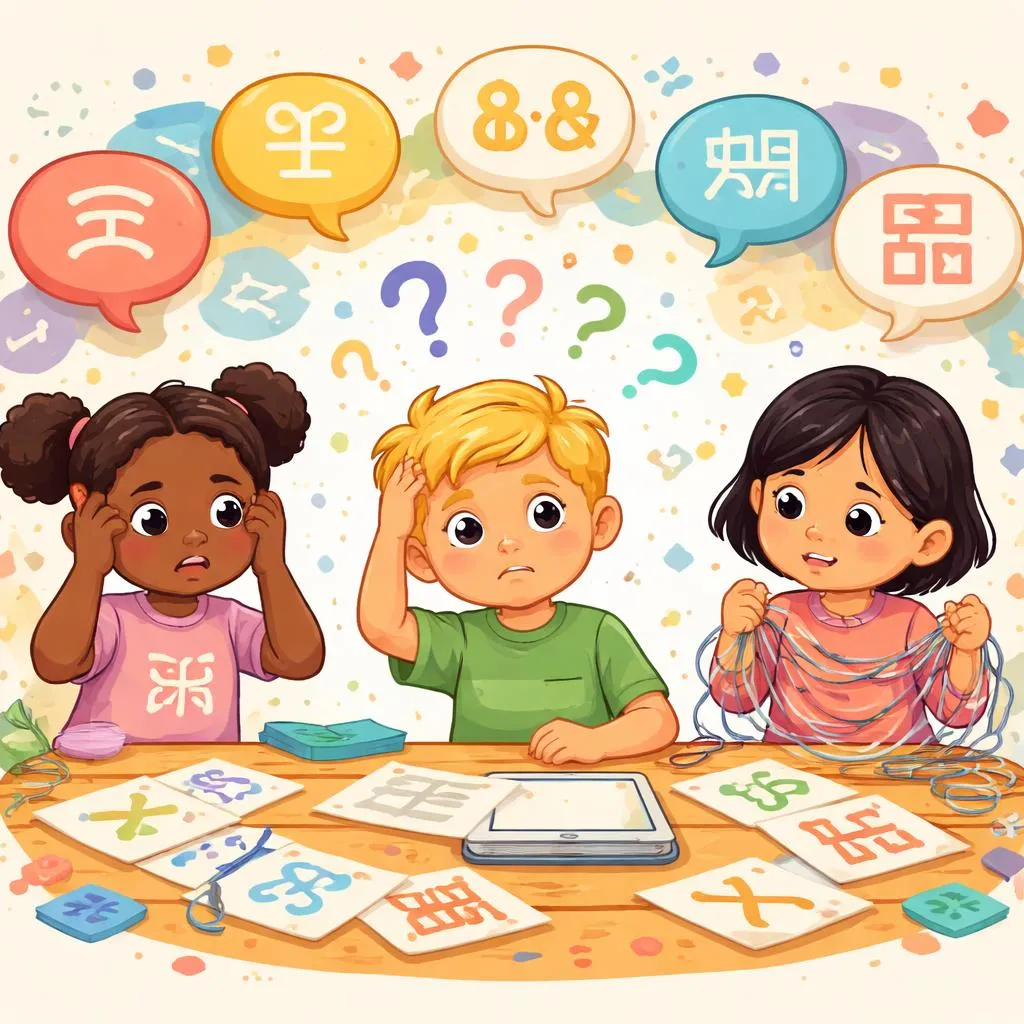

What is tough languages to learn?
Hello, young explorers. Today, we are going to talk about a fascinating topic. We are going to learn about tough languages to learn. What does that mean. It does not mean some languages are bad or not good. It means that for someone who speaks English, some languages can feel like a bigger, more exciting puzzle. They have more new rules, sounds, or symbols to figure out.
Think of learning languages like climbing different hills. Learning a language similar to English, like Spanish, might be like climbing a gentle, grassy hill. Learning a language very different from English might be like climbing a rocky mountain with a new path. The mountain climb is tougher, but the view from the top is amazing. It takes more time, more practice, and more curiosity. Every language is a beautiful way to talk and think. Some just have a different puzzle for your brain to solve. Let's explore what makes a language puzzle tough and fun.
Meaning and explanation
When we call a language "tough to learn," we usually mean it is very different from the language you already know. For a child who speaks English, a tough language might be tough for a few big reasons.
The writing might look like art, not letters. Languages like Chinese use characters. Each character is a small picture that stands for a word or an idea. This is very different from the ABCs.
The sounds might be new for your mouth. Some languages have clicks, tones (where your voice pitch changes the word's meaning), or sounds we do not use in English. Your tongue and ears need to learn a new gym routine.
The grammar rules might be very different. The order of words in a sentence might be backwards. Words might change their endings in many complex ways to show meaning. It is like learning a new code for building sentences.
The culture behind the language might be very different. Languages are connected to how people see the world. Learning the language means learning a new way of thinking. This makes it deep and interesting, but also a big challenge.
Categories or lists
Let's look at some languages that are often called tough languages to learn for English speakers. We will see what makes their puzzles special.
Languages with Different Writing Systems: These languages do not use the Roman alphabet (A, B, C) that English uses. Chinese (Mandarin): It uses thousands of characters. Each character must be memorized. The language also uses tones. The word "ma" can mean "mother," "hemp," "horse," or "scold" depending on if your voice goes up, down, or stays flat. That is a big puzzle.
Arabic: The Arabic script is beautiful and flows from right to left, not left to right. Letters change shape depending on if they are in the beginning, middle, or end of a word. The sounds in the back of the throat are also new for many learners.
Japanese: It uses three different writing systems together. One is based on Chinese characters. Two are phonetic syllabaries (like alphabets for sounds). Learning to read means mastering all three systems.
Languages with Complex Grammar: These languages have many rules for changing words. Russian: It uses the Cyrillic alphabet, which is new to learn. But the bigger challenge is grammar. Nouns, adjectives, and even numbers change their endings (this is called "case") based on their job in the sentence. There are six main cases to learn.
Hungarian: This language is famous for its complex grammar. It has many cases (up to 18 or more). It also adds many little bits to the end of root words to create long, detailed meanings. The word order is very free, which can be confusing at first.
Languages Isolated from English: These languages come from a completely different language family. They share almost no history with English. Korean: While it has a brilliant and simple alphabet called Hangul, the grammar is very different. Sentence structure is Subject-Object-Verb, so the verb comes last. The language also has complex levels of formality and honorifics (special ways to show respect).
Finnish: Like Hungarian, it has many grammatical cases. Words can get very long as you add suffixes. The vocabulary is not related to English, Latin, or Greek, so most words are completely new to memorize.
Daily life examples
You can think about tough languages in your own world. Here are two ways.
Meeting a New Classmate: Imagine a new student joins your class from China. They might have a name written in characters that look like a beautiful drawing. Saying their name correctly might require a tone your voice is not used to. Learning to say "Hello" (Nǐ hǎo) and "Thank you" (Xièxie) to them is like learning a secret handshake to their world. It might feel tough at first, but it is a wonderful way to make a friend. This shows that "tough" often just means "new and different."
Playing a Video Game or Watching a Cartoon: Have you ever watched anime (Japanese cartoons) and seen the writing on signs or in books? It might be a mix of different scripts. The characters might use very polite or very casual speech depending on who they are talking to. The game Minecraft has terms like "Creeper" and "Redstone." In every language, these words are translated. Thinking about how those fun words sound in Arabic, Russian, or Korean helps you appreciate the job of translators who work with these tough languages to learn and share.
Printable flashcards
Let's make learning about tough languages fun with printables. You can create "Language Challenge Cards."
Each card features one "tough" language. The front has the country's flag and the language's name in its own script and in English. The back has a "Fun Fact" and a "Challenge Point." For Arabic, the Fun Fact is: "Arabic is written from right to left!" The Challenge Point is: "Letters change shape depending on their friends (the letters next to them)." For Mandarin, the Fun Fact is: "The word for 'mother' is 'mā' with a high, flat tone." The Challenge Point is: "The same sound 'ma' can mean 'horse' if you say it with a different tone!" Kids can collect these cards and become experts on language diversity.
Another printable is a "Super Learner Award." When a child tries to learn a simple word or recognize a character from a tough language, they get a certificate. "This award is presented to [Child's Name] for successfully learning to say 'Hello' in Mandarin: Nǐ hǎo! You are a language explorer!" This positive reinforcement focuses on the achievement, not the difficulty.
Learning activities or games
Let's play some games that celebrate the challenge. First, play "Language Explorer." Set up stations around the room. Each station represents a "tough" language with a simple, fun challenge. Chinese Station: Try to copy three simple characters (like 人 for person, 口 for mouth, 山 for mountain). Provide large grids and markers.
Arabic Station: Try to write your name from right to left. Practice the graceful flow of the script.
Russian Station: Try to say a tongue-twister with new sounds. Or match Cyrillic letters (A, B, B, Γ) to their English sounds (A, V, B, G).
Kids rotate, try each challenge, and get a stamp. The goal is not mastery, but joyful exposure to the differences.
Try the "Challenge and Treasure" hunt. Hide a "treasure" (a small prize or sticker). Give clues written in simple codes inspired by tough languages. One clue is in a made-up symbol system (like pictograms). Another clue's words are in the wrong order (simulating different grammar). Another clue must be read in a mirror (simulating right-to-left writing). Solving each clue requires thinking like a codebreaker, which is what learning a tough language is all about.
Finally, have a "Global Greetings Relay." Teach kids how to say "Hello" in a few of these languages: Nǐ hǎo (Mandarin), Marhaba (Arabic), Konnichiwa (Japanese), Zdravstvuyte (Russian - a real challenge!). Form teams. One person from each team must run to the other side, pick a language card, and correctly say the greeting to a judge before running back. The mix of physical activity and practicing tricky sounds makes it a fun, supportive way to engage with tough languages to learn, turning the "tough" into a shared, playful adventure.