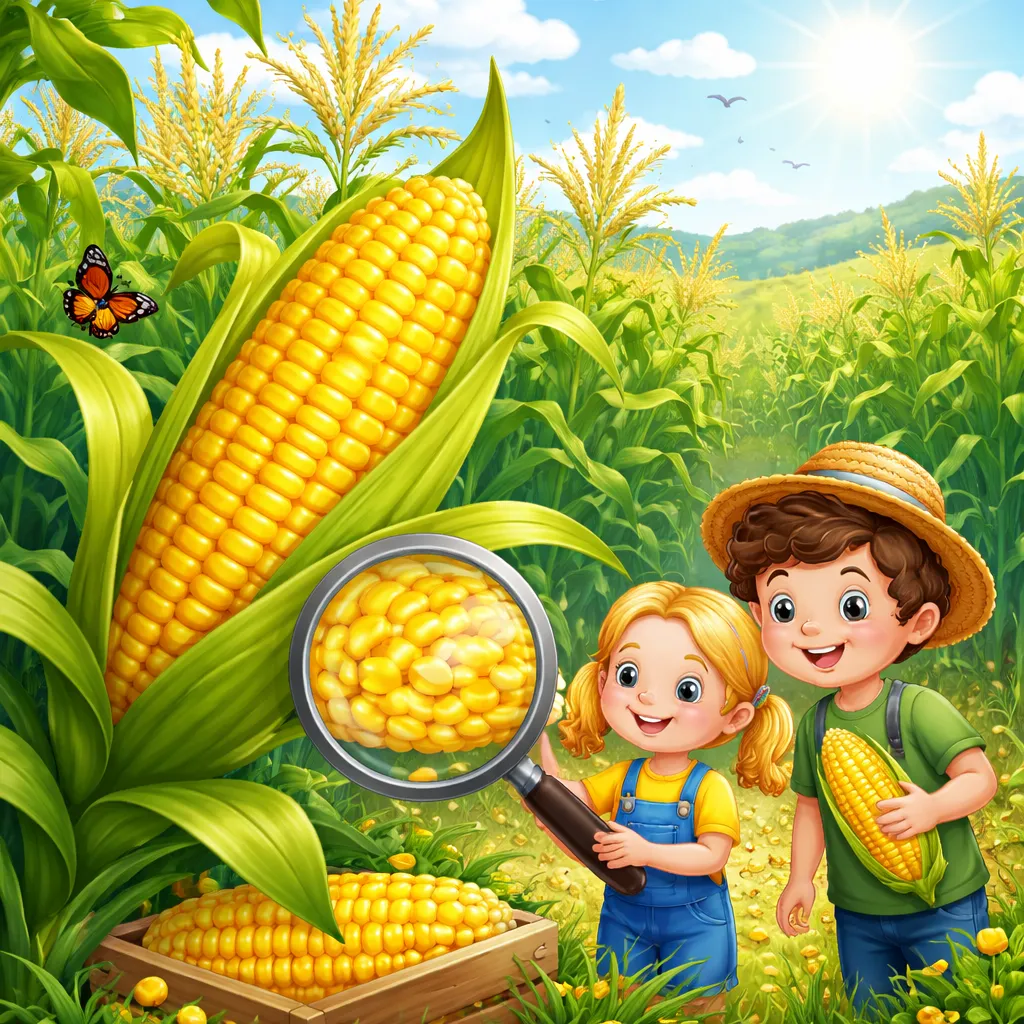

Have you ever eaten sweet yellow corn on the cob at a summer picnic? What about fluffy, buttery popcorn at the movies? Believe it or not, they both come from the same amazing plant! This plant grows tall and straight, with wide green leaves that rustle in the wind. It produces ears wrapped in green husks, and when you peel them back, you find golden rows of seeds. This plant is a superstar of farms and gardens. Let’s go on a summery adventure to learn about the tall and tasty Corn plant.
Let’s Learn the Word! – Open the Treasure Box of Language
Formal Name and Pronunciation This tall, golden plant is called Corn. In many parts of the world, it is called Maize. You can say it like this: /kɔːrn/ (korn). It rhymes with “born” and “horn.” Corn. Say it: Corn. Its other name, Maize, sounds like this: /meɪz/ (mays). It rhymes with “days.”
The Etymology Tale The word “Corn” is a general old word that once meant any small, hard seed or grain. In England, “corn” meant wheat. When English settlers came to America, they saw this new tall grass with big seeds and called it “Indian corn.” Over time, in America, it just became “corn.” Its scientific name, Zea mays, comes from languages of the native peoples who first grew it thousands of years ago.
Nicknames and Friendly Aliases Corn has many fun names. People call it Maize, its original and scientific name. An uncooked ear is Corn on the Cob. Dried corn for popping is Popcorn. Corn for animal food is Field Corn. Because of its tall stalks, it’s sometimes called Stalk Corn. Sweet corn for eating is just called Sweet Corn.
Building Your Word Web: Core Parts Let’s learn the words for Corn’s interesting body. The Stalk is the tall, thick main stem. The Ear is the part we eat, the cob with all the kernels. It grows from the stalk, wrapped in a green Husk. The Silk is the soft, thread-like hair coming out of the top of the ear. Each strand of silk is connected to one future kernel! The Kernel is the single seed or piece of corn. The Tassel is the flowery, feathery top of the stalk that holds the pollen. A Field of corn is often called a cornfield.
Action and State Words Corn plants are busy and tall. They grow fast in the summer sun. The wind shakes the tassels to pollinate the silks. Farmers harvest the ears in the fall. The plant provides food for people and animals. A corn plant is tall, sun-loving, productive, and annual.
Ecosystem Friends Vocabulary A cornfield is a busy place. Birds like crows eat the seeds. Bees and other insects visit the tassels. Squirrels and raccoons love to munch on sweet corn. Even some butterflies lay eggs on the leaves. The tall stalks provide a little bit of shade and shelter for small creatures on the ground.
Cultural Imprint in Language Corn is a symbol of harvest and abundance, especially in the Americas. A Native American saying teaches, “When you plant corn, you plant a people.” This means corn helps a community grow strong. Many Native American stories tell how corn was a gift from the spirits. In English, something very easy is “as easy as taking candy from a baby,” but for something simple and straight, we might say it’s “straight as a row of corn.”
Ready for Discovery We know its golden, many-named history. Are you ready to be a field detective and discover how this giant grass grows its hidden ears? Let’s explore the secrets of the Corn plant.
Discover the Plant’s Secrets! – A Nature Detective’s Notebook
The Plant Passport Corn, or maize, belongs to the grass family, Poaceae. Its scientific name is Zea mays. It is a tall annual grass, often growing taller than a person! The stalk is thick and sturdy. The leaves are long, wide, and have a prominent midrib. Corn has separate male and female flowers. The tassel at the very top is the male flower that makes pollen. The ear with its silk is the female flower. It needs wind to carry pollen from the tassel to the silk. It grows in warm weather and is harvested in late summer or fall.
Survival Smarts Corn’s big trick is its way of making seeds. Unlike many plants, it can’t pollinate itself easily. The male tassel is high up, and the female silks are lower down. The wind blows the tiny pollen grains from the tassel onto the sticky silks. Each silk leads to one spot on the cob where a kernel will grow. This is why corn is planted in blocks, not single rows—so the wind can easily find the silks! Another trick is its height, which helps it compete for sunlight.
Its Role and Gifts In a farm ecosystem, corn provides food for wildlife. Its greatest gift is to people. The kernels are eaten fresh, dried, ground into cornmeal, popped, or processed into oil and syrup. The stalks and leaves can be used for animal feed or to make compost. Corn is in hundreds of products, from tortillas to cereal to batteries! It is one of the world’s most important crops.
Human History and Cultural Symbol Corn was first domesticated in southern Mexico over 9,000 years ago from a wild grass called teosinte. Native American cultures developed thousands of varieties and saw corn as one of the “Three Sisters” (with beans and squash), a perfect garden partnership. It is a sacred plant of life and sustenance. Today, it is a major crop everywhere, a symbol of farming, summer, and abundance.
Fun “Wow!” Facts Get ready for a pollination fact! Each strand of corn silk is connected to one potential kernel. If a pollen grain doesn’t land on a silk, that spot on the cob won’t grow a kernel! That’s why you sometimes see ears with missing kernels. And here’s a height fact: some types of corn can grow over 15 feet tall—that’s taller than most rooms!
From Ancient Grain to Your Garden The story of the Corn plant is one of human partnership with nature. Would you like to grow your own towering cornstalk? You can grow corn in a garden or even a large pot! Let’s see how.
Let’s Grow It Together! – A Little Guardian’s Action Guide
Good for Home Growing? Yes, you can! Corn needs a good amount of space and sun. It is best grown in a garden bed because it is wind-pollinated. You need to plant it in a block (like a square of plants), not a single row, so the pollen can fall on the silks. You can also grow a few stalks in a very large, deep container, but you will have to help pollinate by shaking the tassels yourself.
Little Gardener’s Toolkit You will need a packet of corn seeds. Choose a “dwarf” or “short” variety for containers. Get a few large, deep pots or find a sunny garden spot. Use rich, well-draining potting soil. Have a watering can, some compost, and a sunny spot ready.
Step-by-Step Growing Guide
Planting Your Tall Friend Plant corn in late spring, after the last frost, when the soil is warm. If in pots, plant 2-3 seeds about 1 inch deep in each large pot. If in the ground, plant seeds about 1 inch deep and 8-12 inches apart, in a block shape. Water the seeds well. They need warmth to sprout.
Care Calendar Keep the soil moist until the seedlings come up. Corn is a heavy drinker and feeder. Water it regularly, especially when it’s hot. When the plants are about knee-high, you can pile a little soil around the base of the stalks; this is called “hilling” and helps support them. You can feed them with a balanced fertilizer.
Watch and Be Friends Watch for the wide green leaves unfurling. See how fast it grows! Watch for the tassels forming at the top. Then, look for the ears forming lower down, with their silks peeking out. This is the most exciting part! You can gently shake the plants when the tassels are dusty with pollen to help the process. Watch the ears get fat under the husks.
Problem Diagnosis If the lower leaves turn yellow, it might need more nitrogen fertilizer. If you see chewed leaves, look for caterpillars (like corn earworms); you can pick them off. The biggest problem for home growers is poor pollination, which is why planting in a block is so important. If you only have a few plants, you can collect pollen from the tassel on a dry day and sprinkle it on the silks.
Your Rewards and Gifts Your gift is the wonder of growing your own food from a seed to a towering plant. You are learning about pollination, plant needs, and patience. Caring for corn teaches responsibility, observation, and the joy of harvesting something you helped create. You become a partner in an ancient story of growth.
Creative Fun Start a Tall Corn Chronicle. Draw your plant every week and measure its height. Make a corn husk doll by tying and shaping dried husks. Paint a picture of the “Three Sisters” garden (corn, beans, squash). With an adult, make homemade popcorn from your dried ears (if you grew a popping type). Research all the things made from corn and make a colorful collage. Write a summer poem about the sound of rustling corn leaves.
Growing Your Own Sunshine By planting corn, you are not just growing a vegetable. You are growing a piece of history, a lesson in ecology, and a delicious connection to the earth. You are a grower of summer’s gold.
Conclusion and Forever Curiosity What a towering, tasty journey! You started by learning the word “Corn,” you discovered its secrets as the tall, wind-pollinated grass of the Americas, and you learned how to help it grow in your own space. You now know the Corn plant is not just a summer vegetable; it is a wonder of co-evolution with humans, a masterpiece of natural engineering, a global food source, and a symbol of golden harvest. Remember, its strength is in its community and its partnership with the wind and the gardener. Your curiosity helps you see the incredible story in every kernel. Keep planting, keep watching, keep wondering about the amazing plants that feed and shape our world. Your adventure to learn about the Corn plant shows us that from tiny seeds, mighty and delicious things can grow.