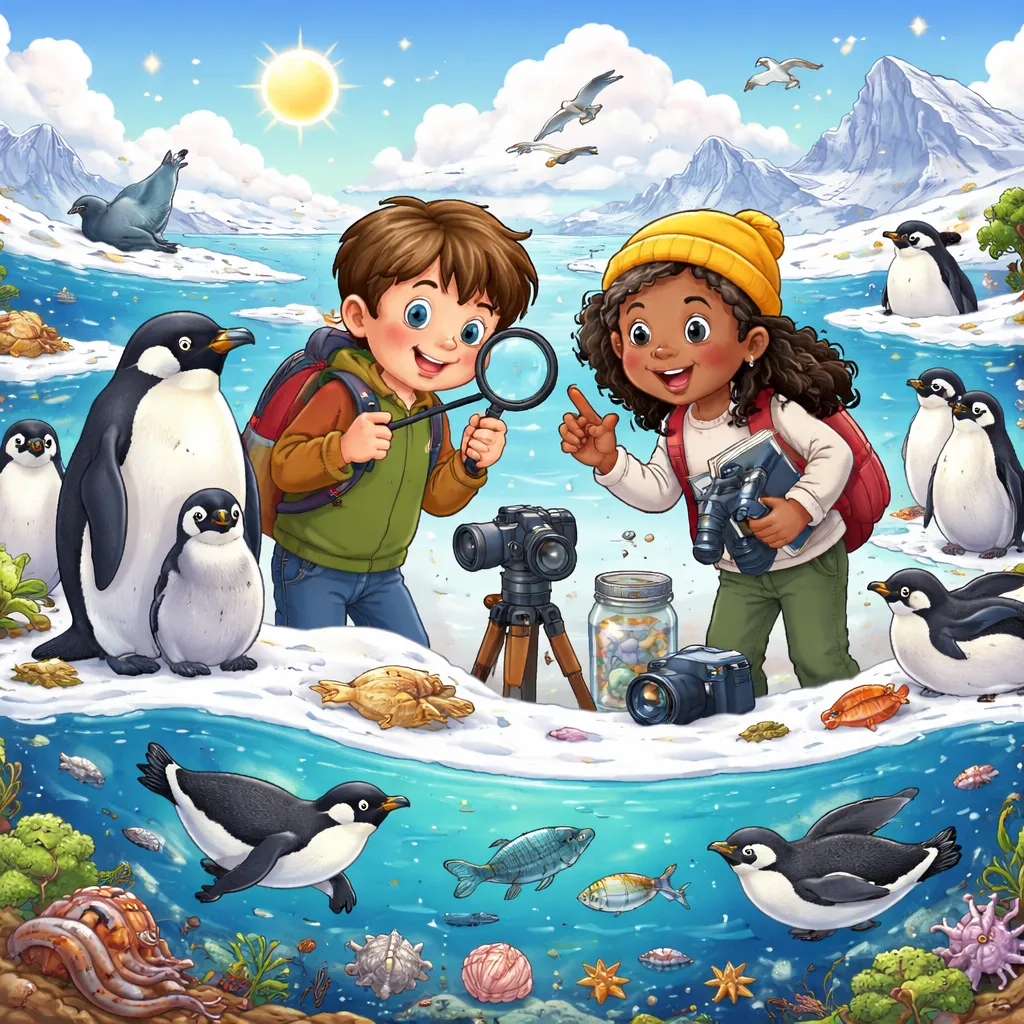

Have you ever seen a penguin at the zoo or in a movie, waddling on the ice in its black and white suit? Penguins are birds that cannot fly, but they are amazing swimmers and divers. They live in cold places and warm our hearts with their funny walks. Learning about penguins is a cool adventure to the icy parts of our planet. Let’s slide into our journey of learning about penguin life and skills!
English Language Learning
Vocabulary and Spelling Our tuxedo-wearing friend is called a penguin. The word "penguin" is a noun. A noun names a person, place, or thing. So, a penguin is a thing—a flightless, swimming bird. Spelling "penguin" is fun: P-E-N-G-U-I-N. The 'P' starts the word, the 'E' and 'N' are in the middle, and it ends with 'G-U-I-N'. P-E-N-G-U-I-N spells penguin.
Sound and Pronunciation Let’s say the word correctly. It sounds like this: /ˈpeŋ.ɡwɪn/. We can say it in two clear parts. First, say "peng". It rhymes with "sing". Next, say "gwin". It rhymes with "win". Now, put it together! "Peng" "gwin". Penguin! Great! The word "penguin" has two beats, or two syllables. Clap your hands twice: Pen-guin. It’s a bouncy, fun word.
Related Words Learning about penguins is more fun with new words! Here are some important ones. Group: A big group of penguins on land is called a colony or a rookery. A group in the water is a raft. Baby: A baby penguin is called a chick. Action: The way penguins walk on ice is called a waddle.
A Famous Saying People sometimes say: "As cool as a penguin." This means someone is very calm and collected, even in a tricky situation. It comes from the penguin’s calm nature and its cool, icy home. It reminds us to stay calm and "cool" under pressure. Say the saying with me: "As cool as a penguin." Can you stay cool like a penguin?
Now you know the word "penguin"! Are you ready to waddle into some amazing facts? Let’s slide from words to wonderful knowledge!
Animal Knowledge
Who Are They? – Family and Group What kind of animal is a penguin? Penguins are birds. They are warm-blooded, have feathers, and lay eggs. They are flightless birds in the family Spheniscidae. Their closest relatives are other seabirds like albatrosses and petrels. There are 18 different species, from the big Emperor penguin to the little Blue penguin.
What Do They Look Like? – Amazing Bodies Penguins come in different sizes. The Emperor penguin is as tall as a 6-year-old child! They have a black back and a white belly, which looks like a tuxedo. Their most famous features are their flipper-like wings and their streamlined bodies. Their wings are not for flying, but for swimming. They are like powerful flippers. Their body shape is perfect for zooming through the water. Their black and white color helps them hide from predators—the black back blends with the dark ocean from above, and the white belly blends with the bright sky from below. Penguins have special adaptations for the cold. They have a thick layer of fat called blubber and very dense, waterproof feathers to keep them warm. They huddle together in big groups to share body heat in the freezing wind.
Where Do They Live and How? – Home and Habits Most penguins live in the Southern Hemisphere. Their homes are cold places like Antarctica, and also cooler coasts of South America, Africa, Australia, and islands. Some even live on warm beaches! Penguins are carnivores. This means they are meat-eaters. They eat fish, squid, and tiny shrimp-like animals called krill. They are excellent hunters in the water, using their wings to "fly" through the sea. Penguins are very social and live in huge colonies. They are active during the day. They spend their time swimming, hunting, and taking care of their chicks. On land, they waddle or slide on their bellies, which is called tobogganing.
A Penguin’s Life Story – Growing Up A baby penguin is called a chick. Penguins are birds, so chicks hatch from eggs. Most penguin parents take turns keeping the egg warm on their feet and going to sea to find food. Penguin parents are very dedicated. The father Emperor penguin holds the egg on his feet for two months in the middle of winter, without eating! The mother returns with food for the chick. Both parents work hard to feed the growing chick. Chicks are born with soft, fluffy gray or brown feathers called down. They grow quickly and are very hungry. They form groups with other chicks called crèches to stay warm and safe while their parents are hunting. Later, they grow their waterproof feathers and learn to swim.
How Do They "Talk"? – Communication Penguins talk with sounds and body language. They squawk, bray, honk, and trill. Each penguin has a unique call, so parents and chicks can find each other in a noisy colony. They use their bodies a lot. Bowing, pointing, and flapping their flippers are all ways to say hello or show they are friendly. They preen each other’s feathers to stay clean and to bond. Their best senses are their excellent eyesight and hearing. They can see well both underwater and on land. Their good hearing helps them recognize their family’s call among thousands of other penguins.
Are They Okay? – Taking Care of Them Many penguin species are facing big problems. Some, like the African penguin, are endangered. Others are vulnerable. The main threats are climate change melting the sea ice they need, overfishing of their food, pollution (like oil spills and plastic), and human disturbance near their nests. You can be a penguin protector! You can learn and tell others about their challenges. You can support groups that protect oceans and fight climate change. You can reduce plastic use, recycle, and choose sustainable seafood. Every action to help our planet helps penguins too.
Life Connections and Inspiration
How to Be With Them – Safety and Love Penguins are wild animals. We must always respect them and their environment, especially in the wild. The rule is: Always watch from a safe and respectful distance. In zoos or aquariums, follow the rules and do not tap on the glass. In the wild (like on a trip to Antarctica), you must stay far away as directed by guides, so you don’t scare them or damage their nests. Never try to touch or feed a penguin. We show our love by protecting the cold, clean oceans and beaches they call home. We can be voices for a healthy planet.
Super Qualities We Learn from Them Penguins teach us wonderful things. One super quality is incredible teamwork and perseverance. Penguins work together to survive the harshest winters. They take turns in the center of the huddle to share warmth. They teach us the power of teamwork, sharing, and never giving up, even when things are tough. Another quality is grace in a different environment. On land, they might seem clumsy, but in the water, they are graceful and fast. This reminds us that everyone has an environment where they shine. It’s okay to be different and to find your own strength. Think about it: How can you use teamwork to get a big job done with friends or family? What is something you are really good at, even if it’s different from what others do?
Take Action! – Your "Penguin Huddle" Project Let’s do a cool and cooperative activity! Your project is to demonstrate how penguins huddle for warmth. Gather your family or a group of friends. Stand very close together in a circle, just like penguins. Now, slowly rotate the circle so that everyone gets a turn to be in the warmer middle and the cooler outside. Time how long you can stand together quietly. This shows how penguins work as a team to survive the cold. You can even draw paper penguin hats to wear!
Closing Learning about penguin adventures is a cool and wonderful journey! We learned the word "penguin" and how to say its two-part name. We discovered amazing facts about their waterproof feathers, their expert swimming, and their life in big, caring colonies. We know that penguins are tough, social birds who need our help to protect their icy and ocean homes. You can use your new words to teach others about these tuxedo-clad birds. You can use your knowledge to understand the importance of teamwork, perseverance, and taking care of our planet. The animal world is full of tough and graceful teachers. Always remember to respect wildlife from a safe distance, work well with your team, and find the environment where you shine. Keep exploring with curiosity, waddle through challenges with a smile, and be a friend to the wild. Your caring actions and cool spirit make you a true friend to the amazing penguin.