
Opening Introduction
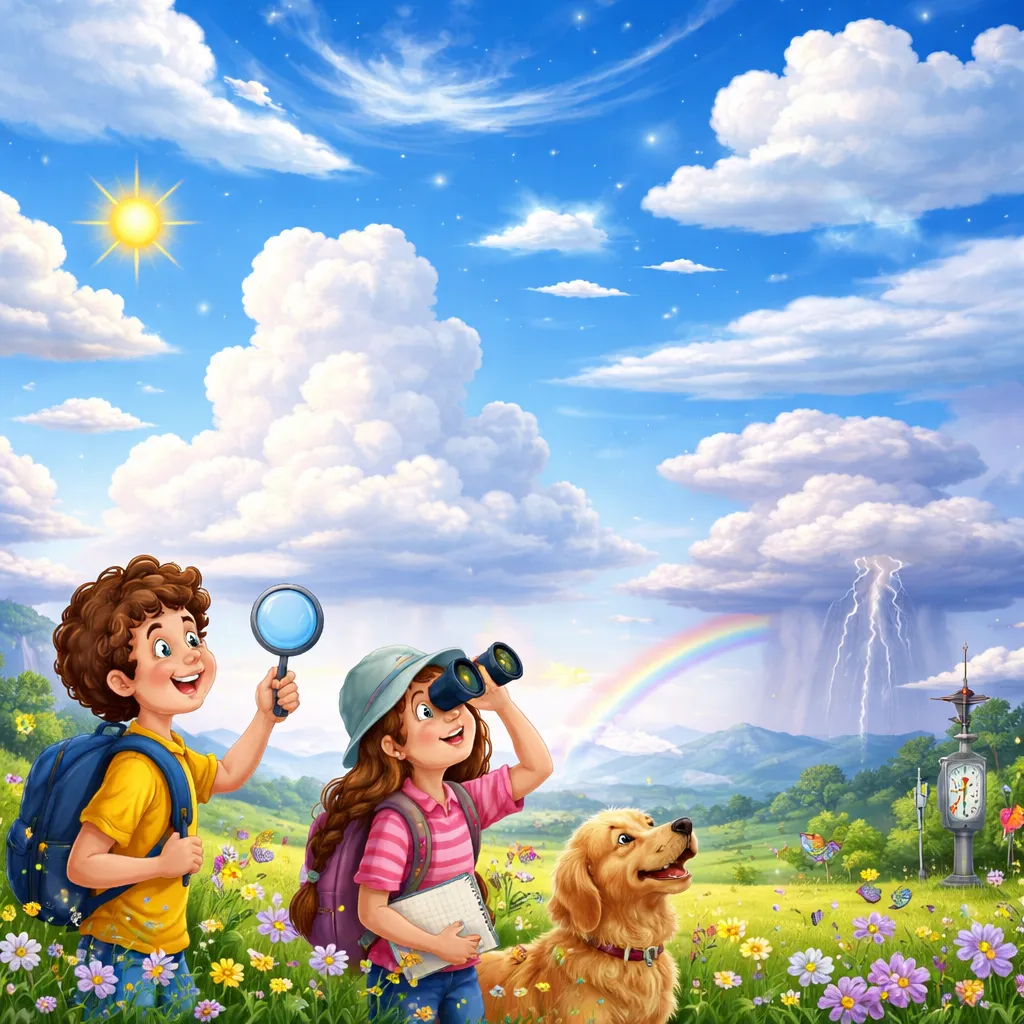
Leo loves to lie on the grass. He looks up at the sky. Today, the sky is like a big, blue sea with fluffy white sheep. "What are those, Dad?" he asks, pointing. His dad looks up. "Those are clouds, Leo. And they have names, just like you. Look, that one looks like a big pile of cotton. That's a cumulus cloud. Learning the types of clouds and weather terms is like learning the alphabet of the sky. It helps us read the weather." Leo is fascinated. The sky has an alphabet? Let's look up and learn this amazing sky language together.
Core Knowledge Explanation
Clouds are made of tiny water droplets or ice crystals. They float in the sky. They come in different shapes and sizes. Each shape has a name. Learning the types of clouds and weather terms helps us understand what the weather might do. Let's meet the main cloud families. First, the fluffy, white clouds. They look like cotton balls. These are cumulus clouds. "Cumulus" means "heap" or "pile." They often mean fair, nice weather. We see them on sunny days. But if they grow big and tall, they can turn into storm clouds.
Second, the flat, gray layers. These are stratus clouds. "Stratus" means "layer." They cover the sky like a blanket. They make the day look gray. They often bring drizzle or light rain. Sometimes, they are so low they are fog. Fog is a cloud on the ground. Third, the wispy, feathery clouds. These are cirrus clouds. "Cirrus" means "curl of hair." They are very high up and made of ice. They look like brush strokes. They often mean a change in weather is coming.
Now, some clouds bring rain or storms. The word "nimbus" means a cloud that makes rain. A nimbostratus cloud is a dark, thick layer cloud that brings steady rain. A cumulonimbus cloud is a giant, tall cumulus cloud. It is a thunderstorm cloud. It can bring heavy rain, lightning, thunder, and even hail. These are the main types of clouds and weather terms for clouds. But the sky also talks with weather. Weather is what the air is like outside. Is it sunny? Is it windy? Is it rainy? Let's learn some weather terms. Sunny means the sun is shining. Cloudy means the sky is covered with clouds. Partly cloudy means there are some clouds and some sun. Windy means the air is moving fast. Rainy means water is falling from the sky. We also have snowy, stormy, and foggy. Knowing these words helps you describe every day.
Fun Interactive Learning
Let's become cloud detectives. The best tool is your eyes. Go outside or look out a window. What do you see? Get a notebook. Draw the clouds you see. Try to name them. Are they fluffy (cumulus)? Are they layered (stratus)? Are they wispy (cirrus)? Write the weather term too. "Today is sunny with cumulus clouds." Do this for a week. You will have your own cloud diary. This is the first step in learning types of clouds and weather terms.
Another fun game is "Cloud Shapes." Lie on your back. Look at the clouds. What do they look like? That cumulus cloud looks like a dragon! That one looks like a car! Use your imagination. Describe it in English. "I see a fluffy cloud. It looks like a big rabbit." This game makes you observe and use descriptive words. You can also play "Weather Charades." One person acts out a weather word. "Windy" 每 they spin around. "Rainy" 每 they wiggle their fingers down like rain. The others guess. This is a fun, active way to learn the types of clouds and weather terms.
You can also make a "Weather Wheel." Cut a big circle from cardboard. Divide it into parts. Draw or paste pictures for sunny, cloudy, rainy, windy, snowy, and stormy. Attach a cardboard arrow in the middle. Every morning, turn the arrow to show the day's weather. Say the word out loud. "Today is cloudy." This makes learning a daily habit.
Expanded Learning
People have always watched the sky. Long ago, farmers watched clouds to know if rain was coming for their crops. Sailors watched the sky to know if a storm was near. They did not have a weather forecast on TV. They used the types of clouds and weather terms they knew to stay safe. In different parts of the world, clouds can look different. In some places, you can see beautiful, colorful clouds at sunrise or sunset. They are not a new type. They are the same clouds, but the sun's light makes them pink, orange, and purple.
Did you know that clouds are part of the water cycle? The sun heats water from the sea and land. It becomes vapor, a gas we cannot see. The vapor rises and cools. It turns back into tiny drops. These drops form clouds. When the drops get heavy, they fall as rain or snow. Then the cycle starts again. Learning about clouds is learning about our planet's water. In other languages, cloud names are different, but the science is the same. The English names are used by scientists everywhere. So, when you learn the types of clouds and weather terms in English, you are learning the language of science.
Let's sing a cloud song. We can use the tune of "I'm a Little Teapot."
I'm a little cumulus, fluffy and white. I float in the sky, so puffy and light. When the sun is shining, you'll see me around. I'm a fair-weather cloud, up from the ground. I'm a stratus cloud, a blanket of gray. I cover the sun and can last all day. I might bring some drizzle, a light, misty rain. Then I slowly go away again. I'm a wispy cirrus, way up high. I'm made of ice crystals, in the cold sky. I look like soft feathers, brushing the blue. A change in the weather might follow me too!
What You Will Learn
You are learning about meteorology, the study of weather. You are learning the main types of clouds and weather terms: cumulus, stratus, cirrus, nimbostratus, cumulonimbus, sunny, cloudy, rainy, windy, stormy. You are also learning related words: droplets, crystals, vapor, cycle, forecast.
You are learning descriptive and predictive sentences. You can say, "The sky is full of dark cumulonimbus clouds. A storm is coming." You can observe, "The cirrus clouds are high and thin. The weather might change tomorrow." You are using English to describe nature and make simple predictions. This is a scientific skill.
You are building wonderful abilities. You are building observation skills. You look carefully at the sky. You are building vocabulary. You learn precise words for nature. You are building patience. You watch changes over time. You are building curiosity about science and the natural world. You are building confidence. You can name what you see in the sky.
You are forming a mindful habit. The habit of looking up and noticing the world around you. You see that English is a tool for understanding and describing your environment. Learning the types of clouds and weather terms connects you to the sky and makes you a junior meteorologist.
Using What You Learned in Life
Use your new knowledge every day. When you wake up, look out the window. Name the clouds. Say the weather. When you are on a car trip, play cloud spotting. Who can see a cumulus cloud first? When you are drawing a picture, draw the sky with the right clouds. When you talk to your family, use the new words. "It's very windy today. Look at the trees sway." When you watch a weather report on TV, listen for the words you know. "The forecaster said 'partly cloudy.' I know what that means!"
You can start a weather chart for your class. Every day, a different student can be the weather reporter. They can look outside and report to the class in English. "Good morning. Today is Tuesday. It is sunny with a few cirrus clouds." This is a great way to share your learning. The more you use the types of clouds and weather terms, the more they will be a natural part of your world. You will never look at the sky the same way again.
Closing Encouragement
You are a sky watcher. You are a word collector. You are a curious and observant learner. I am so proud of you. Learning the names of clouds and weather terms shows you have a keen eye and a love for the world around you.
Keep looking up. Keep wondering. Keep learning the language of the sky. Remember, every cloud has a story, and now you know how to read it.
You are smart, you are attentive, and you have learned to speak a little bit of the sky's language. Great work, my wonderful weather watcher.