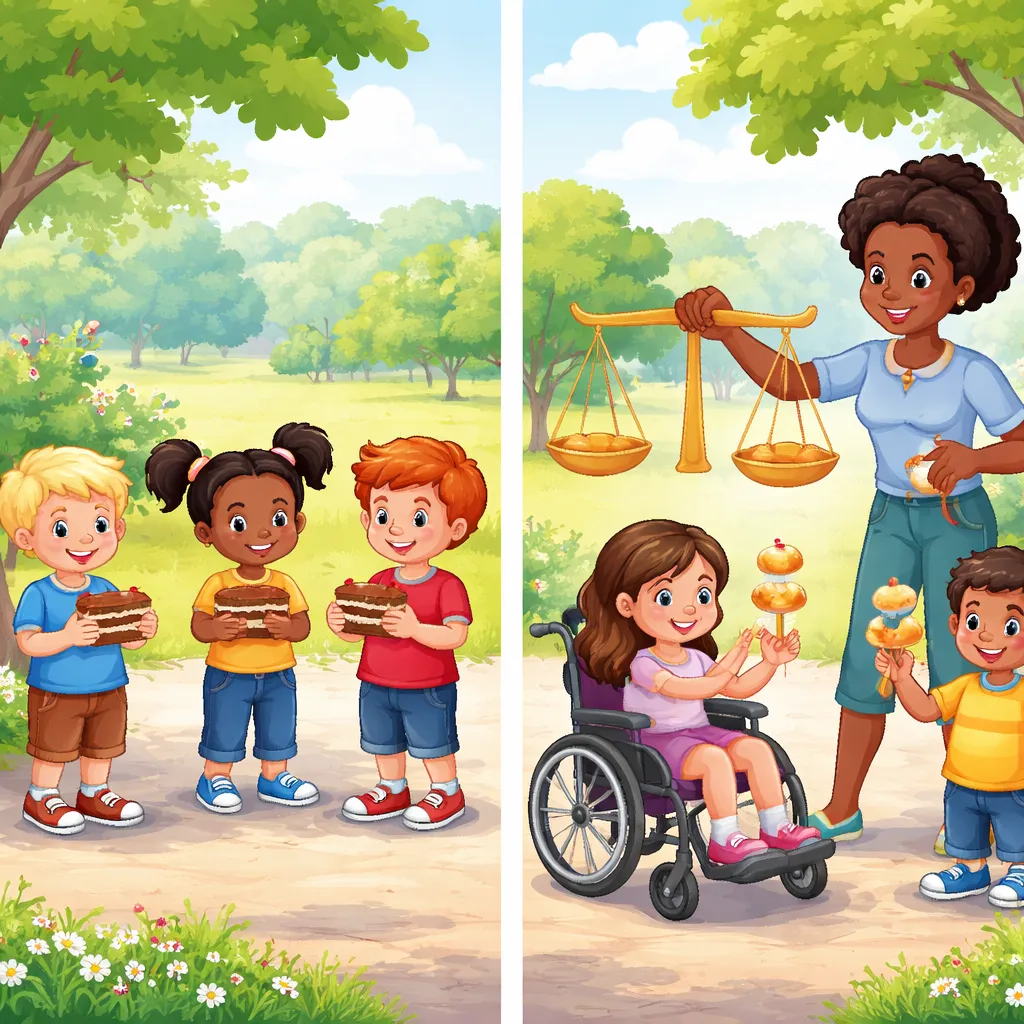

Fair and Just: What’s the Difference?
Children often come across the words fair and just when learning English. These terms seem very similar because both deal with the idea of treating others equally and doing what is right. However, they are used in different ways, and understanding their subtle differences can help children use them correctly in conversations.
In this article, we will explore the meanings of fair and just, compare their usage, and explain how they can be applied in different situations. Parents and children will gain a better understanding of these words and learn when to use each one.
Are Similar Words Really Interchangeable?
Fair and just have similar meanings, but they are not always interchangeable. While both words relate to the concept of equality and rightness, the context in which they are used can make a difference.
A fair situation is one where everyone is treated equally, and the rules are applied consistently to all involved. It is often used in a more general sense, especially when discussing behavior or how people are treated in daily life.
A just situation, on the other hand, refers to a decision or action that is morally right or based on law. It often carries a stronger moral weight and can be used to describe situations in which the right thing is done according to principles of justice or fairness.
While both fair and just involve the idea of treating others equally, just is more strongly tied to ethical or legal standards, while fair is more about balance and equality in everyday situations.
Set 1: Fair vs Just — Which One Is More Common?
In everyday conversations, fair is much more common than just. People often talk about fairness in terms of equality in situations like games, school, or at home. For example, children are encouraged to share toys or take turns, and fairness is a key concept in these interactions.
For instance:
“It’s not fair that I have to do all the chores.” “The teacher gave everyone a fair chance to answer the question.”
In contrast, just is less commonly used in everyday speech, but it appears more often in formal settings or in discussions about laws, ethics, or moral principles. It is frequently used in legal or philosophical contexts, where the focus is on making decisions based on what is morally right or justifiable.
For example:
“The judge made a just decision in the courtroom.” “It is just for everyone to have equal rights.”
Although both words deal with equality, fair is more widely used in situations involving everyday interactions and personal relationships.
Set 2: Fair vs Just — Same Meaning, Different Contexts
While both fair and just involve the idea of treating people with respect and ensuring equality, they are used in different contexts.
Fair is often used to describe everyday situations where people expect equal treatment. It is about balance and making sure that rules or actions don’t favor one person over another. For example, when two children are playing a game and one child complains that the other is cheating, a parent might say, “That’s not fair.” The idea is that both children should have the same opportunity to win.
Examples of fair:
“It’s not fair to let one person have all the toys.” “The teacher gave fair grades to everyone in the class.”
Just, on the other hand, is used in more formal situations, often when talking about ethical principles, laws, or moral decisions. It suggests a deeper understanding of what is morally right and what is not. A just decision is one that aligns with fairness and justice in a legal or ethical sense.
Examples of just:
“The decision to free the prisoner was just, as he had been wrongfully accused.” “It is just for all students to have access to the same educational opportunities.” Set 3: Fair vs Just — Which Word Is “Bigger” or More Emphatic?
While both fair and just suggest treating others equally, just is often considered to carry a stronger, more formal sense of moral or legal rightness. It implies that the action or decision is not just balanced, but also morally correct and in line with ethical or legal standards.
For example:
Just is used when making decisions that align with justice, often in legal or social contexts. Fair, while it is about balance, can sometimes imply a simpler, more immediate sense of equality, such as in a game or classroom setting.
So, just can be seen as a “bigger” or more emphatic term because it is often associated with deep moral or ethical principles, whereas fair is a more general term used to describe equal treatment in everyday life.
Set 4: Fair vs Just — Concrete vs Abstract
The difference between fair and just can also be thought of in terms of abstract vs. concrete.
Fair is often more concrete and practical. It can apply to everyday situations where people are asked to follow certain rules that ensure balance and equality. For example, fairness is about making sure that everyone in a group has an equal opportunity to succeed. It’s a term that is easily understood in daily life because it is applied directly to specific actions and behaviors.
For example:
“It’s fair to share the candy equally among all your friends.” “The rules of the game were fair for everyone playing.”
Just, however, is more abstract. It refers to a deeper concept of moral or legal correctness. It is less about specific actions and more about ensuring that the right thing is done according to some higher standard, such as law or ethics.
For example:
“It is just for everyone to have the same opportunities regardless of their background.” “The judge’s decision was just because it was based on the law.”
In this sense, fair is more practical, while just is more philosophical or ethical.
Set 5: Fair vs Just — Verb or Noun? First Understand the Role
Both fair and just are primarily used as adjectives, but they can also take on other roles depending on the context.
As adjectives: “She gave a fair response to the question.” “It was a just decision based on the evidence.” As nouns, fair can also refer to an event, like a market or exhibition: “We went to the local fair over the weekend.”
Just is not commonly used as a noun, but it can be used as an adverb, meaning “in a way that is morally right.”
“He acted justly when he helped his friend.”
So, while both words are most often adjectives, fair can also function as a noun, while just is used as an adverb in some contexts.
Set 6: Fair vs Just — American English vs British English
The usage of fair and just is similar in both American and British English, but there may be slight differences in their application.
In American English, fair is used more frequently in casual conversations, especially when discussing situations involving equality, such as at school or in sports. Just tends to be used more formally, often in discussions about justice, law, or ethical decisions.
In British English, fair is also commonly used in everyday contexts, and just carries a similar meaning of ethical correctness. However, just may be more frequently associated with legal matters or situations that require deeper moral consideration.
Set 7: Fair vs Just — Which Fits Formal Situations?
Just is more commonly used in formal situations, especially when talking about legal, ethical, or moral issues. It is often used in contexts where decisions are made based on principles of justice or fairness in a deeper sense.
For example, when discussing the law or ethical principles:
“It is just to treat all people equally.” “The court ruled in a just manner based on the facts.”
Fair, however, is often used in less formal situations, such as when describing how people are treated in a game, at school, or in daily interactions. It is about ensuring that everyone gets an equal chance in a more immediate, practical sense.
For example:
“The teacher was fair in grading everyone’s assignments.” “The children played a fair game of soccer.” Set 8: Fair vs Just — Which One Is Easier for Kids to Remember?
For children, fair is typically easier to remember because it is used more often in their everyday lives. Whether it’s sharing toys, taking turns, or following the rules of a game, children are familiar with the concept of fairness and can easily apply it in various situations.
Just, on the other hand, may be harder for young children to fully grasp because it involves a deeper understanding of ethics and morality. As children grow older, they will become more familiar with the concept of justice and its applications in society, law, and ethical decision-making.
Mini Exercise: Can You Spot the Differences Between These Similar Words?
Test your understanding of fair and just with these short questions:
Which word would you use to describe an equal game where everyone has the same chances? a) Fair b) Just “The teacher made a ____ decision about the class project.” a) Fair b) Just “It’s ____ to help those in need, no matter who they are.” a) Fair b) Just “The judge gave a ____ verdict in the courtroom.” a) Fair b) Just Parent Tips: How to Help Kids Learn and Remember Similar Words
To help your child understand and remember the difference between fair and just, encourage them to apply these words to their everyday lives. Discuss situations where fairness is important, like sharing toys or playing a game, and explain how justice relates to making moral or legal decisions. You can also use stories or books that highlight themes of fairness and justice to reinforce these concepts.