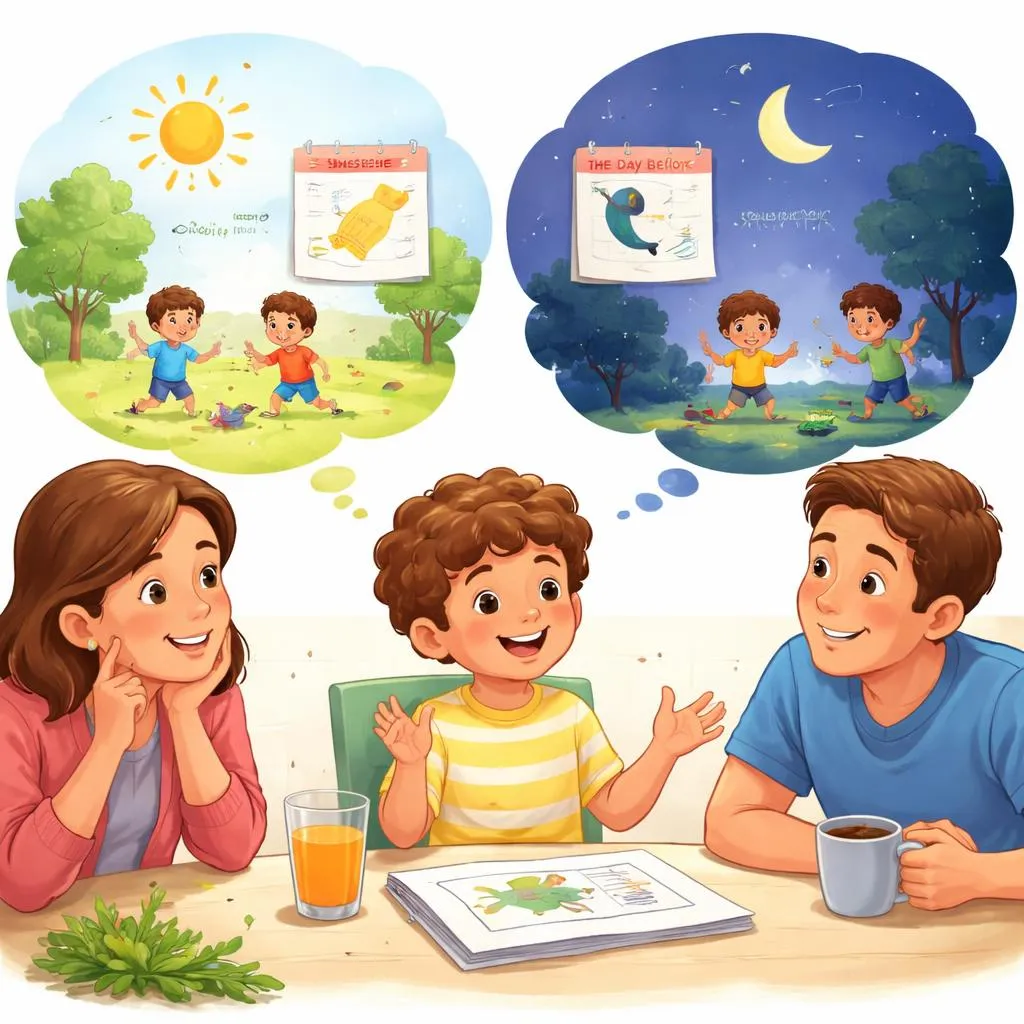

What Do These Expressions Mean? “Yesterday” and “the day before” both mean the day that came before today. They tell someone that an event happened one day in the past. Children hear these words when recalling events, telling stories, or answering questions. Both refer to the recent past.
“Yesterday” is the common, everyday word for the day before today. A child says it when talking about what they did. It is short and natural.
“The day before” means the same thing, but it is often used in stories or when referring to the day before another specific day. It is less common in direct speech about “today.” It is more useful in narratives.
These expressions seem similar. Both mean “one day ago.” Both answer “when did it happen?” But one is for everyday talk while one is for storytelling sequences.
What's the Difference? One is the standard, everyday word. One is used in stories or for clarity in sequences. “Yesterday” is what you say to your family and friends. It is simple and direct. Children learn it first.
“The day before” is used when you are already talking about a specific day. For example: “We went to the beach on Tuesday. The day before, we packed our bags.” It refers to the day before a specific day, not necessarily before today.
Think of a child describing what they ate. “I had pizza yesterday” is right. “I had pizza the day before” would be confusing because you haven’t named a starting day. One is clear. One is vague for a simple sentence.
One is for “day before today.” The other is for “day before a different day.” “Yesterday” = from now. “The day before” = from a day already mentioned. Use the first for now. Use the second for stories.
Also, “the day before” is rarely used for the day before today in conversation. It sounds like a narrator. For children, use “yesterday.”
When Do We Use Each One? Use “yesterday” for the day before today. Use it for recalling activities, school events, or meals. Use it in everyday conversation. It fits daily talk.
Examples at home: “Yesterday, we went to the park.” “I finished my homework yesterday.” “What did you eat yesterday?”
Use “the day before” for storytelling or when referring to the day before a specific day. Use it in narratives or written stories. Use it to be clear about sequences. It fits narrative talk.
Examples for stories: “We arrived on Friday. The day before, we packed our suitcases.” “She took the test on Wednesday. The day before, she studied all night.” “The day before the party, we decorated the house.”
Children can use both. “Yesterday” for daily talk. “The day before” for stories. Both are correct.
Example Sentences for Kids Yesterday: “Yesterday was my friend’s birthday.” “I saw a rainbow yesterday.” “Yesterday, I played with my blocks.”
The day before: “We went camping on Saturday. The day before, we bought food.” “The day before my birthday, I was so excited.” “My test was on Thursday. The day before, I practiced.”
Notice “yesterday” is for real past plans. “The day before” is for storytelling sequences. Children learn both. One for life. One for stories.
Parents can use both. Recalling: “yesterday.” Reading a book: “the day before.” Children learn different contexts.
Common Mistakes to Avoid Some children say “the day before” when they mean “yesterday.” That can confuse a listener. If you mean the day before today, say “yesterday.” Save “the day before” for stories.
Wrong: “I saw you the day before.” (without a reference day) Better: “I saw you yesterday.”
Another mistake: using “yesterday” for the day before a different day. If you are telling a story, “yesterday” would be wrong unless the story is happening “today.”
Wrong: “We went to the store. Yesterday we went to the park.” (in a story set in the past) Right: “We went to the store. The day before, we went to the park.” (if that’s the sequence)
Some learners think “the day before” is more polite. It is not. It is just for sequence. Politeness is in tone, not word choice.
Also avoid saying “yesterday” for any day in the past. “Yesterday” means exactly one day ago. For longer ago, say “last week” or “on Monday.” Be precise.
Easy Memory Tips Think of “yesterday” as a calendar turned one page back. From now. Direct.
Think of “the day before” as an arrow pointing from one day back to another in a story. Sequential. Narrative.
Another trick: remember the starting point. “Yesterday” starts from today. “The day before” starts from another day. From today gets “yesterday.” From another day gets “the day before.”
Parents can say: “Yesterday for a recall. Day before for a story thrall.”
Practice at home. Recall yesterday: “yesterday.” Tell a story: “the day before.”
Quick Practice Time Let us try a small exercise. Choose the better phrase for each situation.
A child tells a parent about a fun event that happened one day ago. a) “The day before, we had ice cream.” b) “Yesterday, we had ice cream.”
A child is telling a story about a camping trip. They set up the tent on Saturday. Then they talk about Friday. a) “Yesterday, we packed.” b) “The day before, we packed.”
Answers: 1 – b. A recall of the day before today fits the direct “yesterday.” 2 – b. A story sequence about the day before a specific day fits the narrative “the day before.”
Fill in the blank: “When I talk about what I did one day ago, I say ______.” (“Yesterday” is the natural, direct, everyday choice.)
One more: “When I tell a story that starts on Tuesday and then I talk about Monday, I say ______.” (“The day before” fits the sequential, narrative, story-telling language.)
Every yesterday holds a memory. “Yesterday” is for sharing. “The day before” is for sequencing. Teach your child both. A child who learns both can tell their day and tell a tale.