
Fun Introduction
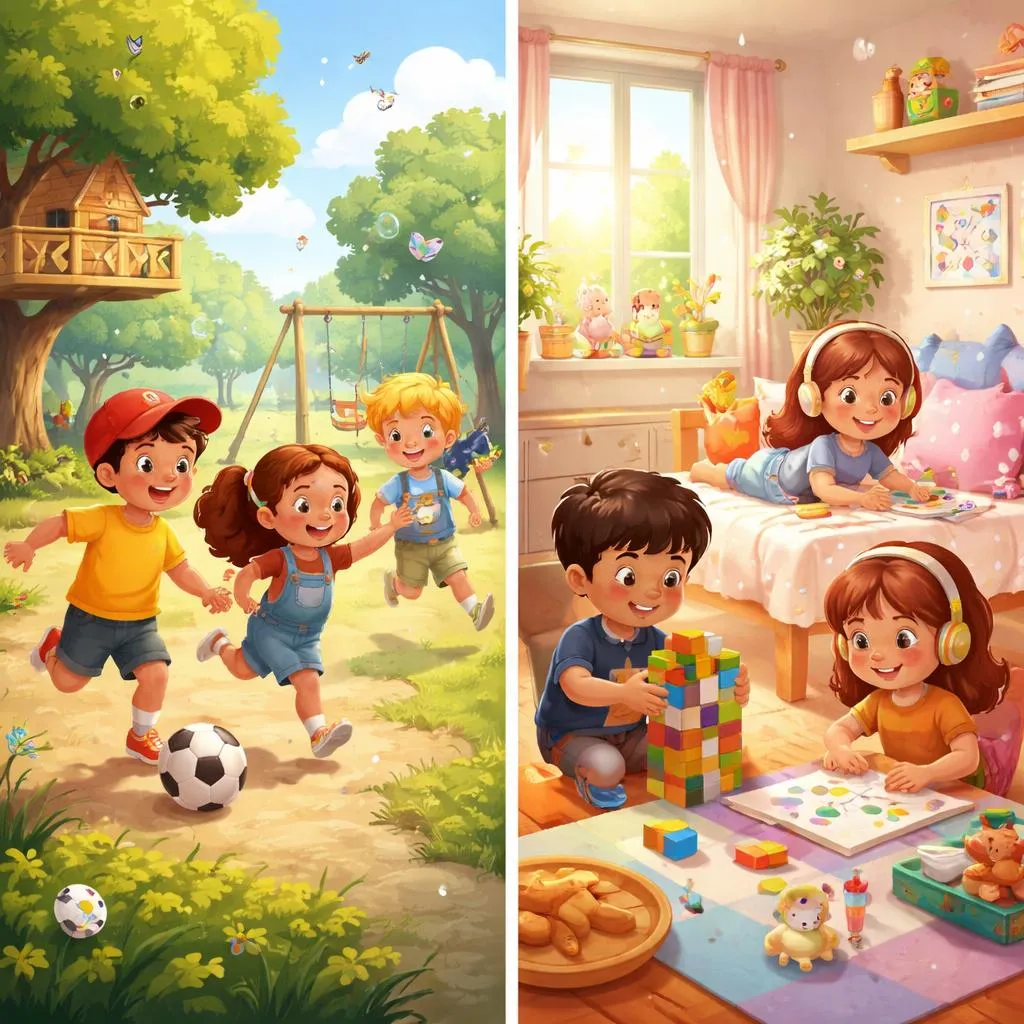
Last Saturday, Mia kicked a soccer ball outside. She ran fast and laughed. This was play to do. Later, Mia amused herself with a comic book. She giggled at funny pictures. Both were fun. But playing made her move. Amusing kept her still. Mia wondered about the difference. She asked her dad. Dad smiled and explained. Playing is active fun. Amusing is quiet fun. Let’s learn together.
Mia felt sweaty on the field. Grass tickled her knees. She chased the ball. Then she flopped on the couch. Comics sprawled around her. Her dad peeked in. He said playing is like dancing. Amusing is like daydreaming. Mia understood now.
Word Breakdown
Core Principle
We reject boring dictionary definitions. We use pictures in your mind. We add functions and memory hooks. This helps you remember forever.
Play To Do
Image: Imagine playing tag with friends. You run and shout. That is play to do. It means active fun with movement.
Function: It is for energetic activities. Like play soccer. Or play hide-and-seek.
Sensory Description: You hear laughter. You feel your heart beat. Your legs move fast.
Memory Anchor: Kids running on a playground. See the jumping? That is play to do.
Amuse To Do
Image: Think of amusing yourself with a puzzle. You sit and smile. That is amuse to do. It means quiet fun without much moving.
Function: It is for calm entertainment. Like amuse with a book. Or amuse with music.
Sensory Description: You hear soft sounds. You feel relaxed. Your mind wanders happily.
Memory Anchor: A child reading a comic. See the grin? That is amuse to do.
Advanced Comparison
Play is active and loud. Amuse is quiet and still. Play uses energy. Amuse uses calm. Use play for moving fun. Use amuse for sitting fun.
Scene Comparison
Scene One happens at the park. Mia plays tag with friends. She sprints and tags Leo. Everyone cheers. This is play to do—active fun.
Scene Two takes place in her room. Mia amuses herself with stickers. She peels and sticks slowly. She smiles. This is amuse to do—quiet fun.
Scene Three occurs at the beach. Ben plays frisbee with his dog. He leaps high. Mia amuses herself by watching clouds. She lies back. Notice the shift. Playing involves others. Amusing can be alone.
Pitfalls Deep Reminder
Mistake One is saying “I amused to play soccer.” Why wrong? Soccer needs playing. Amusing is too calm. Funny result? You sit and watch the ball. Correct phrase is I played soccer. Memory trick: Play for sports.
Mistake Two is saying “I played to read my comic.” Why wrong? Comics need amusing. Playing is too active. Funny result? You kick the comic away. Correct phrase is I amused myself with the comic. Memory trick: Amuse for reading.
Mistake Three is saying “I amused to build a Lego tower.” Why wrong? Building needs playing. Amusing is passive. Funny result? Tower never grows. Correct phrase is I played with Legos. Memory trick: Play for making things.
Mistake Four is saying “I played to listen to music.” Why wrong? Music needs amusing. Playing is for action. Funny result? You dance wildly and miss the song. Correct phrase is I amused myself with music. Memory trick: Amuse for listening.
Interactive Exercises
Read each sentence. Pick play or amuse.
I will ___ basketball with my friends. (play/amuse)
She ___ herself with a coloring book. (play/amuse)
We ___ tag during recess. (play/amuse)
He ___ himself by watching cartoons. (play/amuse)
They ___ hopscotch on the sidewalk. (play/amuse)
Act with a friend. Use the phrases.
Scene A: Playing Actively
A: Let us play a game.
B: I will chase you first.
Scene B: Amusing Quietly
A: I need to amuse myself now.
B: Pick a quiet activity.
Spot the Mistake
Which sentence sounds odd? Explain why.
Sentence: I amused to swim in the pool.
Reason: Swimming needs playing. Use play instead.
Sentence: I played to solve a crossword puzzle.
Reason: Puzzles need amusing. Use amuse instead.
Sentence: I amused to ride my bike.
Reason: Biking needs playing. Use play instead.
Create Sentences
Use both phrases.
Play to do: I play soccer every Saturday.
Amuse to do: I amuse myself with funny videos.
Bonus Challenge
You are at a party dancing. Do you play or amuse? Answer: Play. You move actively.
Rhyme Time
Play to move, amuse to sit.
One runs wild, one stays fit.
Active fun? Choose play.
Quiet smile? Amuse, hip hooray.
Homework Task
Pick one activity. Complete it this week. Share with family.
Option One: Observation Journal. Get a small notebook. Draw three pictures. Write a sentence under each.
Picture One: You play something. Sentence: I played tag with friends today.
Picture Two: You amuse something. Sentence: I amused myself with a puzzle.
Picture Three: You play something else. Sentence: I played frisbee at the park.
Show your journal to a parent. Explain the differences.
Option Two: Role Play. With a parent, act out moments. Use phrases correctly.
You: Mom, I will play outside now.
Parent: Have fun and be safe.
You: Dad, I will amuse myself with a book.
Parent: Enjoy your quiet time.
Practice until it feels natural.
Option Three: Sharing Time. Tomorrow at school, tell a friend. Describe one play and one amuse. Say: Yesterday I played basketball. I amused myself with a comic. Ask your friend about theirs.
Life Practice
Week Challenge: Try one task. Complete within seven days. Share your success.
Task One: Observation Log. For three days, note play and amuse moments. Draw icons.
Day One: Play soccer. Draw a ball icon.
Day Two: Amuse with book. Draw a book icon.
Day Three: Play tag. Draw a running icon.
Show your log to your teacher. Place it on the classroom wall.
Task Two: Action Demo. Use both phrases in real actions.
Step One: Play energetically. Say: I play to have active fun.
Step Two: Amuse calmly. Say: I amuse myself to relax.
Demonstrate to a sibling. Explain the difference.
Task Three: Social Mission. Use phrases with others.
Play to help a friend. Say: I play catch with you.
Amuse to help a friend. Say: I amuse you with a funny story.
Record a short voice message. Send it to your teacher.
Task Four: Creative Story. Write a short tale. Include both phrases.
Title: The Fun Day.
Story: I played hopscotch with Mia. Then I amused myself with stickers. Both made me happy.
Share your story in class.
Remember, practice makes perfect. Use these phrases often. Soon they will feel easy.