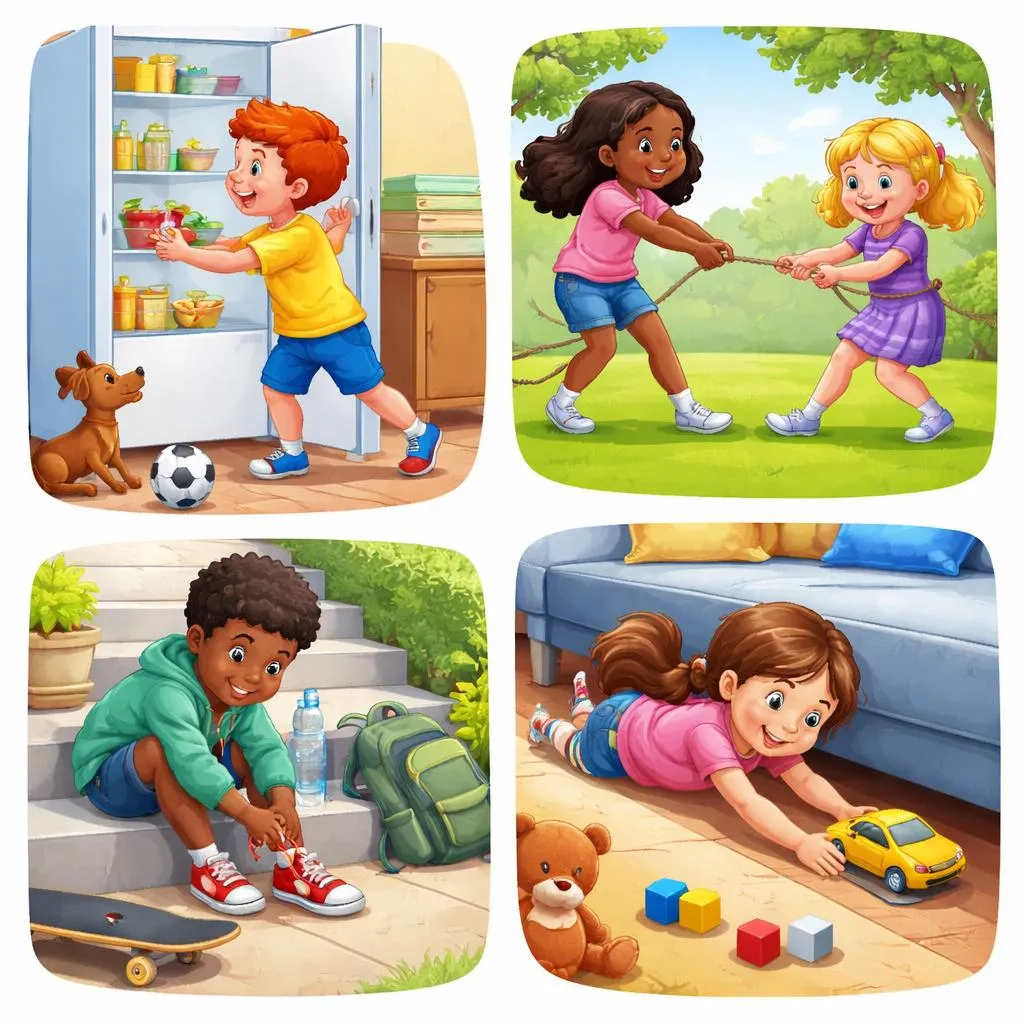

Fun Introduction
Last Saturday, Mia helped her dad in the garden. She pulled a wagon full of soil. Her hands gripped the handle firmly. The wagon moved smoothly over grass. Later, Mia tried to open a stuck drawer. She tugged it hard with both hands. The drawer popped open suddenly. Both actions used force. But pulling was steady and controlled. Tugging was quick and jerky. Mia wondered about the difference. She asked her dad. Dad smiled and explained. Pulling moves things steadily. Tugging gives a sharp yank. Let’s learn together.
Word Breakdown
Core Principle
We reject boring dictionary definitions. We use pictures in your mind. We add functions and memory hooks. This helps you remember forever.
Pull To Do
Image: Imagine pulling a wagon on a path. Your steps are even and slow. That is pull to do. It means drawing something toward you steadily.
Function: It is for controlled movement. Like pull a friend up a hill. Or pull a door open.
Sensory Description: You feel steady resistance. You hear a smooth scrape. Your muscles work evenly.
Memory Anchor: A wagon being pulled by a rope. See the straight line? That is pull to do.
Tug To Do
Image: Think of tugging a loose tooth. You give a quick jerk. That is tug to do. It means giving a sudden sharp pull.
Function: It is for stubborn things. Like tug a kite from a tree. Or tug a stuck zipper.
Sensory Description: You feel a snap of resistance. You hear a pop. Your body jerks forward.
Memory Anchor: A dog tugging a rope toy. See the fierce pull? That is tug to do.
Advanced Comparison
Pull is steady and smooth. Tug is sudden and jerky. Pull uses constant force. Tug uses a burst. Use pull for easy moves. Use tug for stuck things.
Scene Comparison
Scene One happens in the backyard. Leo pulls his little sister on a sled. He walks slowly and evenly. The sled glides over snow. This is pull to do—steady movement.
Scene Two takes place in the bedroom. Emma tugs a tangled necklace free. She gives a quick sharp yank. The chain comes loose. This is tug to do—sudden force.
Scene Three occurs at the park. Ben pulls a rope to ring the bell. He hauls it down smoothly. Mia tugs a kite string when it dives. She jerks it up quickly. Notice the shift. Pulling is calm. Tugging is urgent.
Pitfalls Deep Reminder
Mistake One is saying “I tugged the wagon up the hill.” Why wrong? Wagons need steady pulling. Tugging would jerk it. Funny result? Sister falls out. Correct phrase is I pulled the wagon up the hill. Memory trick: Pull for smooth rides.
Mistake Two is saying “I pulled the stuck drawer open.” Why wrong? Stuck drawers need tugging. Pulling is too gentle. Funny result? Drawer stays shut. Correct phrase is I tugged the stuck drawer open. Memory trick: Tug for stuck things.
Mistake Three is saying “I tugged my friend up gently.” Why wrong? Friends need steady pulling. Tugging might hurt them. Funny result? Friend gets a bruised arm. Correct phrase is I pulled my friend up gently. Memory trick: Pull for people.
Mistake Four is saying “I pulled the kite string to free it.” Why wrong? Kites need tugging to lift. Pulling is too slow. Funny result? Kite crashes. Correct phrase is I tugged the kite string to free it. Memory trick: Tug for flying things.
Interactive Exercises
Read each sentence. Pick pull or tug.
I will ___ the door open for grandma. (pull/tug)
She ___ the weeds out of the garden. (pull/tug)
We ___ the rope to start the lawn mower. (pull/tug)
He ___ his little brother on the sled. (pull/tug)
They ___ the flag up the pole. (pull/tug)
Act with a friend. Use the phrases.
Scene A: Steady Pulling
A: I need to pull this box now.
B: Keep it level and slow.
Scene B: Sudden Tugging
A: I will tug this knot loose.
B: Give it a sharp yank.
Spot the Mistake
Which sentence sounds odd? Explain why.
Sentence: I tugged the wagon with a steady hand.
Reason: Wagons need pulling. Use pull instead.
Sentence: I pulled the stuck zipper with a jerk.
Reason: Zippers need tugging. Use tug instead.
Sentence: I tugged my friend up the hill gently.
Reason: Friends need pulling. Use pull instead.
Create Sentences
Use both phrases.
Pull to do: I pull the curtains every morning.
Tug to do: I tug my socks up when they slip.
Bonus Challenge
Your dog is chewing a rope toy. Do you pull or tug? Answer: Tug. Dogs love a good tug.
Rhyme Time
Pull it smooth, tug it sharp.
One moves with care, one gives a jolt.
Steady move? Choose pull.
Sudden yank? Tug with all.
Homework Task
Pick one activity. Complete it this week. Share with family.
Option One: Observation Journal. Get a small notebook. Draw three pictures. Write a sentence under each.
Picture One: You pull something. Sentence: I pulled my sister on the sled.
Picture Two: You tug something. Sentence: I tugged a weed from the garden.
Picture Three: You pull something else. Sentence: I pulled the door shut.
Show your journal to a parent. Explain the differences.
Option Two: Role Play. With a parent, act out moments. Use phrases correctly.
You: Mom, I will pull the chair closer.
Parent: Good, do it gently.
You: Dad, I will tug this knot loose.
Parent: Be careful not to break it.
Practice until it feels natural.
Option Three: Sharing Time. Tomorrow at school, tell a friend. Describe one pull and one tug. Say: Yesterday I pulled my wagon. I tugged a kite free. Ask your friend about theirs.
Life Practice
Week Challenge: Try one task. Complete within seven days. Share your success.
Task One: Observation Log. For three days, note pull and tug moments. Draw icons.
Day One: Pull a door. Draw a door icon.
Day Two: Tug a zipper. Draw a zipper icon.
Day Three: Pull a rope. Draw a rope icon.
Show your log to your teacher. Place it on the classroom wall.
Task Two: Action Demo. Use both phrases in real actions.
Step One: Pull steadily. Say: I pull to help move things.
Step Two: Tug sharply. Say: I tug to free stuck things.
Demonstrate to a sibling. Explain the difference.
Task Three: Social Mission. Use phrases with others.
Pull to help a friend. Say: I pull you up this step.
Tug to help a friend. Say: I tug your sleeve to get attention.
Record a short voice message. Send it to your teacher.
Task Four: Creative Story. Write a short tale. Include both phrases.
Title: The Great Garden Helper.
Story: I pulled the wagon full of flowers. Then I tugged a weed free. What fun!
Share your story in class.
Remember, practice makes perfect. Use these phrases often. Soon they will feel easy.