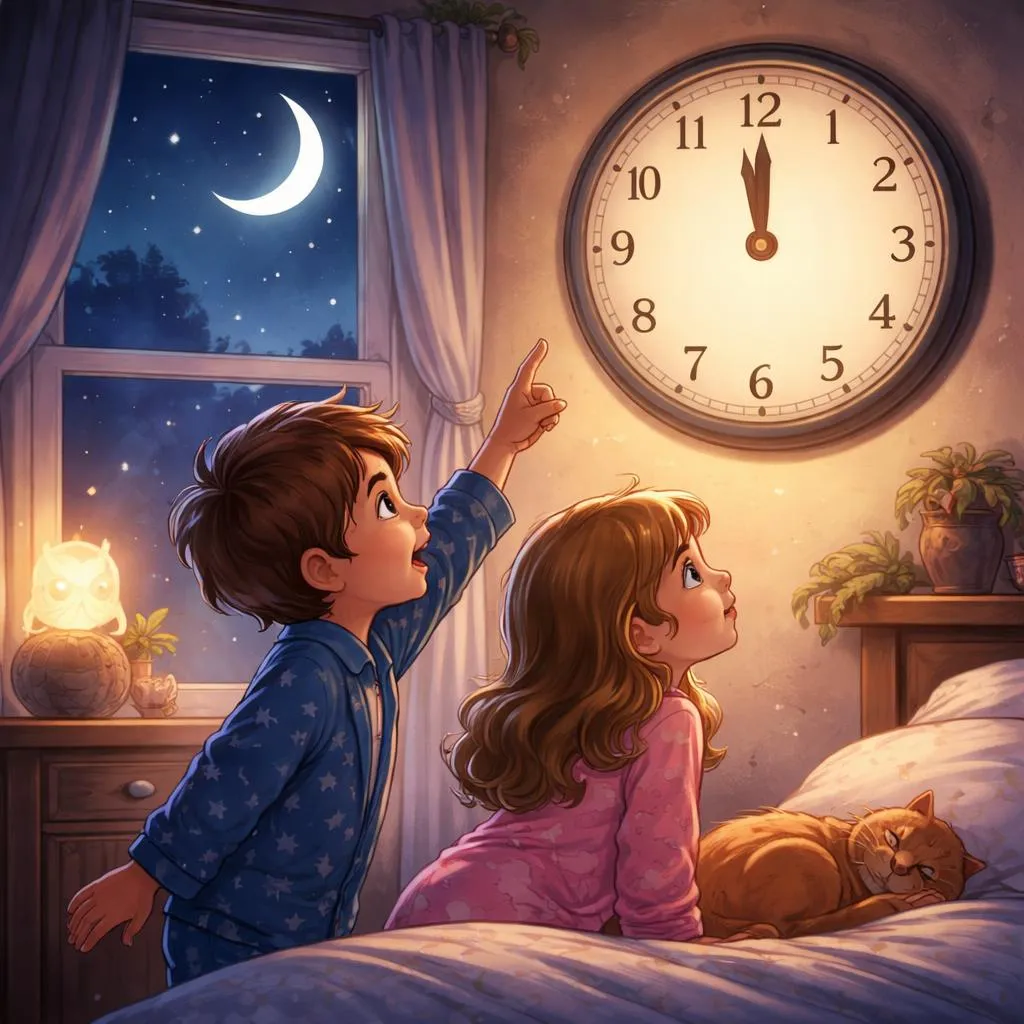

What Do These Expressions Mean? “It's midnight” and “middle of the night” both mean the darkest, deepest hour of the night. They tell a child that the clock has reached 12:00 AM and it is very late. Children hear these words on New Year's Eve, during storms, or when waking up. Both describe the central night hour.
“It's midnight” means exactly 12:00 at night. It is precise and common. A child says it when fireworks go off on New Year's. It is a specific time.
“Middle of the night” means the period around midnight, usually from about 11 PM to 3 AM. It is a range, not an exact time. A child says it when they wake up and it is still dark. It is a general phrase.
These expressions seem similar. Both mean “the night is deep.” Both describe late hours. But one is an exact time while one is a general period.
What's the Difference? One is an exact time. One is a general period. “It's midnight” means 12:00 AM exactly. It is precise. You can see it on a clock.
“Middle of the night” is a range of hours. It means the darkest part of the night, not one fixed minute. It is vague. It describes a feeling, not a clock reading.
Think of a child waking up at 2:00 AM. “It's the middle of the night” is right because it is very late. “It's midnight” would be wrong at 2 AM. One is for a specific hour. One is for a period.
One is for the clock. The other is for the dark period. “Midnight” for a clock reading. “Middle of the night” for waking up too early. Use the first for exact. Use the second for feeling.
Also, “midnight” is often a celebration (New Year's). “Middle of the night” is often a complaint (can't sleep). Tone matters.
When Do We Use Each One? Use “it's midnight” for the exact time 12:00 AM. Use it for New Year's Eve, clocks, or precise timing. Use it as a factual statement. It fits exact talk.
Examples at home: “It's midnight. Happy New Year!” “At midnight, the clock chimes twelve times.” “The movie starts at midnight.”
Use “middle of the night” for the general period of deep darkness. Use it when you wake up and it is still very dark. Use it to describe late hours without being precise. It fits general talk.
Examples for period: “I woke up in the middle of the night and couldn’t sleep.” “The baby cried in the middle of the night.” “It's the middle of the night. Go back to sleep.”
Children can use both. “Midnight” for the exact hour. “Middle of the night” for the period. Both describe late night.
Example Sentences for Kids It's midnight: “It's midnight. The day changed.” “We stayed up until midnight on New Year's Eve.” “At midnight, it is officially tomorrow.”
Middle of the night: “I heard a noise in the middle of the night.” “The moon is bright in the middle of the night.” “Don't call me in the middle of the night.”
Notice “midnight” is a specific clock time. “Middle of the night” is a vague period. Children learn both. One for clock. One for feeling.
Parents can use both. New Year's Eve: “it's midnight.” Waking up: “it's the middle of the night.” Children learn different night words.
Common Mistakes to Avoid Some children say “midnight” for 3:00 AM. That is wrong. Midnight is only 12:00 AM. 3 AM is early morning, not midnight.
Wrong: “It's midnight at 3 AM.” Right: “It's the middle of the night at 3 AM.”
Another mistake: saying “middle of the night” for 12:00 AM. That is not wrong, but “midnight” is more precise. If you mean the exact hour, say “midnight.”
Wrong: “It's the middle of the night at 12 AM.” (true but less precise) Better: “It's midnight.”
Some learners think “middle of the night” means 12:00 AM exactly. It does not. It means a period around midnight. Teach the difference between exact time and general period.
Also avoid saying “it's midnight” in the middle of the day. That would be 12:00 noon, also called “midday.” Be clear.
Easy Memory Tips Think of “midnight” as a clock striking 12. Bong. Bong. Bong. Exact time.
Think of “middle of the night” as a dark sky. Stars. Quiet. Long hours. General period.
Another trick: remember the number. “Midnight” = 12:00 exactly. “Middle of the night” = around midnight. 12:00 gets “midnight.” Around that time gets “middle of the night.”
Parents can say: “Midnight for a chime. Middle for a long time.”
Practice at home. New Year's Eve: “it's midnight.” Wake up at 2 AM: “it's the middle of the night.”
Quick Practice Time Let us try a small exercise. Choose the better phrase for each situation.
A child stays up to watch the ball drop on television. The clock shows 12:00 AM. a) “It's the middle of the night.” b) “It's midnight!”
A child wakes up scared at 2:30 AM. The room is dark. a) “It's midnight at 2:30.” b) “It's the middle of the night.”
Answers: 1 – b. The exact moment of 12:00 AM fits the precise “midnight.” 2 – b. A dark, late hour (2:30 AM) fits the general “middle of the night.”
Fill in the blank: “When the clock says 12:00 AM on New Year's Eve, it's ______.” (“Midnight” is the exact-time, clock-based choice.)
One more: “When I wake up and it's still dark and my clock says 2:00 AM, I say it's ______.” (“The middle of the night” fits the general, period-based, dark-night description.)
The night has many names. “It's midnight” marks the exact turn. “Middle of the night” spans the dark hours. Teach your child both. A child who learns both can read a clock and feel the night.